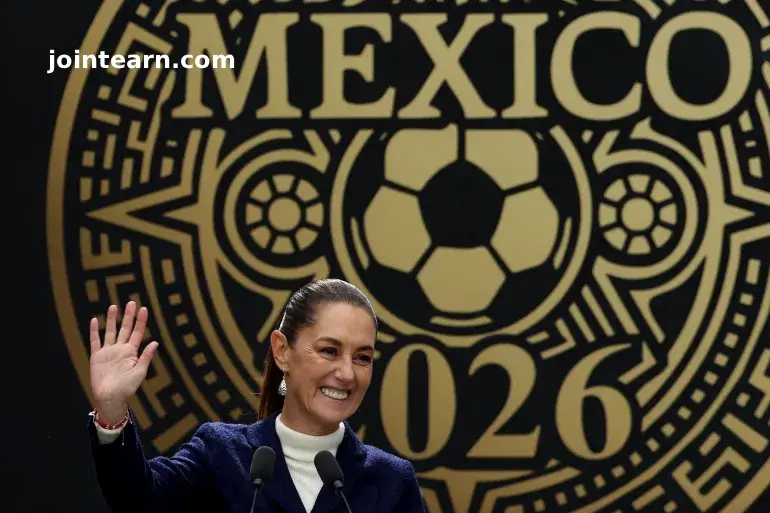
Mexican President Claudia Sheinbaum has firmly rejected any prospect of United States military intervention on Mexican territory, despite repeated threats from US President Donald Trump to strike land-based cartel targets.
Speaking at a Tuesday morning press conference, Sheinbaum emphasized that while Mexico is open to intelligence-sharing and military collaboration with the United States, no foreign military action would be tolerated on Mexican soil.
“It’s not going to happen,” Sheinbaum stated emphatically in Spanish, reinforcing her position that Mexico’s sovereignty must be respected.
Trump’s Threats and Military Campaign
Sheinbaum’s comments follow a series of statements by Trump, who has repeatedly suggested that the US may take forceful action against drug cartels in Mexico. During an Oval Office meeting with FIFA President Gianni Infantino on Monday, Trump openly discussed expanding his ongoing bombing campaign against drug-smuggling operations in the Caribbean and Pacific.
“To stop drugs? It’s OK with me. Whatever we have to do to stop drugs,” Trump said, referring to his missile strikes on vessels allegedly transporting narcotics.
Since September 2, 2025, at least 21 missile strikes have targeted boats suspected of smuggling drugs, resulting in 83 deaths. Critics, including UN officials and international legal experts, have condemned the strikes as extrajudicial killings with no verified evidence linking victims to drug trafficking.
Trump has suggested that future attacks could target land-based operations in Mexico, raising concerns in both Mexico City and Washington about the legality and diplomatic consequences of such actions.
Sheinbaum’s Firm Stand on Mexican Sovereignty
President Sheinbaum reiterated that any cooperation with the US would be limited to intelligence and law enforcement collaboration, stressing that no foreign military presence would be allowed on Mexican soil.
“There is collaboration, and there is coordination,” Sheinbaum said. “But there is no subordination, nor can we allow an intervention.”
Sheinbaum also noted that she has communicated her position directly to Trump and US officials, including Secretary of State Marco Rubio, several times.
Legal and Political Context
Trump’s administration has taken extraordinary measures to justify military action against drug cartels. Earlier this year, Trump issued a memo to Congress declaring that Latin American cartels are “enemy combatants” in a non-international armed conflict. He has also designated certain cartels as “foreign terrorist organizations”, though such designations do not legally permit unilateral strikes under international law.
Since taking office for a second term, Trump has framed the US as being in a de facto war against drug traffickers, claiming knowledge of every cartel member’s location.
“We know the addresses of every drug lord. We know their address. We know their front door. We know everything about every one of them. They’re killing our people. That’s like a war,” Trump said.
Historical Precedents and Regional Concerns
US military intervention in Latin America has a long and controversial history. During Trump’s first term (2017–2021), there were similar threats of using the foreign terrorist organization designation to justify cross-border action. Sheinbaum’s predecessor, Andres Manuel Lopez Obrador, also faced pressure to prevent US intervention.
Concerns over potential US strikes have been reinforced by other Republican leaders. For example, 2023 presidential candidate Ron DeSantis pledged to deploy US special forces into Mexico to combat drug cartels on day one of his administration.
Current Mexican-U.S. Strategy
Despite rising tensions, Sheinbaum has emphasized a cooperative but independent approach. Mexico is willing to coordinate with the United States on intelligence, law enforcement, and counter-narcotics operations, but will not permit foreign military intervention.
“There is collaboration, and there is coordination,” Sheinbaum said. “But there is no subordination, nor can we allow an intervention.”
Her position underscores Mexico’s commitment to sovereignty while balancing the complex realities of cross-border crime and international diplomacy.
Conclusion
Claudia Sheinbaum’s rejection of US military intervention marks a clear stance on Mexican sovereignty amid escalating threats from the Trump administration. While Mexico continues to cooperate with US authorities on intelligence and anti-cartel operations, any unilateral military action by the United States on Mexican soil remains firmly off the table.


Leave a Reply