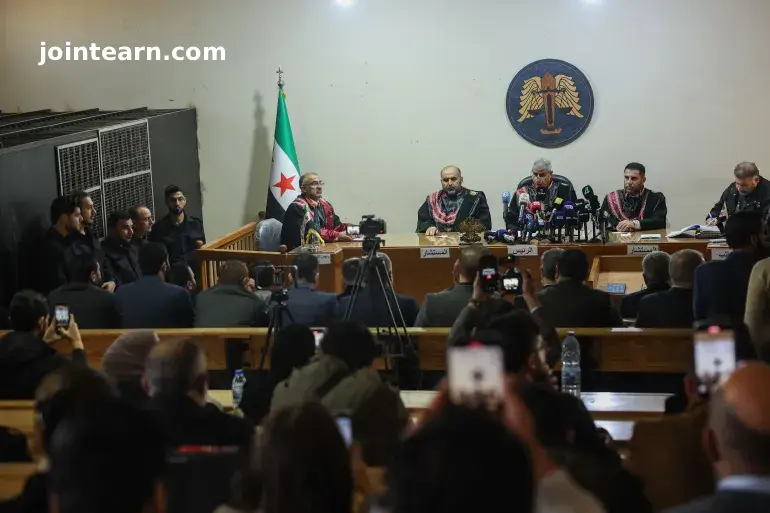
Syria has officially begun the trial of the first group of suspects linked to the deadly clashes in the country’s coastal provinces earlier this year that claimed the lives of thousands, predominantly from the Alawite religious minority. The proceedings mark the country’s first public judicial effort in connection with the massacres that erupted in March 2025.
First Trial of Coastal Violence Suspects
On Tuesday, 14 individuals appeared before the Palace of Justice in Aleppo, following months of government-led investigations, according to Syrian state media. The defendants include seven loyalists of former President Bashar al-Assad and seven members of the new government’s security forces.
Charges reportedly cover a range of serious crimes, including sedition, inciting civil war, attacks on security forces, murder, looting, and leading armed gangs. The seven accused from the security forces face prosecution for premeditated murder.
Background: March 2025 Coastal Violence
The violence began after attacks on the new government’s security apparatus by armed factions aligned with the deposed Assad regime. Counterattacks quickly escalated, resulting in widespread civilian casualties in coastal areas predominantly populated by Alawites, the same sect as Bashar al-Assad.
According to the National Commission of Inquiry, verified reports indicate that at least 1,426 people were killed, most of them civilians, with 298 suspects identified in connection to the massacres. Of those, 238 members of the security forces and army were reported killed during assaults attributed to Assad loyalists. The Syrian authorities responded by deploying roughly 200,000 troops to the region.
While the commission found no direct evidence that Syria’s new military leadership ordered attacks on Alawite civilians, a United Nations investigation determined that government-aligned factions engaged in widespread and systematic violence against civilians, including targeted killings based on religious affiliation. The UN report detailed that homes in Alawite-majority areas were raided, and residents were asked whether they were Sunni or Alawite, with Alawite men and boys subsequently taken away for execution.
Political and Judicial Implications
The trial represents a significant step for President Ahmed al-Sharaa, who assumed power in December 2024 after previously having links to al-Qaeda. Al-Sharaa’s administration is seeking to rebuild Syria’s international standing, convince the United States to ease crippling sanctions, and revive trade to support reconstruction in a country devastated by years of conflict.
Judge Zakaria Bakkar, opening the session, emphasized that “the court is sovereign and independent”, underlining the government’s commitment to judicial transparency. Despite initial state media reports suggesting quick proceedings, the session was adjourned, with the next hearing scheduled for December 2025.
International and Human Rights Response
The international community has closely monitored Syria’s response to the March violence, pressing the new government to commit to judicial reform and accountability for human rights violations. Observers highlight that this trial may be a test of Syria’s willingness to address war crimes and mass violence in a transparent and legally rigorous manner.


Leave a Reply