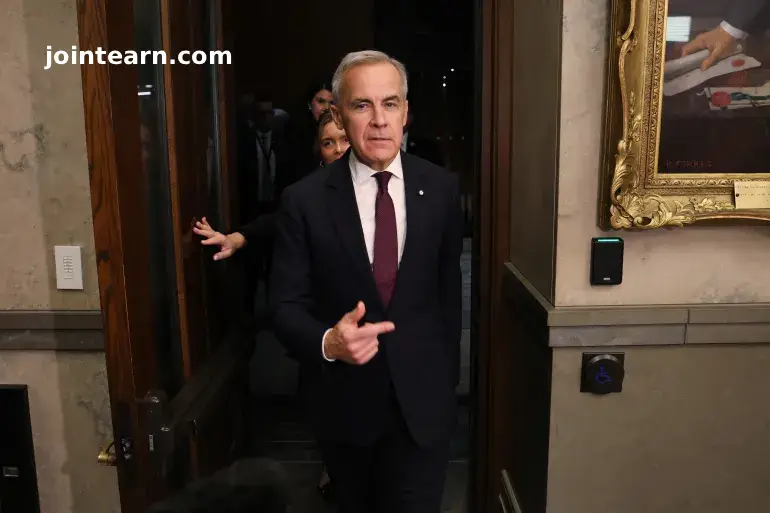
Canadian Prime Minister Mark Carney successfully navigated a critical confidence vote in the House of Commons on Monday, narrowly avoiding the possibility of snap elections less than a year after his minority government was elected. The vote cleared the way for Carney’s first federal budget, a fiscal plan designed to counter escalating US tariffs and strengthen Canada’s economic resilience.
The motion to advance the budget passed by a slim margin of 170-168, with several opposition MPs abstaining, signaling a tentative willingness among lawmakers to avoid plunging the country into an early election cycle.
Carney’s Budget Plan: A “Generational” Economic Response
Carney, a former central banker, has framed the budget as a long-term opportunity to reinforce Canada’s economy and reduce reliance on trade with the United States. His proposal features a significant increase in the national deficit, nearly doubling it to 78.3 billion Canadian dollars ($55.5 billion), with major investments aimed at supporting housing, defence, and trade resilience programs.
“The time has come to work together to deliver on this plan – to protect our communities, empower Canadians with new opportunities, and build Canada strong,” Carney said on social media platform X. He emphasized that the spending blueprint is intended to cushion the Canadian economy from the effects of US tariffs, which have impacted industries including automobiles, steel, and aluminum.
Internal government forecasts suggest that ongoing US trade measures could reduce Canadian GDP by around 1.8 percent, underscoring the urgency of the fiscal interventions.
Political Dynamics: Minority Government Survives
Carney’s Liberal Party, holding slightly fewer than a majority in the 343-seat House of Commons, relied on strategic abstentions from opposition MPs to pass the motion. The Conservative Party, led by Pierre Poilievre, criticized the spending plan as a “credit card budget” and continues to grapple with internal divisions, while the New Democratic Party (NDP) expressed concerns that the plan inadequately addresses pressing issues like unemployment, housing affordability, and cost-of-living pressures.
NDP interim leader Don Davies noted that some MPs abstained to prevent triggering a nationwide election at a time of economic uncertainty caused by US policies. “It was clear that Canadians do not want an election right now … while we still face an existential threat from the Trump administration,” Davies explained.
Finance Minister Francois-Philippe Champagne reinforced this perspective, stating, “Parliamentarians decided to put Canada first,” reflecting broad public support for continuity in leadership during a challenging trade environment.
Public Opinion and Next Steps
Polling conducted prior to Monday’s vote indicated that Canadians largely supported the government’s cautious approach. A November survey by Leger found that half of respondents were satisfied with Carney’s leadership, while only one in five supported immediate elections.
With the vote passed, Carney’s government will now focus on further budget approvals and implementation, seeking to navigate the economic fallout from US protectionist measures while maintaining political stability in Ottawa.


Leave a Reply