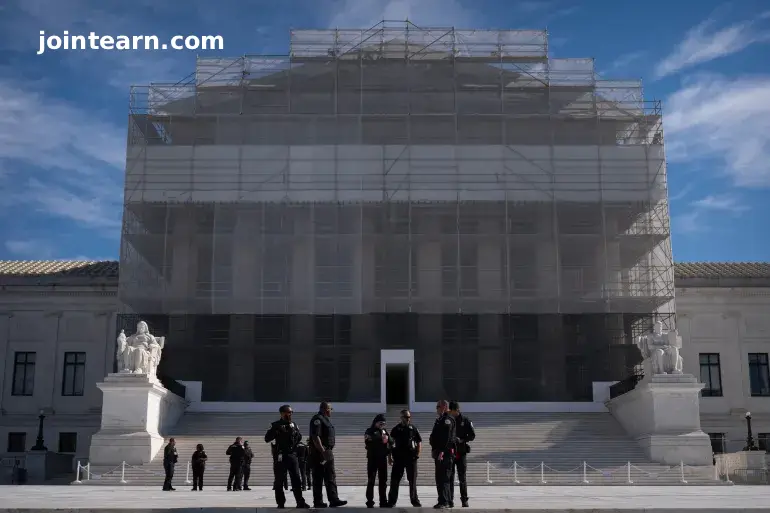
Justices to weigh whether turning away asylum seekers at ports of entry violates federal immigration law
The United States Supreme Court has agreed to hear a pivotal case that could reshape asylum access at the US-Mexico border, taking up the controversial practice known as “metering.” The policy, used most aggressively under the Trump administration, allowed border officials to turn away asylum seekers arriving at official ports of entry on the grounds that facilities were “at capacity,” leaving thousands stuck in Mexico with no clear timeline for when their claims would be processed.
On Monday, the Court accepted the Trump administration’s request to review a lower-court ruling that found metering unlawful. The case, Al Otro Lado v. Noem, was previously decided by the Ninth Circuit Court of Appeals, which held in 2024 that metering constituted an illegal “withholding” of asylum rights guaranteed under US law.
What Is ‘Metering’?
“Metering” refers to the practice of physically preventing asylum seekers from stepping onto US soil, even when they present themselves at designated ports of entry. Officials routinely informed families, unaccompanied minors, and adults that the port was full—forcing them to wait in Mexican border towns without shelter, safety, or legal protections.
Asylum seekers stranded in Mexico often faced extortion, kidnapping, sexual violence, and assault, according to evidence submitted in the lawsuit. The advocacy group Al Otro Lado, one of the plaintiffs, said in a statement that the policy “stranded vulnerable families in dangerous conditions” while violating US statutory obligations.
Ninth Circuit: Metering Was Illegal
In a 2–1 ruling, the Ninth Circuit found that federal immigration statutes clearly require officers to inspect and process asylum seekers who arrive at ports of entry, regardless of capacity concerns. The court concluded that turning people away at the border amounted to a deliberate obstruction of their rights.
Advocates maintain that US law protects anyone fleeing persecution based on race, religion, nationality, political opinion, or membership in a particular social group—and that the government cannot sidestep these protections through administrative barriers.
Trump Administration Defends Metering
The Trump administration has sought to significantly restrict asylum access, arguing that metering was necessary to prevent fraud and abuse within the system. In its appeal, the US Department of Justice argued that asylum seekers “arriving at” a port of entry are not legally considered to be “in” the United States until they physically cross the border.
To illustrate its argument, government lawyers used analogies ranging from D-Day landings in Normandy to American football, stating that a running back “does not arrive in the end zone when stopped at the one-yard line.”
Metering was first used informally in 2016, expanded in 2018, and ultimately halted in 2021 under the Biden administration after a court order. But the legal battle has continued, and the Trump administration—now in its second term—is seeking to reinstate broader limits on asylum.
Part of a Broader Crackdown on Asylum
Metering is one component of a wider policy agenda aimed at restricting entry for asylum seekers. On January 20, 2025, President Trump signed an executive order effectively banning most asylum claims at the southern border. That ban was struck down in July by a federal judge who said it created an “alternative immigration system” not authorized by Congress.
The administration has appealed that ruling as well.
Beyond US borders, Trump officials have also urged other governments to adopt stricter asylum policies. At a United Nations side event titled “Global Refugee Asylum System: What Went Wrong and How to Fix It,” senior US officials encouraged a coordinated international crackdown.
In October, the administration set the lowest refugee cap in US history, limiting admissions for fiscal year 2026 to 7,500 individuals, with stated priority for white Afrikaner applicants from South Africa—a move widely condemned by rights groups and experts who say claims of an anti-white “genocide” in South Africa are unfounded.
What Comes Next?
With a 6–3 conservative majority, the Supreme Court’s decision could have sweeping implications for asylum policy, border enforcement, and the rights of migrants who seek protection under international law. The ruling may also determine whether federal agencies can use “capacity constraints” as a justification to block asylum access.
Immigration advocates say the stakes are high: a decision in favour of the Trump administration could reopen the door to metering or similar strategies that limit access to asylum at ports of entry, forcing vulnerable people to wait in dangerous border regions.
The Supreme Court is expected to hear arguments later this term, with a decision anticipated in 2026.


Leave a Reply