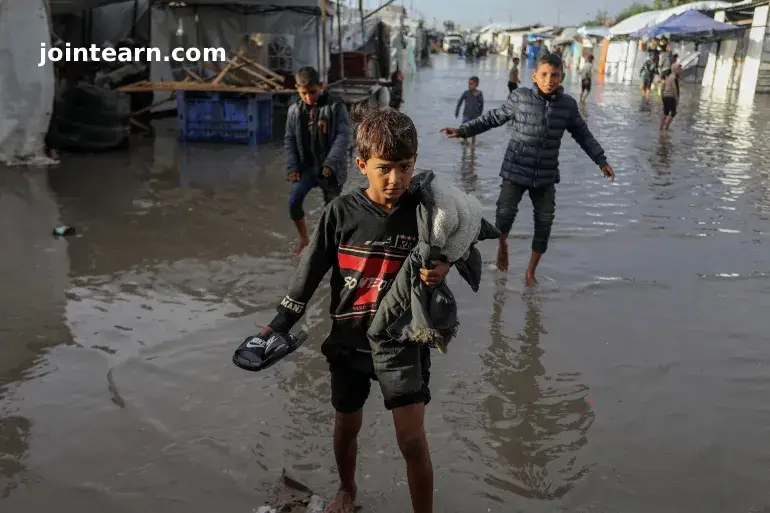
Gaza is facing a rapidly escalating humanitarian emergency as more than 288,000 Palestinian families endure life-threatening shelter conditions amid winter storms, severe flooding, and continued restrictions on essential humanitarian supplies. According to Gaza’s Government Media Office, the situation has evolved into the most dangerous shelter catastrophe since the beginning of the war, leaving displaced civilians exposed to extreme weather with little to no protection.
Heavy Rains Flood Tents Across Khan Younis and Southern Gaza
In the Mawasi area of Khan Younis, where thousands of displaced Palestinians live in makeshift tents, heavy rainfall on November 15, 2025, transformed entire communities into waterlogged disaster zones. Families whose homes were destroyed in Israeli attacks now find their temporary tents submerged in cold, muddy water, forcing them to wade through dangerous conditions to survive. Some residents rely on donkey carts to navigate completely flooded streets, while children walk through pools of water just to move between tents.
Photographs from the scene show tents collapsing under the weight of accumulated rainwater and dirt roads turning into deep, impassable mud. What little shelter the displaced population had is now rapidly deteriorating.
‘Catastrophic Conditions No Society Can Endure’
Local Gaza authorities warned that the flooding crisis is a direct result of both harsh winter conditions and Israel’s continued blockage of essential aid, including tents, tarps, and plastic coverings. Officials stated that Israel is “deliberately deepening the catastrophe” by refusing to allow critical shelter materials into Gaza, despite a ceasefire agreement that began on October 10.
“We hold the occupation fully responsible for the suffering of hundreds of thousands of displaced people who are facing the harshness of winter without safe shelter or basic services,” the Government Media Office said in a statement, condemning the continued closure of crossing points and the ban on shelter materials.
Infrastructure Damage Exacerbates Flooding
The first major winter storm struck Gaza on Thursday, immediately overwhelming drainage systems already crippled by months of bombardment. The United Nations reported that more than 13,000 households were affected within hours of the rain beginning.
In northern Gaza, the Sheikh Radwan Basin—one of the main water retention systems—rose by 37 centimeters, forcing emergency crews to run vacuum trucks continuously to prevent massive overflow into nearby residential areas.
Two Years of Displacement and Camps Built in Low-Lying Areas
Many of Gaza’s displacement camps are built on ground significantly lower than surrounding regions, making them extremely vulnerable to flooding. As the war enters its second year of mass displacement, tents that were never meant to serve as long-term homes are collapsing under the pressure of near-constant rainfall.
Journalists on the ground report that some areas are “completely submerged,” with water rushing in from all directions, leaving families no dry place to seek safety.
Gaza Requires 300,000 Tents—but Israel Blocks Entry, Authorities Say
The Government Media Office has repeatedly stated that Gaza requires at least 300,000 tents and mobile housing units to meet basic shelter needs. Yet, according to Gaza officials, Israel continues to block the entry of these supplies and has not implemented the humanitarian provisions it agreed to under the ceasefire.
More than 80 percent of Gaza’s buildings have been damaged or destroyed during the war, according to the UN, resulting in one of the largest displacement crises in modern history.
International experts have warned that the scale of destruction and intentional deprivation of essential living conditions may fit the UN definition of genocide, which includes actions intended to create “conditions of life calculated to bring about the physical destruction” of a group.
UNRWA: ‘Misery on Top of Misery’
Philippe Lazzarini, the head of UNRWA, described the conditions in Gaza as “misery on top of misery.” He explained that Gaza’s fragile shelters “quickly flood, soaking people’s belongings,” forcing families to choose between staying in wet, freezing tents or attempting to relocate through treacherous floodwaters.
UNRWA says it currently has enough aid stockpiled in Jordan and Egypt to fill 6,000 trucks, including food capable of sustaining Gaza’s population for three months. But Israeli restrictions are allowing only half of the required 500–600 daily aid trucks to enter.
Aid groups also revealed that Israeli import restrictions are so strict that even pens and notebooks are being denied entry into Gaza.
Humanitarian Experts Condemn Political Restrictions on Aid
International humanitarian specialists argue that the obstruction of aid is not a logistical issue but a political strategy.
Professor Mukesh Kapila of the University of Manchester stated:
“Accessing Gaza is one of the easiest regions where a humanitarian crisis is happening. This is entirely a political act and a deliberate strategy.”
Kapila said the restrictions appear designed to pressure Hamas over ongoing hostage negotiations, but that the tactic is worsening the suffering of civilians.
British Foreign Secretary Yvette Cooper echoed these concerns, stating during a visit to Jordan’s aid warehouses that Israel has “no excuse” for delaying critical humanitarian supplies.
Appeal to the United States and Ceasefire Mediators
Gaza’s Government Media Office has appealed to U.S. President Donald Trump and international mediators to take urgent action to pressure Israel into complying with the ceasefire and the humanitarian protocol included in the agreement.
Despite the truce, Gaza’s Ministry of Health reports that at least 266 people have been killed since it began, with Israeli strikes continuing on an almost daily basis.
As winter deepens and flooding worsens, humanitarian agencies warn that without immediate intervention and unrestricted aid access, Gaza’s shelter crisis may rapidly escalate into a historic disaster.


Leave a Reply