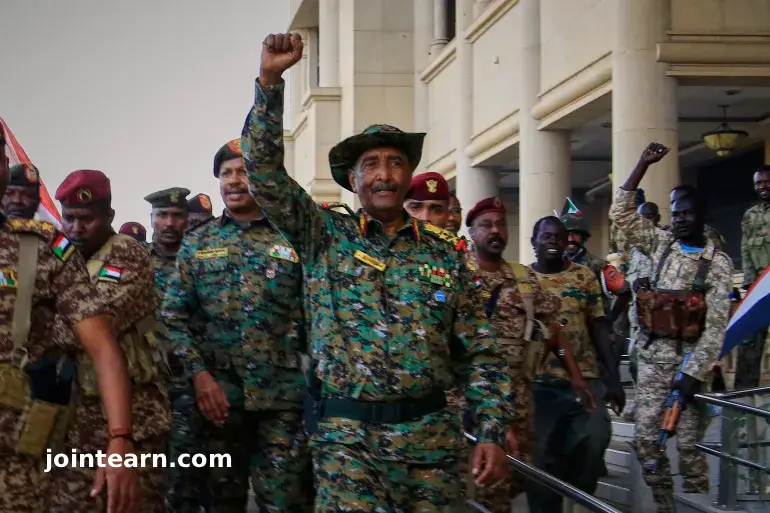
Sudan’s military leader, General Abdel Fattah al-Burhan, has rejected a ceasefire proposal offered by the international “Quad” group—Egypt, Saudi Arabia, the United Arab Emirates, and the United States—sparking renewed concerns that Sudan’s devastating civil war will continue with no sign of relief.
Al-Burhan’s rejection adds another setback to diplomatic efforts aimed at halting a conflict that has displaced millions, deepened famine conditions, and become one of the world’s worst humanitarian crises.
Al-Burhan Rejects Plan, Claims It Favors RSF
In a statement delivered to senior officials and released publicly on Sunday, al-Burhan accused the Quad of presenting a proposal that “eliminates the existence of the armed forces” while “maintaining the rebellious militia in its positions.” He argued that the plan would dissolve Sudan’s security institutions and grant the rival Rapid Support Forces (RSF) an unfair advantage on the ground.
He specifically criticised the UAE’s role in the mediation efforts, claiming that Abu Dhabi’s involvement undermines the plan’s neutrality. Sudan’s military has long accused the UAE of backing the RSF—a charge the UAE firmly denies.
In March, the UAE dismissed Sudan’s attempt to file a case against it at the International Court of Justice, calling the allegation a “cynical publicity stunt.”
Fear Grows That Ceasefire Remains Out of Reach
Al-Burhan’s response raises doubts about the likelihood of progress as the war enters its third year. Since April 2023, when tensions between the army and the RSF escalated into open conflict, more than 40,000 people have been killed according to UN estimates, though aid organisations warn that the actual toll may be far higher.
More than 14 million people have been displaced, forcing families to flee cities, villages, and farms across Sudan. Widespread hunger and the collapse of essential services have intensified the crisis.
Criticism of US Adviser, Praise for Regional Allies
The army chief also criticised Massad Boulos, a senior adviser on regional affairs to US President Donald Trump, accusing him of becoming an obstacle to peace efforts. Boulos has previously stated that the Sudanese army has hindered humanitarian aid and used prohibited weapons—claims the military denies.
Despite rejecting the Quad plan, al-Burhan praised President Trump and Saudi Crown Prince Mohammed bin Salman for raising the urgency of ending the war during recent diplomatic talks in Washington.
He argued that ongoing mediation lacks credibility, saying: “The entire world has witnessed the UAE’s support for rebels against the Sudanese state.” He warned that mediation efforts appearing biased would not be accepted.
RSF Signals Willingness to Accept Humanitarian Truce
In contrast, the RSF announced earlier this month that it supports entering a humanitarian truce, saying that the proposal recognises the “catastrophic humanitarian consequences” of the war.
The plan calls for a three-month ceasefire, intended to open the way for negotiations on a long-term political settlement and the establishment of a new civilian-led government after years of military dominance.
However, RSF forces continue operations across Sudan, particularly in the western region of Darfur, where they have gained control of key areas, including the strategic city of el-Fasher. International observers and humanitarian agencies report ongoing abuses, large-scale displacement, and widespread fear among civilians.
Sporadic fighting also continues in parts of the Kordofan region, where both sides are battling for control of strategic territory. The RSF recently stated its intention to seize the city of Babnusa from the army’s 22nd Division.
Sudan’s Conflict Continues to Worsen
The war began in April 2023 following a breakdown in power-sharing between the Sudanese Armed Forces and the RSF. What started as a political dispute rapidly escalated into a nationwide conflict that has devastated Khartoum and numerous other areas.
The United Nations warns that Sudan is now facing the largest humanitarian crisis on the planet, with millions displaced and several regions pushed into famine conditions. Aid agencies have struggled to reach affected areas due to insecurity, bureaucratic restrictions, and ongoing fighting.
Despite ongoing mediation efforts by international and regional powers, the latest rejection from Sudan’s military leader signals that peace remains elusive, leaving civilians trapped in a conflict with no clear end in sight.


Leave a Reply