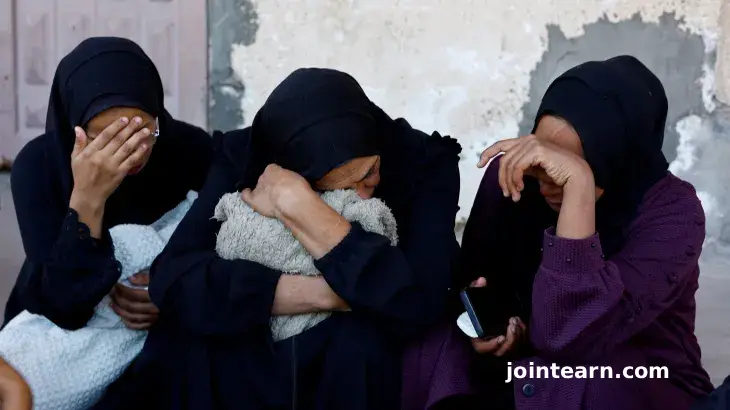
A senior delegation from Hamas recently met with Egypt’s intelligence chief in Cairo to address ongoing concerns over Israel’s repeated breaches of the ceasefire agreement in Gaza. This high-level meeting comes as Palestinians across Gaza mourned the loss of dozens of civilians killed in recent Israeli attacks.
According to Hamas, the discussions with Hassan Rashad, Egypt’s spy chief, focused on Israel’s “continued violations” of the ceasefire, which the Palestinian group claims threaten to undermine the fragile agreement reached last month.
Funerals Highlight the Human Cost of Ceasefire Violations
On Sunday, Gaza saw widespread funerals for the victims of Saturday’s Israeli strikes, which reportedly killed at least 24 Palestinians, including children. Mourners gathered at hospitals and local cemeteries to honor the deceased, reflecting deep concern over the escalation of violence despite the ceasefire.
Journalists in Gaza have reported that residents fear a widening of Israel’s attacks, with repeated strikes destroying homes, shelters, and civilian infrastructure, leaving parts of the city in ruins.
Hamas Calls for Monitoring Mechanisms
Hamas’ delegation, which included exiled Gaza chief Khalil al-Hayya, emphasized the need for a “clear and defined mechanism” to monitor and prevent further breaches of the ceasefire. The group urged Egypt, along with Qatar and the United States—key mediators of the truce—to intervene urgently to stop continued hostilities.
The delegation also discussed the situation of Hamas fighters trapped in tunnel networks in Rafah, an area under partial Israeli control. Communication with these fighters has reportedly been cut off, raising concerns about their safety.
Recent Israeli Strikes and Hamas Response
The Israeli military stated that the Saturday attacks targeted Hamas members who had allegedly attempted an incursion into Israeli-controlled areas. Among those killed was a local Hamas commander. Hamas has rejected these claims, insisting that Israel is seeking excuses to continue targeting Palestinian civilians.
Since the ceasefire took effect on October 10, 2025, Israel has reportedly violated the agreement at least 497 times. The Gaza Government Media Office estimates that these violations have resulted in the deaths of 342 civilians, with women, children, and the elderly making up the majority of the casualties.
Ceasefire Phase One and Humanitarian Efforts
Phase one of the ceasefire, based on Donald Trump’s peace plan, involves:
- The exchange of captives and prisoners
- Delivery of humanitarian aid
- Opening of the Rafah crossing with Egypt
So far, Hamas has released all remaining captives and returned dozens of bodies, while Israel has freed nearly 2,000 Palestinian prisoners. However, restrictions on border crossings continue to impede the flow of aid, and Israel has not yet allowed the Rafah crossing to fully open, creating significant humanitarian challenges.
Phase Two: Governance and International Oversight
The second phase of the ceasefire envisions Gaza governed by a technocratic Palestinian committee, supervised by the Trump-led “Board of Peace.” This phase also includes:
- Deployment of an International Stabilisation Force
- Training of Palestinian police
- Demilitarization of Gaza
Hamas has made it clear that it will not surrender weapons while the Israeli occupation persists. The plan also guarantees that Palestinians will not be forced to leave Gaza and that Israel will refrain from annexing the territory.
The United Nations Security Council has endorsed the plan, highlighting the international community’s support for a negotiated peace framework, even as violence continues on the ground.
Conclusion
The recent Hamas-Egypt meeting underscores the urgency of addressing ceasefire violations and the pressing humanitarian needs in Gaza. With tensions remaining high, mediators face a critical task: ensuring compliance with the ceasefire, safeguarding civilian lives, and enabling humanitarian aid to reach those most affected.


Leave a Reply