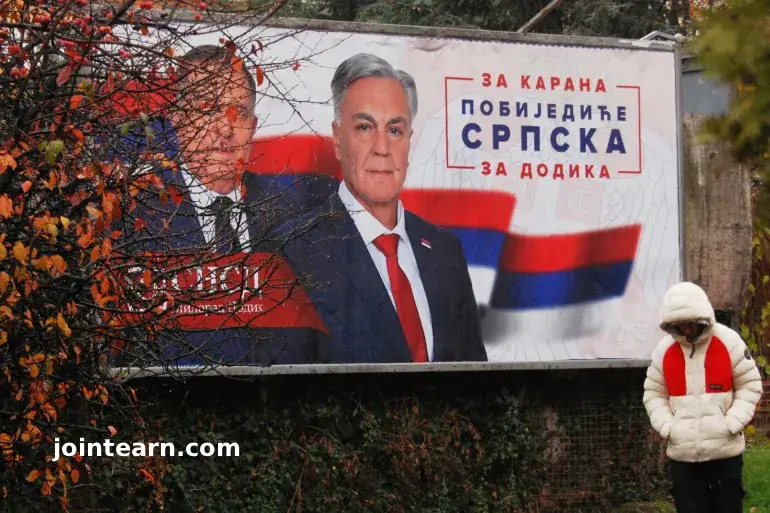
Voters in Republika Srpska, the Serb-majority political entity of Bosnia and Herzegovina, headed to the polls on Saturday in a snap presidential election following the ousting of separatist leader Milorad Dodik. Dodik was removed from office in August after defying the rulings of Bosnia’s international peace envoy, Christian Schmidt, and was banned from political activity for six years.
The early election serves as a critical test for Dodik’s nationalist party, the Union of Independent Social Democrats (SNSD), which has dominated Republika Srpska politics for nearly two decades. The winner of this vote will serve a short term of less than a year until the general elections scheduled for October 2025.
Why Dodik Was Removed
Dodik’s removal followed a ruling by Bosnia’s top court, which upheld a one-year prison sentence for ignoring international directives and rulings. While he avoided prison by posting bail, the court barred him from participating in politics, marking a major turning point in Republika Srpska’s political landscape.
The decision has been viewed as a test of support for Dodik’s leadership and his party’s secessionist rhetoric, which has increasingly challenged the Dayton peace agreement, the 1995 treaty that ended Bosnia’s devastating 1992-1995 war and established the country’s post-war constitutional structure.
Key Candidates in the Election
The snap election features six candidates, but the two frontrunners are:
- Sinisa Karan, 63, a former interior minister and Dodik’s personal choice to succeed him. Karan represents continuity with Dodik’s nationalist policies and remains closely aligned with the SNSD.
- Branko Blanusa, 56, an electrical engineering professor representing the opposition Serb Democratic Party. Blanusa has criticized Dodik’s government, highlighting alleged corruption and mismanagement during the SNSD’s long tenure.
With roughly 1.2 million eligible voters, Republika Srpska’s electorate is expected to have a high-stakes influence on both local and national politics, as the election outcome may signal the future direction of Bosnian Serb leadership and the entity’s relationship with the central government in Sarajevo.
Republika Srpska’s Political Context
Republika Srpska, established in 1995 under the Dayton peace agreement, is one of Bosnia and Herzegovina’s two main political entities alongside the Federation of Bosnia and Herzegovina. The entity maintains substantial autonomy and shares equal rights over the Brčko District, a self-governing administrative unit.
Historically, Republika Srpska has been dominated by ethnic Serbs, who now make up 82 percent of the population according to the 2013 census. The entity’s first president, Radovan Karadzic, was convicted for genocide by the International Criminal Tribunal for the former Yugoslavia in The Hague, emphasizing the region’s turbulent past.
What’s at Stake
The snap presidential vote is closely watched both domestically and internationally. Analysts believe that the outcome could influence Republika Srpska’s political stance, its approach to the Dayton peace framework, and the broader stability of Bosnia and Herzegovina. Preliminary results are expected on election night, with official results announced after validation by the Central Election Commission.
As tensions continue over secessionist rhetoric and challenges to international oversight, this election represents a pivotal moment for the future of Republika Srpska and Bosnia’s fragile post-war order.


Leave a Reply