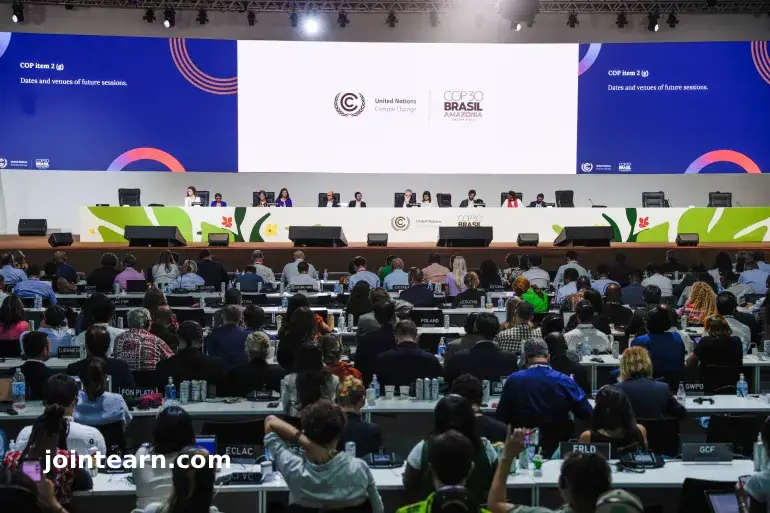
Belem, Brazil – November 22, 2025: The COP30 United Nations Climate Conference concluded with a global climate deal urging nations to accelerate climate action, yet it fell short of calling for a complete phase-out of fossil fuels. The summit, held in the Brazilian city of Belem, brought together world leaders, climate advocates, and civil society groups for two weeks of intense negotiations aimed at addressing the escalating climate crisis.
COP30 Agreement: Key Points
The COP30 deal emphasizes the urgent need for countries to “significantly accelerate and scale up climate action worldwide.” Among its main measures:
- Developed nations are urged to triple climate adaptation funding to help vulnerable countries cope with climate change.
- The agreement sets a framework for reducing reliance on fossil fuels, but it does not explicitly commit to phasing out oil, coal, and gas.
- Calls for halting and reversing deforestation and mobilizing resources for sustainable development.
While observers recognize COP30 as a step forward, many argue that the deal does not go far enough to meet the scientific targets outlined in the Paris Agreement.
Reactions from World Leaders
COP30 President Andre Aranha Correa do Lago
During the closing plenary, COP30 President Correa do Lago acknowledged that some participants had hoped for stronger measures. He announced plans to create two roadmaps: one focused on halting deforestation and another on a just transition away from fossil fuels.
UN Secretary-General Antonio Guterres
Guterres highlighted that COP30 delivered progress, particularly on financing adaptation, but stressed that the world is still on track to surpass the 1.5°C global warming limit. He warned that the “gap between where we are and what science demands remains dangerously wide,” emphasizing the urgency of immediate and decisive action.
European Union: Wopke Hoekstra
EU Climate Commissioner Hoekstra admitted that while the deal could have been more ambitious, it represents “a hugely important step in the right direction” for global climate action.
Colombia: President Gustavo Petro
Colombian President Petro criticized the agreement for failing to explicitly name fossil fuels as the primary driver of the climate crisis. He called for a clearer acknowledgment of the scientific evidence linking oil, coal, and gas to global warming.
Cuba: Foreign Minister Bruno Rodriguez Parrilla
Cuba praised the deal for reinforcing multilateralism and highlighted key outcomes, including climate finance commitments and mechanisms for just transitions for affected communities.
China: Li Gao
China welcomed the COP30 agreement as a success, emphasizing the importance of international solidarity in tackling climate change despite difficult negotiations.
Alliance of Small Island States
Representing 39 low-lying nations, the Alliance described the agreement as “imperfect” but acknowledged it as a step forward, demonstrating the value of multilateral dialogue and cooperation.
Responses from Rights Groups
Amnesty International
Ann Harrison, Climate Justice Adviser at Amnesty International, stressed the importance of inclusive participation and noted that Indigenous Peoples and civil society groups were largely excluded from the decision-making process. She highlighted that “people power” contributed to the creation of a Just Transition mechanism, intended to protect workers’ rights and communities affected by the shift away from fossil fuels.
Oxfam Brasil
Oxfam’s Viviana Santiago expressed cautious optimism, calling COP30 “a spark of hope but far more heartbreak.” She criticized the lack of adequate financial support from wealthy nations, warning that the just energy transition risks stalling without proper funding for vulnerable countries.
Conclusion: COP30’s Impact on Global Climate Action
COP30 in Belem underscores both the progress and limitations of current global climate negotiations. While the agreement advances climate finance, adaptation efforts, and frameworks for just transitions, it leaves critical gaps in fossil fuel reduction commitments. As the world faces increasingly extreme weather events, the urgency for coordinated, science-based action remains higher than ever.


Leave a Reply