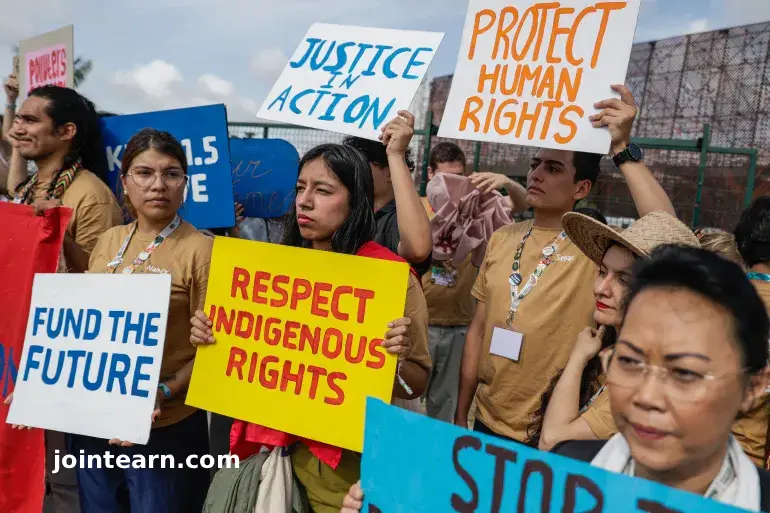
Belem, Brazil – November 22, 2025: World leaders at the United Nations COP30 climate summit in Belem, Brazil, reached an agreement aimed at addressing global warming, but the deal notably does not include a commitment to phase out fossil fuels, the primary drivers of the climate crisis.
After two weeks of intense negotiations, the agreement was finalized late Saturday, stretching beyond the expected close of the summit amid deep divisions over fossil fuel reduction and climate finance.
Key Points of the COP30 Agreement
The COP30 deal outlines several measures to accelerate global climate action:
- Developed nations are urged to at least triple funding to help poorer countries adapt to extreme weather events and climate-related disasters.
- A review of climate-related trade barriers is included to facilitate greener economic practices.
- The agreement calls on all countries to scale up climate action worldwide with the aim of keeping the global temperature increase within 1.5°C of pre-industrial levels, as stipulated in the Paris Agreement.
Although the deal marks progress, some officials and climate activists have criticized it for falling short of expectations, particularly regarding fossil fuel reduction.
Global Reactions
European Union
Wopke Hoekstra, EU Climate Commissioner, called the outcome a step forward but admitted the bloc had hoped for greater ambition. “We should support it because at least it is going in the right direction,” he said.
France
Monique Barbut, France’s Ecological Transition Minister, described the agreement as “rather flat” but not objectionable, noting that there was nothing “extraordinarily bad” in the text.
Cuba
Cuban Foreign Minister Bruno Rodriguez Parrilla highlighted that while the results fell short, COP30 reinforced the importance of multilateralism in tackling global challenges such as climate change.
Civil Society and NGOs
Asad Rehman, CEO of Friends of the Earth, criticized richer nations for trying to weaken the agreement and delay meaningful action. “We will have taken a step forward, but in the scale of the crisis, a giant leap forward was needed,” he said.
Roadmaps for Fossil Fuel Phase-Out and Deforestation
COP30 President Andre Aranha Correa do Lago emphasized the need for structured plans to overcome fossil fuel dependence and halt deforestation. He announced that two international roadmaps will be developed:
- Deforestation and reforestation roadmap
- Just transition roadmap for phasing out fossil fuels
Delegates responded positively, and the first international conference focused on fossil fuel phase-out is scheduled to take place in Colombia in April 2026.
Conclusion
While COP30 in Belem advanced climate finance commitments and encouraged global cooperation, it underscores the ongoing challenge of addressing fossil fuel dependence. Climate experts warn that urgent, ambitious action is still required to prevent catastrophic temperature increases and global climate disruption.


Leave a Reply