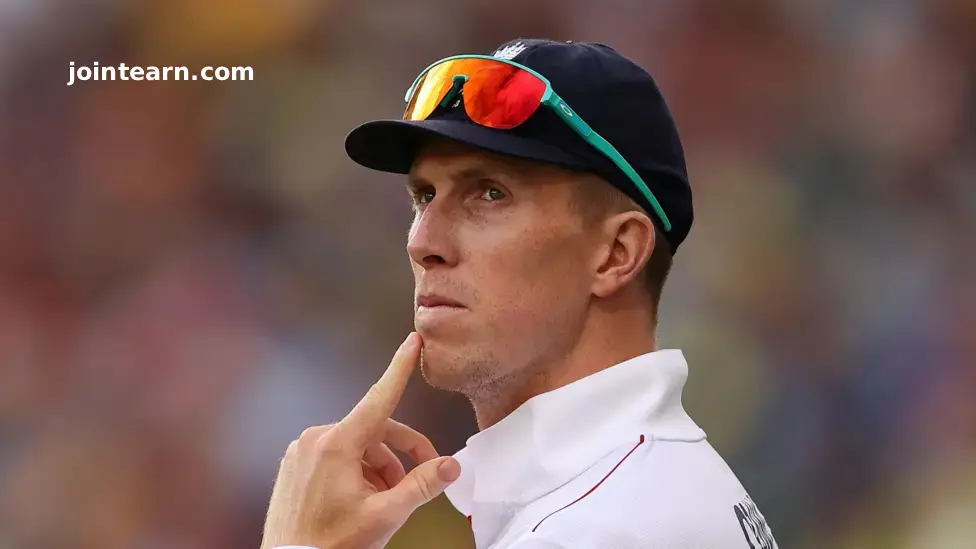
Zak Crawley’s spot at the top of England’s Test order is once again a talking point after the opener recorded ducks in both innings of the first Test in Perth. For many fans, the déjà vu feels all too familiar: another Ashes tour, another debate about whether England’s long-term faith in Crawley is sound strategy or stubborn persistence.
Despite criticism, Crawley remains central to England’s plans. With no specialist reserve opener in the touring party and a track record the selectors still value, a change before the second Test appears unlikely. But after a pair of first-over dismissals, the long-standing reasoning behind his selection has come under fresh scrutiny.
Why England Keep Backing Crawley
England’s management has repeatedly pointed to Crawley’s partnerships, his style, and his specific suitability to Australian conditions as justification for their unwavering faith.
Since Ben Duckett returned to the Test side in late 2022, no opening pair in world cricket has scored more runs or produced more fifty or hundred stands than the Crawley–Duckett duo. Their contrast — Duckett’s low, busy technique and Crawley’s tall, classical stroke play — has given England tempo and balance at the top of the order.
Crawley has also historically saved some of his best cricket for the Australians. Coming into the current series, he averaged over 40 against them — the highest by an England batter in that period — highlighted by his blistering 189 at Old Trafford in 2023, viewed as one of England’s standout Ashes innings of the decade.
He has also fared unusually well against Australia’s frontline attack. Before this tour:
- He averaged over 50 against Pat Cummins
- He had never been dismissed by Josh Hazlewood
- He scored nearly 39 runs per dismissal against Mitchell Starc
Those numbers form a major part of England’s belief that Crawley is built for Australian conditions.
His game — tall at the crease, strong on the bounce, and historically effective against pace — seemed a natural fit for fast, hard Australian pitches.
But the Decline Is Becoming Hard to Ignore
The challenge for England is that Crawley’s recent performances no longer match the theory.
Across the current year, Crawley’s reputation for playing high pace well has sharply deteriorated. A player who once averaged nearly 50 against balls over 87 mph now averages just six against similar deliveries. He has been dismissed repeatedly by the world’s quickest bowlers — including Mitchell Starc, Jasprit Bumrah, and Mohammed Siraj — in a small but worrying cluster of innings.
His latest dismissals in Perth had one consistent theme: the drive. The shot that is both his trademark and his biggest liability. Whether thrown into an ambitious flourish or poked tentatively away from the body, drives in Australia — especially with the more responsive Kookaburra ball — have become a high-risk option.
At home, Crawley averages over 55 when driving. In Australia, that average plummets to barely over eight.
When your most dominant shot becomes your most dangerous, something is out of sync.
The Australian Conditions Problem
England have long insisted Crawley was selected because his technique suits Australia. Yet his career average in the country — just over 20 — tells a different story. His promising 77 in Sydney during the 2021–22 Ashes was followed by a string of brief, hopeful innings that never developed into something more substantial.
The first Test of this tour offered England the conditions they believed Crawley thrives in: bounce, pace, carry. Instead, he walked off without scoring in both attempts.
It’s becoming harder to argue the theory is paying off.
Why England Are Sticking With Him (For Now)
Dropping Crawley now would force England into even riskier territory. With no other specialist opener on tour, the alternatives are:
- Asking a middle-order player to reinvent themselves as an opener mid-series
- Promoting an uncapped Lions player for a baptism of fire in Australia
Either option would be a far bigger gamble than giving Crawley another chance.
England’s philosophy under the current leadership has also been built around backing players long-term, even when results wobble.
But patience is not infinite. And with more Tests to come on pitches that may be even tougher than Perth, Crawley’s margin for error is narrowing.
Is England’s Faith Sound — or Flawed?
The case for Crawley has always been one of potential: his height, his timing, his ability to dominate fast bowling when everything clicks. Few English openers in the past two decades have looked as capable of scoring quickly and shaping a match.
But potential needs evidence. And recent numbers are pulling the conversation in the opposite direction.
England will stand by Crawley for now because they believe in the plan. But unless performances start reflecting the faith placed in him, the question will return stronger than ever:
Is this loyalty justified — or simply hope disguised as strategy?


Leave a Reply