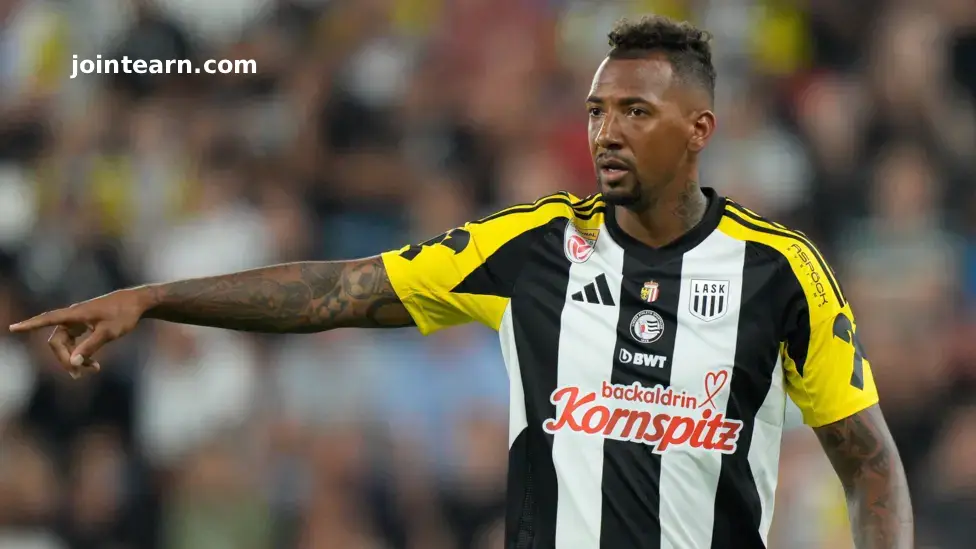
FC Barcelona have issued a public statement reaffirming their “full commitment to fighting gender-based violence” after facing criticism for allowing former Germany and Bayern Munich defender Jerome Boateng to visit the club’s training facility.
The visit, shared in a video posted on the club’s official X (formerly Twitter) account, showed Boateng greeting and embracing former team-mate Robert Lewandowski at the Ciutat Esportiva training complex. The post, which carried the caption “Welcome to the Ciutat Esportiva, Jerome Boateng”, sparked immediate backlash online.
Why the Visit Caused Controversy
Boateng, now 37, retired from professional football in September after a spell with Austrian club LASK. However, his off-field history remains highly controversial.
He received a suspended €200,000 (£176,000) fine and a formal warning from a Munich court in 2024 after being found guilty of premeditated bodily harm against his former partner. Boateng has always denied injuring the mother of his twin daughters during the 2018 altercation and had already appealed against an earlier conviction issued in 2021.
The 2024 ruling became the third trial in the long-running case, raising public scrutiny each time his name resurfaced.
Barcelona’s social media post arrived just two days before the club’s return to their rebuilt Nou Camp stadium, where they held a minute’s silence to honour victims of gender-based violence as part of the International Day for the Elimination of Violence Against Women.
This juxtaposition — a high-profile visit from Boateng followed by a club campaign condemning male violence — drew strong online criticism, with supporters calling the situation “tone-deaf”, “embarrassing” and “deeply ironic”.
Barcelona Issues Clarification: “No Contract, No Official Role”
Amid growing pressure, FC Barcelona moved to clarify the circumstances of Boateng’s visit.
Their statement emphasised:
- Boateng does not work for Barcelona
- He holds no official or representative role
- He was not invited in an institutional or ambassadorial capacity
Barcelona said the former defender only attended the training ground for a “one-off, educational visit” as part of his ongoing process to obtain coaching qualifications.
The club added:
“Jerome Boateng has no contractual relationship or active role within the club.
His presence was solely a one-off, educational visit as part of his personal process toward obtaining a coaching licence.
The club remains fully committed to combating gender-based violence and regrets any perception of inconsistency.”
The statement concluded by stressing that tributes to women killed by gender-based violence remain “an essential and non-negotiable value” for the club.
Boateng Already Forced to Withdraw From Bayern Munich Internship
This is not the first time Boateng’s attempts to enter coaching have triggered backlash.
In October, he had to cancel a planned coaching internship at Bayern Munich after fans protested and expressed outrage over his conviction and the surrounding circumstances.
Boateng, a member of Germany’s 2014 World Cup-winning squad, retired from professional football earlier this year and has stated that he intends to move into coaching. He completed his UEFA B Licence in late 2024.
The conversation around his post-playing career continues to be complicated by his personal history. In 2021, another of Boateng’s former partners passed away, an event that drew intense media attention in Germany amid reports that the couple had recently separated.
The Debate Continues
Barcelona’s response may ease immediate criticism, but the incident has reignited broader discussions in Spain about:
- Personal conduct of public figures
- The responsibility of football clubs in cases involving gender-based violence
- The optics and consequences of hosting controversial individuals
- How clubs balance educational or professional obligations with public sensitivities
As Boateng pushes forward with ambitions to become a coach, his presence in football environments is likely to draw further scrutiny — and clubs will continue to face difficult questions about how they manage these situations.


Leave a Reply