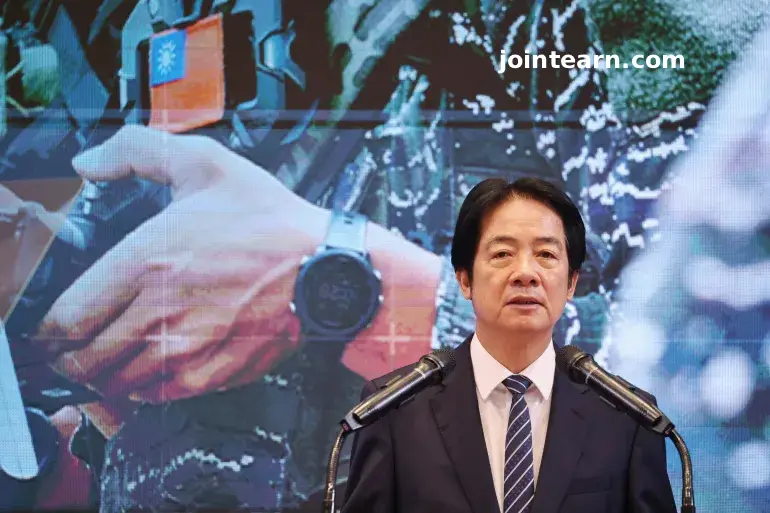
Taiwanese President William Lai Ching-te has unveiled a $40 billion defence spending plan over the next eight years, aiming to fortify Taiwan’s military capabilities and bring the nation closer to “an unassailable Taiwan, safeguarded by innovation and technology.” This announcement underscores Taiwan’s determination to defend itself amid rising tensions with China, which claims the self-ruled island as part of its territory and has repeatedly threatened to use force to regain control.
Accelerated Military Spending
Taiwan has gradually increased defence spending over the past decade, but the recent plan reflects an accelerated push, influenced in part by pressure from the United States. The Trump administration encouraged Taiwan to significantly boost its defence budget as a deterrent against potential Chinese military action.
President Lai outlined that the military aims to achieve a high level of joint combat readiness by 2027, which aligns with US assessments of a possible Chinese timeline for a military operation against the island.
“The ultimate goal is to establish defence capabilities that can permanently safeguard democratic Taiwan,” Lai said during a press conference in Taipei after also publishing an opinion piece in The Washington Post.
Strategic Investments and Defence Initiatives
The $40 billion budget is intended to fund new arms acquisitions from the US, as well as to enhance Taiwan’s ability to conduct asymmetrical warfare, a strategy designed to offset the numerical advantage of a larger opponent. Among the priority projects is the accelerated development of the T-Dome, a multi-layered air defence system designed to protect Taiwan from aerial threats.
Although some analysts expected a smaller allocation, the proposed spending exceeds prior estimates of $32 billion announced by Democratic Progressive Party (DPP) officials.
US Support and Diplomatic Context
The United States has welcomed Taiwan’s new spending plan. Raymond Greene, the US’s top envoy in Taiwan, urged the island’s political parties to reach consensus on bolstering national defence. Earlier this month, the US approved $330 million in military parts and components, marking the first arms sale to Taiwan since Trump’s return to the presidency.
President Lai emphasized that the budget is not linked to tariff negotiations with the US, but is primarily intended to demonstrate Taiwan’s resolve to defend itself against external threats.
Domestic Political Challenges
Despite broad public support for stronger defence capabilities, the spending plan faces potential hurdles in Taiwan’s parliament. The Kuomintang (KMT), the main opposition party advocating closer ties with China, holds significant influence over budget approval. KMT chairperson Cheng Li-wun has previously criticized Lai’s defence spending proposals, arguing that Taiwan lacks sufficient funds for such ambitious military programs.
If passed, the budget would allow Taiwan to increase annual defence spending to over 3% of GDP next year and potentially 5% by 2030. This figure remains below US suggestions of raising defence expenditure to 10% of GDP, an unusually high proportion compared to US or allied standards.
Rising Regional Tensions
Lai’s announcement comes amid regional diplomatic turbulence. Tokyo and Beijing have been embroiled in a weeks-long dispute following remarks by Japanese Prime Minister Sanae Takaichi suggesting Japan might intervene militarily if Taiwan were attacked. Such tensions further underscore the strategic importance of Taiwan’s military preparedness in a volatile East Asia.
China has criticized Taiwan’s budget as allowing “external forces” to dictate domestic decisions, reflecting Beijing’s persistent objection to international support for the island.


Leave a Reply