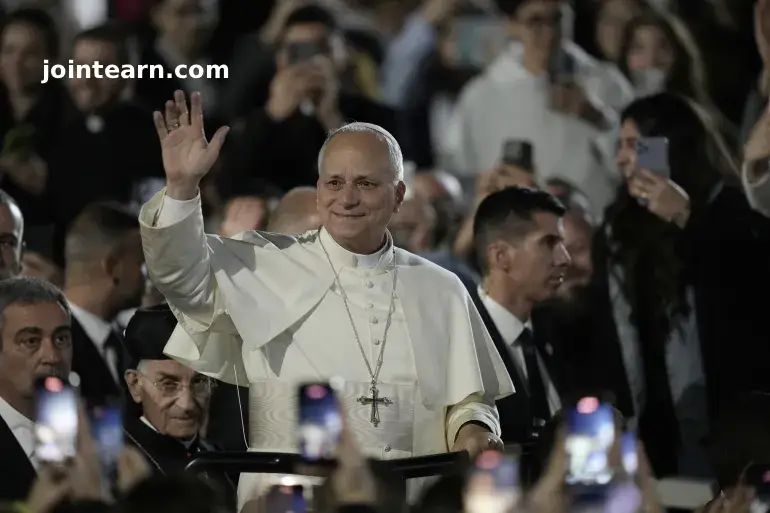
Beirut, Lebanon – Pope Leo XIV urged interfaith coexistence and national unity on the second day of his visit to Lebanon, gathering religious leaders from across the country and highlighting the importance of reconciliation amid Lebanon’s ongoing political and economic crises.
Message of Peace at Martyrs’ Square
Speaking at Martyrs’ Square on Monday, a site that once marked the “green line” dividing Christian east Beirut and Muslim west Beirut during the 1975–1990 civil war, Pope Leo said Lebanon demonstrated that “fear, distrust and prejudice do not have the final word.”
“In an age when coexistence can seem like a distant dream, the people of Lebanon, while embracing different religions, stand as a powerful reminder that unity, reconciliation, and peace are possible,” he said.
The pope called for harmony between religious traditions, saying, “May every bell toll; every adhan, every call to prayer blend into a single, soaring hymn.”
Martyrs’ Square, which also hosts a monument honoring Lebanon’s independence martyrs and has been a focal point for political protests, remains a powerful symbol of the country’s struggle to overcome sectarian divisions.
Interfaith Gathering and Youth Outreach
About 15,000 young people gathered outside the Maronite Catholic headquarters to hear the 70-year-old pontiff speak. Pope Leo encouraged the youth to embrace hope, saying, “There is hope within you, a gift that we adults seem to have lost. You have more time to dream, to plan, and to do good.”
Representatives of all major religious communities attended the interfaith event, including Christian, Sunni, Shia, Alawite, and Druze leaders. Sheikh Ali al-Khatib, deputy head of the Supreme Shia Islamic Council, thanked the pope for his visit while noting that Lebanon still bore wounds from regional conflict, including Israeli attacks.
Al Jazeera’s Zeina Khodr reported that the interfaith gathering highlighted a contrast between symbolic unity and Lebanon’s deep political divisions, saying, “Religious leaders coming together under one tent look like they are speaking with one voice, but the reality is, this is a deeply divided country.”
Regional Context and Security Concerns
Leo’s visit occurs amid ongoing tensions in Lebanon and the broader region. Hezbollah began firing rockets into Israel in October 2023 following Israeli attacks on Gaza. Although the group has largely remained inactive since a November 2024 ceasefire, cross-border Israeli strikes have killed more than 300 people in Lebanon, including roughly 127 civilians, according to the UN.
Khodr noted that many believe the pope’s presence acts as a deterrent against renewed violence, but there are concerns that conflict could escalate once he leaves.
Itinerary and Key Stops
Pope Leo arrived in Lebanon on Sunday, marking his first overseas trip as pope. His visit included:
- A meeting with President Joseph Aoun, the Arab world’s only Christian head of state.
- Visits to the tomb of St Charbel and the Harissa shrine, where crowds shouted “Viva il Papa.”
- On Tuesday, he will visit the 2020 Beirut port explosion site and lead a mass on the city’s historic waterfront.
The visit underscores the Vatican’s continued emphasis on interfaith dialogue, peace-building, and support for countries grappling with conflict and economic collapse. Lebanon, which hosts roughly one million Syrian and Palestinian refugees, continues to face political paralysis and a severe financial crisis since 2019.


Leave a Reply