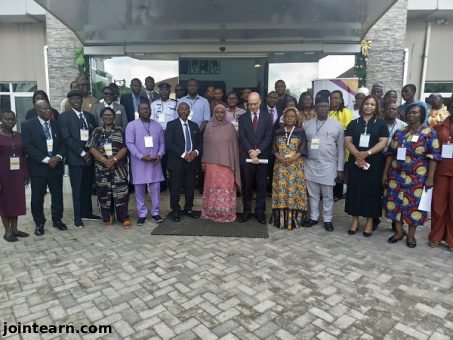
The Federal Government and Lagos State have announced enhanced measures to combat human trafficking and violence against persons, highlighting the increasingly complex, transnational, and technology-driven nature of these crimes.
Director-General of the National Agency for the Prohibition of Trafficking in Persons (NAPTIP), Hajiya Binta Adamu Bello, revealed the plans at the opening of a four-day workshop organized in partnership with the International Centre for Migration Policy Development (ICMPD) and supported by the Ministry of Asylum and Migration of the Kingdom of the Netherlands under the TIPVAP NG project.
Bello emphasized the need for a coordinated, multi-agency approach to address “a pervasive and evolving threat,” noting that traffickers exploit poverty, conflict, inequality, and abuse to traffic victims for sexual exploitation, forced labor, and other forms of abuse across West Africa and beyond.
The workshop is designed to enhance collaboration among investigators, prosecutors, financial intelligence officers, and social workers to improve detection, evidence management, and victim support. “The complex nature of trafficking demands a multidisciplinary response. Strengthening our mechanisms and aligning with international best practices is essential to dismantle these criminal networks,” Bello stated.
She also highlighted that human trafficking is increasingly linked with money laundering, drug trafficking, and corruption, exacerbated by armed conflict, economic instability, and rapid technological advances. Bello commended the Netherlands and ICMPD for their support, urging participants to translate insights from the workshop into actionable strategies. “Every statistic represents a person whose dignity has been violated,” she added.
In his message, Lagos State Attorney-General, Pedro Lawal (SAN), outlined plans to expand community-based anti-trafficking structures, deploy trained officers across local governments, and build dedicated shelters for survivors. “Lagos is a nation within a nation. What happens elsewhere affects us, which is why we are sharing our systems with other states,” he said.
Consul General of the Kingdom of the Netherlands, Michel Deelen, emphasized the project’s focus on building investigative and prosecutorial capacity, training participants in cyber-investigation, evidence preservation, inter-agency cooperation, and case-based problem-solving. He noted that no single agency can effectively tackle the multifaceted crime of human trafficking and praised NAPTIP for its leadership in this effort.
The workshop convened officials from federal and state institutions in Lagos and Ogun States to strengthen integrated national and sub-national responses, combining law enforcement, social protection, political will, and international cooperation to combat human trafficking.


Leave a Reply