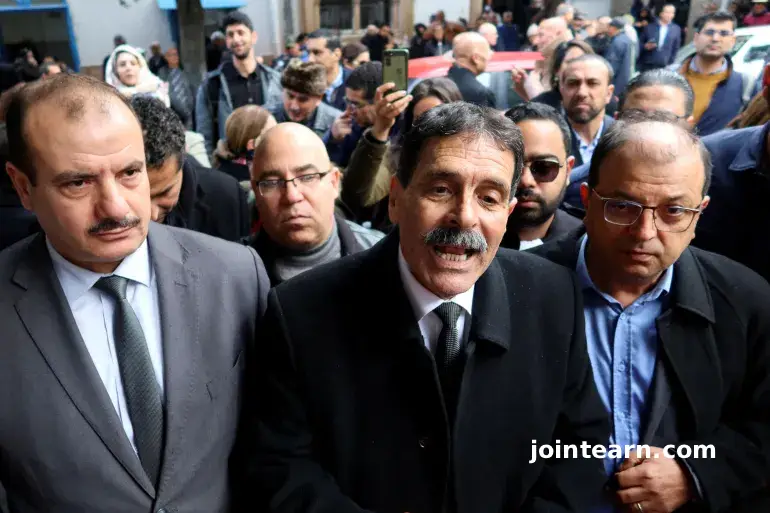
Prominent Opposition Figure Ayachi Hammami Detained
Tunisia’s authorities have arrested Ayachi Hammami, a prominent opposition politician and former Minister of Human Rights, at his home to enforce a five-year prison sentence. The arrest follows an appeals court decision upholding convictions against dozens of opposition figures, including politicians, lawyers, and business leaders, accused of plotting to overthrow President Kais Saied.
Hammami addressed supporters in a video posted by his family on Facebook, declaring:
“If you are seeing this video, I have been arrested. I have spent years fighting for democracy, freedom, rights. I will turn my cell into a new front of struggle.”
He also announced plans to go on a hunger strike in protest of what he described as politically motivated charges.
Broad Sweep Targets Tunisia Opposition
The arrests are part of a sweeping prosecution that has affected roughly 40 individuals, including former government officials and Kamel Guizani, the former head of intelligence. Fellow opposition leader Chaima Issa was detained last week to enforce a 20-year prison sentence related to the same case.
Charges brought against opposition members, such as attempting to destabilize the government, are widely described as fabricated. Critics argue the prosecutions are part of a broader effort to suppress dissent and consolidate power through the judiciary, signaling Tunisia’s deepening authoritarianism.
Najib Chebbi and Exile Sentences
Authorities are expected to arrest Najib Chebbi, head of the National Salvation Front, Tunisia’s main opposition coalition, who received a 12-year sentence.
Around 20 of those charged have fled abroad and were sentenced in absentia, marking one of the largest political prosecutions in Tunisia’s recent history.
President Saied maintains that he does not interfere in judicial matters. However, when the case was initiated in 2023, he warned that judges who acquitted the accused could be considered accomplices, raising concerns about judicial independence.
International Condemnation
Human rights groups have condemned the arrests and convictions. Amnesty International and Human Rights Watch have called for the sentences to be annulled, citing politically motivated prosecutions and violations of fair trial rights.
Sara Hashash, Amnesty’s Deputy Director for the Middle East and North Africa, stated:
“The decision by the Tunis Court of Appeal to uphold the unjust convictions in the so-called ‘conspiracy case’ is an appalling indictment of the Tunisian justice system … the Appeals Court has deliberately ignored the litany of fair trial violations that have plagued this sham case from day one.”
Saied’s Consolidation of Power
President Kais Saied has progressively consolidated power since suspending parliament in July 2021, which opponents described as a coup, and later ruling by decree. Many powers were enshrined in a new constitution ratified in a 2022 referendum that was widely boycotted.
A “fake news” law introduced the same year has been used to detain journalists, activists, and lawyers critical of Saied, further tightening control over political opposition.
Other Prominent Opposition Figures Targeted
Saied’s crackdown has affected leaders across the political spectrum, including:
- Jawhar Ben Mbarek, co-founder of Tunisia’s main opposition alliance
- Issam Chebbi, leader of the centrist Al Joumhouri party
- Rached Ghannouchi, leader of the Ennahda Party and former parliament speaker
- Former Prime Minister Ali Larayedh
- Abir Moussi, head of the Free Constitutional Party
This ongoing campaign underscores a shrinking political space in Tunisia and growing international concern over democratic backsliding.
Conclusion
The arrest of Ayachi Hammami signals a continuation of Tunisia’s extensive crackdown on opposition figures. With dozens of political leaders imprisoned or exiled, international observers and rights groups warn that the country is moving away from democratic principles, raising questions about the future of political freedom in Tunisia.


Leave a Reply