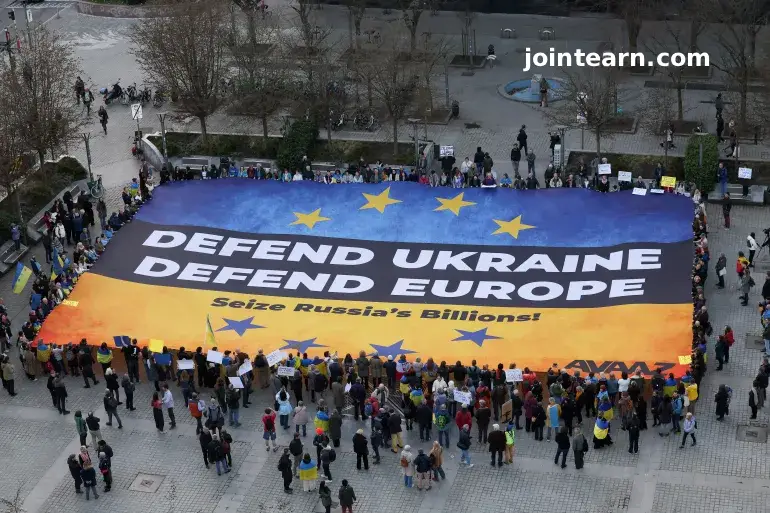
The European Union (EU) has put forward a groundbreaking proposal to tap into frozen Russian assets and international borrowing to fund a massive $105 billion (90 billion euros) financial package in support of Ukraine’s war effort against Russia. The proposal, announced by the European Commission on Wednesday, 4 December 2025, aims to secure Ukraine’s financial stability for 2026 and 2027 while bolstering Europe’s strategic security interests.
However, the plan has encountered immediate resistance from Belgium, a key EU member, which has raised unresolved legal and financial concerns about using Russia’s frozen state assets to back Kyiv.
Two Financial Options Proposed by the EU
The European Commission outlined two primary options to cover Ukraine’s financing needs:
- EU Loan from Private Markets: This option involves borrowing funds directly from the international financial markets to support Ukraine, a more conventional and legally secure approach.
- “Reparations Loan” Using Frozen Russian Assets: This preferred alternative would use frozen Russian state assets within the EU as collateral for loans to Ukraine. The Commission clarified that the scheme does not amount to outright confiscation; Ukraine would only repay if Russia compensates for war damages.
Commission President Ursula von der Leyen emphasized that the EU’s initiative reflects a dual purpose: safeguarding Ukraine’s sovereignty and functioning as a strategic investment in European security. “We are proposing to cover two-thirds of Ukraine’s financing needs for the next two years. That’s 90 billion euros. The remainder would be covered by international partners,” von der Leyen said.
She added that the proposal aims to increase the cost of Russia’s war of aggression, sending a signal that could incentivize Moscow to engage in meaningful peace negotiations.
Legal and Political Hurdles
Despite assurances from von der Leyen that the plan addresses Belgium’s concerns, the country remains cautious. Belgium’s central financial institution, Euroclear, holds a significant portion of the frozen Russian assets, totaling approximately 140 billion euros ($163 billion). Belgian officials have warned that using these funds could provoke future legal action from Russia, potentially jeopardizing EU member states.
Belgian Foreign Minister Maxime Prevot reiterated that the current legal texts “do not address our concerns in a satisfactory manner.” He emphasized that the reparations loan is the riskiest option and highlighted the preference for the EU to borrow the necessary amounts on international markets instead.
From a broader EU perspective, approval of the frozen assets plan requires a qualified majority—15 out of 27 member states voting in favor. Conversely, the alternative international borrowing route demands unanimity, which could be blocked by Russia-friendly governments such as Hungary.
International Reactions
Russia has strongly opposed the proposal, labeling it as theft and threatening decades of legal challenges. Andrei Kostin, head of Russia’s second-largest bank VTB, warned of up to 50 years of litigation if the EU proceeds with the scheme.
Meanwhile, the United States has expressed cautious support. Von der Leyen noted that US Treasury Secretary Scott Bessent had “positively received” the idea of the reparations loan, even amid legal complexities linked to previous US proposals for a joint investment plan involving Russian assets.
Broader EU Energy and Strategic Moves
The Commission’s announcement comes alongside another historic EU decision: phasing out Russian gas imports by 2027. Under the agreement, imports of Russian liquefied natural gas (LNG) will end by the close of 2026, with pipeline gas ceasing in November 2027.
Von der Leyen hailed this move as a step toward Europe’s full energy independence from Russia, highlighting that ending reliance on Moscow will protect European energy security, stabilize markets, and cut off funding for Russia’s military operations.
While most EU nations back the energy transition, Hungary and Slovakia are expected to challenge the measure due to continued reliance on Russian energy and fears of increased costs for alternative sources.
Conclusion
The EU’s dual proposal to use frozen Russian assets or international loans represents a bold, unprecedented approach to funding Ukraine’s defense and post-war reconstruction. While it demonstrates Europe’s commitment to Ukrainian sovereignty and regional stability, legal, financial, and political challenges remain, particularly from Belgium and Russia.
The upcoming EU leaders’ summit on 18 December 2025 will be critical in determining whether the plan moves forward, shaping the EU’s role in the ongoing Russia-Ukraine conflict and broader European security strategy.


Leave a Reply