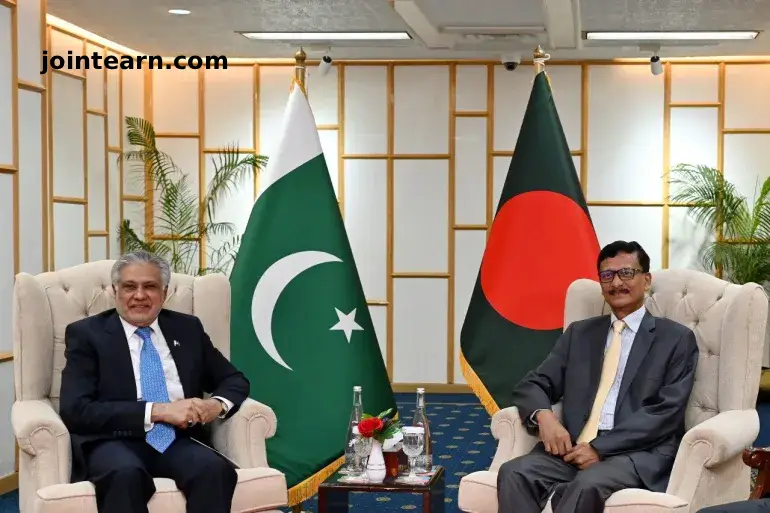
Pakistan has proposed the creation of a new South Asian regional bloc, potentially excluding India, as part of a growing trilateral cooperation with Bangladesh and China. The initiative, outlined by Pakistan Deputy Prime Minister and Foreign Minister Ishaq Dar, aims to enhance regional collaboration on economic growth, connectivity, and stability. However, analysts question whether a South Asian forum without India can gain traction among neighboring countries.
Pakistan’s Regional Proposal
Speaking at the Islamabad Conclave, Ishaq Dar highlighted the potential of expanding the existing trilateral cooperation between Pakistan, Bangladesh, and China. He described the initiative as an effort to “foster mutual collaboration” on shared interests, with the possibility of including additional countries and regions over time.
“There could be groups with variable geometry on issues from economy to technology to connectivity,” Dar said, emphasizing that regional development should not be held hostage to any single country’s rigidity — a veiled reference to India.
The plan reflects Pakistan’s long-standing frustration with stalled India-Pakistan dialogue, which has remained largely inactive for over a decade. Dar’s vision promotes a South Asia where cooperation replaces divisions, disputes are resolved peacefully, and economic growth occurs in synergy with regional priorities.
Background: SAARC and Its Challenges
The South Asian Association for Regional Cooperation (SAARC), founded in 1985, includes India, Pakistan, Bangladesh, Sri Lanka, Nepal, Bhutan, Maldives, and Afghanistan. SAARC’s objectives focus on economic growth, cultural development, and improving quality of life in South Asia.
However, persistent India-Pakistan tensions have left the organization largely ineffective. The 19th SAARC summit, planned in Islamabad in 2016, was indefinitely postponed after India withdrew in response to security concerns. The last summit took place in 2014 in Kathmandu, Nepal.
Analysts note that without cooperation from the two largest members — India and Pakistan — SAARC cannot operate effectively. This paralysis has prompted countries to explore alternative regional arrangements.
Regional Trade and Connectivity Challenges
South Asia is home to over two billion people, making it the world’s most densely populated region. Yet intra-regional trade remains minimal, accounting for only about 5% of total commerce — approximately $23 billion, according to the World Bank. In contrast, Southeast Asia’s ASEAN bloc trades 25% of its international commerce.
Trade between India and Pakistan is particularly limited. Official figures show bilateral trade falling from $2.41 billion in 2017–2018 to $1.2 billion by 2024. Informal trade, routed through third countries, is estimated at $10 billion.
Attempts to improve connectivity, such as a 2014 Motor Vehicles Agreement and regional railway pacts, were blocked due to India-Pakistan tensions. The lack of infrastructure and cooperative frameworks remains a key obstacle to South Asian economic integration.
Bangladesh and China in Pakistan’s Vision
The trilateral cooperation between Pakistan, Bangladesh, and China began in June 2025, focusing on regional stability, economic development, and improving citizens’ lives. While the countries claim that the initiative is not directed at any “third party,” it naturally reflects Pakistan’s intent to create alternatives to SAARC, which has been paralyzed due to India-Pakistan rivalries.
Bangladesh’s interim government, following the ouster of former Prime Minister Sheikh Hasina, has seen its ties with India weaken, creating space for renewed engagement with Pakistan. China’s involvement provides financial and strategic support, signaling Islamabad’s ambition to assert influence in the region.
Expert Analysis: Will Pakistan’s Proposal Work?
Experts remain cautious about the proposal’s immediate impact. Rabia Akhtar, director at the Centre for Security, Strategy and Policy Research (CSSPR), calls the initiative “more aspirational than operational,” noting that countries may be hesitant to join if it risks political backlash from India.
Potential participants like Sri Lanka, Nepal, Bhutan, and the Maldives could explore limited engagement on connectivity, climate adaptation, or economic resilience projects. However, broader membership uptake is expected to remain restrained.
Professor Shahab Enam Khan of the Bangladesh Center for Indo-Pacific Affairs stresses that South Asia’s persistent failure at regionalism underscores the need for ambitious initiatives. Praveen Donthi of the International Crisis Group notes that the demise of SAARC has created a vacuum for alternative forums, particularly when bilateral and trilateral arrangements offer clearer incentives and outcomes.
Strategic Implications
Pakistan’s proposal could:
- Diversify regional cooperation mechanisms
- Strengthen Islamabad’s diplomatic positioning vis-à-vis China and the United States
- Challenge India’s regional influence
However, the initiative may also:
- Intensify India-Bangladesh tensions
- Complicate South Asia’s multilateral frameworks
- Face limited participation due to geopolitical sensitivities
Analysts generally agree that Pakistan’s approach is strategically coherent, but its success will hinge on countries prioritizing functional cooperation over political rivalry.
Conclusion
Pakistan’s push for a new South Asian bloc reflects frustration with stalled SAARC mechanisms and the ongoing India-Pakistan divide. While the initiative could foster targeted collaboration on trade, connectivity, and regional resilience, political and strategic constraints suggest that formal adoption will likely be cautious and limited. Nevertheless, the proposal highlights Islamabad’s ambition to reassert itself as a key regional actor in South Asian diplomacy.


Leave a Reply