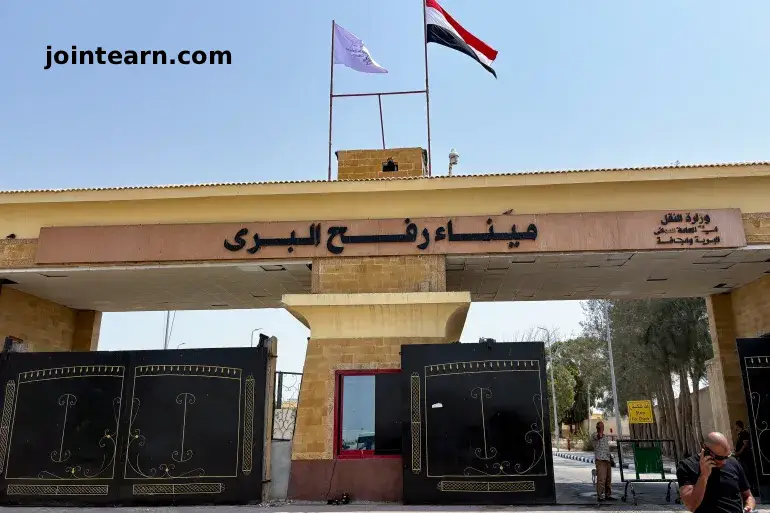
Foreign ministers from Egypt, Indonesia, Jordan, Pakistan, Qatar, Saudi Arabia, Turkiye, and the United Arab Emirates have strongly condemned Israel’s proposed one-way opening of the Rafah border crossing between Egypt and the Gaza Strip. The plan, which would allow Palestinians to leave Gaza but block their return, has been criticized as a potential tool for mass displacement and a violation of the ongoing ceasefire.
International Concerns Over Exit-Only Crossing
Israel announced via the Coordination of Government Activities in the Territories (COGAT) that the Rafah crossing would open exclusively for Palestinians to exit Gaza, pending Israeli “security approval” in coordination with Egypt.
Arab and Muslim nations, alongside mediators Egypt and Qatar, expressed “deep concern” over the announcement, stressing it violates the first phase of the US-led peace plan. The ministers rejected “any attempts to displace the Palestinian people from their land” and called for full compliance with President Donald Trump’s 20-point plan, which stipulates that Rafah should allow bidirectional movement for both people and humanitarian aid.
Humanitarian Crisis Persists in Gaza
Since the ceasefire began on October 10, 2025, Israel has delayed reopening Rafah for the flow of food, medicine, and medical evacuation due to coordination issues and the retrieval of captive bodies. Only one body remains unrecovered, hindered by widespread destruction across the enclave.
The foreign ministers called for conditions that would allow the Palestinian Authority to resume governance in Gaza, highlighting the need for sustainable peace and the eventual establishment of an independent Palestinian state on the 1967 borders, including Gaza, the West Bank, and East Jerusalem as its capital.
Diplomatic Dialogue at the Doha Forum
The situation in Gaza was a key topic at the Doha Forum, an annual diplomatic conference in Qatar. Qatari Prime Minister Sheikh Mohammed bin Abdulrahman Al Thani emphasized that the ceasefire remains fragile, noting, “We cannot consider it yet a ceasefire. A ceasefire cannot be completed unless there is a full withdrawal of Israeli forces and stability is restored in Gaza.”
Turkish Foreign Minister Hakan Fidan stressed that negotiations over the Gaza International Stabilisation Force (ISF) are ongoing, including its mandate and rules of engagement. Arab nations interested in providing troops have demanded stronger protections for Palestinian self-determination before endorsing the international force.
Attacks Continue Despite Ceasefire
Despite diplomatic efforts, Israel continued its military operations in Gaza, with at least three people killed in a drone strike in Beit Lahiya on Saturday. Al Jazeera reports indicate that the victims were civilians inspecting their farmland, who allegedly crossed into restricted zones without realizing the danger.
In addition, Israel carried out 20 airstrikes across Gaza, targeting areas including eastern Gaza City, Maghazi refugee camp, Rafah, and zones east of Khan Younis. Artillery, tank fire, and naval attacks on Palestinian fishing boats were also reported. Currently, Israel controls more than 50% of Gaza’s territory, including southern, eastern, and large parts of northern Gaza.
Since October 2023, Israel’s military operations in Gaza have resulted in over 70,125 deaths and 171,015 injuries, deepening the humanitarian crisis and further alarming the international community.
Conclusion
The proposed exit-only plan for Rafah crossing has drawn strong condemnation from Arab and Muslim nations, highlighting concerns over forced displacement, blocked humanitarian aid, and violations of the ceasefire. As the conflict continues, international mediators urge Israel to comply fully with the US-led peace plan and facilitate safe, two-way access to Gaza for both civilians and aid.


Leave a Reply