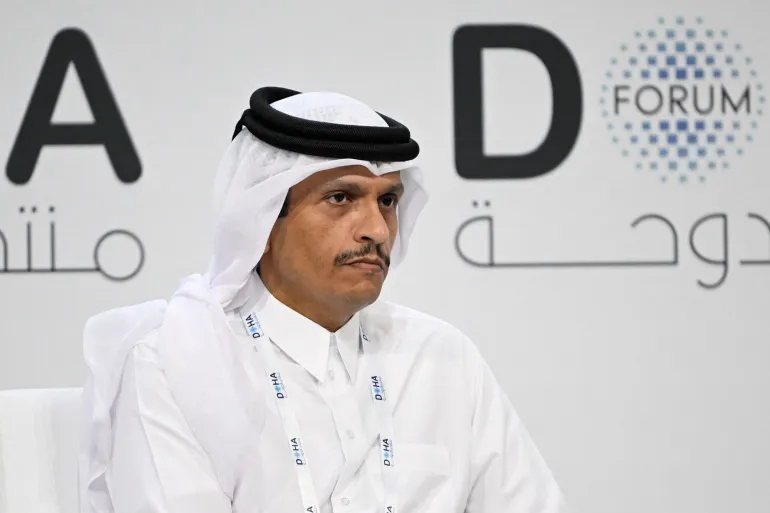
Speaking at the Doha Forum 2025, Prime Minister Sheikh Mohammed bin Abdulrahman bin Jassim Al Thani emphasizes that meaningful conflict resolution requires engaging non-state actors, including Hamas and the Taliban.
Doha, Qatar — December 7, 2025 — Qatar’s Prime Minister and Minister of Foreign Affairs, Sheikh Mohammed bin Abdulrahman bin Jassim Al Thani, has called for an inclusive, engagement-driven approach to resolving conflicts across the Middle East, stressing that peace is impossible without communication channels that include non-state actors.
During a high-profile conversation with U.S. journalist Tucker Carlson at the annual Doha Forum, Sheikh Mohammed highlighted Qatar’s longstanding role as a mediator and diplomatic bridge between conflicting parties. He argued that real negotiations cannot happen if influential non-state groups—such as Hamas in Palestine—are left out of the peace process.
“You cannot resolve or reach a solution if you have no one speaking to non-state actors,” he stated, underscoring Qatar’s belief that dialogue is essential for de-escalation and humanitarian relief.
Qatar’s Relationship With Hamas: A Decade of Mediation Efforts
The prime minister noted that Qatar’s engagement with Hamas began more than a decade ago and was initiated at the request of the United States to improve communication and help facilitate ceasefires.
He clarified that the Hamas office in Doha, opened in 2012, was established strictly as a communication channel to help negotiate truces and deliver humanitarian support to Gaza.
Addressing claims that aid to Gaza indirectly funds Hamas, Sheikh Mohammed strongly rejected the accusations:
“All our aid, financing, and support went directly to the people of Gaza. The process was transparent, the United States monitored it, and Israel facilitated it.”
He emphasized that Qatar’s mediation has led to ceasefires, humanitarian relief, and hostage releases, underscoring its effectiveness.
Qatar’s Mediation Role With the Taliban
In addition to hosting the Hamas office, Qatar has also been home to the Taliban’s political office since 2013, again at the request of Washington. The aim was to create a neutral location for peace talks during the conflict between the Taliban, the U.S., and the former Afghan government.
This, Sheikh Mohammed noted, reflects Qatar’s consistent stance: mediation and dialogue, not isolation, drive progress.
Sheikh Mohammed Condemns Israeli Attack on Qatar as “Unethical”
The prime minister addressed Israel’s previously reported attack on Qatar in September, describing it as an unprecedented and “unethical move.”
“The mediator being bombed by one of the parties — this has been unprecedented,” he said.
He added that former U.S. President Donald Trump was “frustrated and disappointed” when informed of the incident, emphasizing that Washington understood Qatar’s critical role in negotiations and humanitarian efforts.
Qatar’s Stance on Rebuilding Gaza
Commenting on the challenge of reconstructing Gaza after two years of devastating conflict, Sheikh Mohammed reaffirmed Qatar’s commitment to supporting Palestinian civilians, but drew a firm line regarding responsibility for destruction.
“We will continue supporting the Palestinian people. But Qatar will not write the cheque for what others destroyed.”
He highlighted what he called a global “double standard,” noting that the international community expects Russia to pay for rebuilding Ukraine, yet rejects the notion that Israel should take responsibility for the massive destruction in Gaza.
According to UN estimates, more than 92% of residential buildings in Gaza have been damaged or destroyed, leaving behind tens of millions of tonnes of rubble that could take decades to clear.
Firm Opposition to Forced Displacement of Palestinians
Sheikh Mohammed also condemned any proposals for the forced relocation of Gaza’s population:
“No one has the right to deport them or force them to go somewhere else. The people of Gaza want to remain in their homeland.”
He stressed that Palestinians should retain full authority over their future and identity, saying it was painful to hear discussions treating them as if they were “different people.”
Conclusion
At a moment of intense tension and regional instability, Qatar reaffirmed its commitment to inclusive diplomacy, humanitarian assistance, and balanced mediation. Sheikh Mohammed’s message at the Doha Forum was clear: sustainable peace will only be possible when all parties—including non-state actors—are part of the conversation, and when global powers apply principles consistently rather than selectively.


Leave a Reply