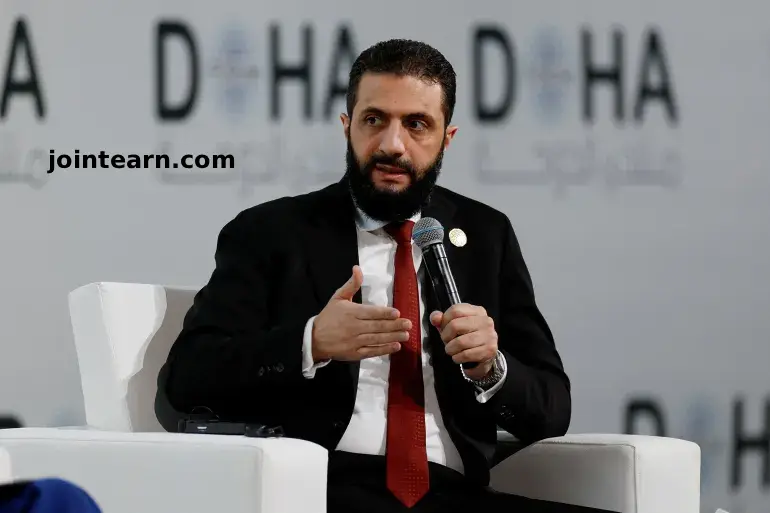
Doha, Qatar – In a strong statement at the 23rd Doha Forum, Syrian President Ahmed al-Sharaa vowed to prioritize peace, national unity, and democratic transition, while condemning Israel for escalating military aggression in the region. Speaking during an exclusive interview with CNN’s Christiane Amanpour, al-Sharaa accused Israel of exploiting security concerns as a pretext for attacks, and reiterated his commitment to holding elections within the next five years.
Al-Sharaa Criticizes Israeli Aggression
President al-Sharaa highlighted Israel’s frequent military actions across Syrian territory, arguing that these operations often serve to divert international attention from the “horrifying massacres” in Gaza.
“Israel has become a country that is in a fight against ghosts. They justify everything, using their security concerns, and they take October 7 and extrapolate it to everything that is happening around them,” al-Sharaa said.
Since the fall of Bashar al-Assad’s regime in December 2024, Israel has reportedly conducted frequent airstrikes, killed hundreds of civilians, and advanced deeper into Syrian territory, setting up checkpoints and detaining Syrian citizens. Last month, Israeli operations in the Damascus countryside town of Beit Jinn killed at least 13 people.
Commitment to Peace and Stability
Al-Sharaa emphasized that his administration has consistently worked to de-escalate tensions with Israel.
“We’ve said very frankly that Syria will be a country of stability, and we are not concerned with being a country that exports conflict, including to Israel,” he stated.
He stressed that Syria’s sovereignty and territorial integrity must be respected, calling on Israel to withdraw to pre-2024 positions and adhere to the 1974 Disengagement Accord, which created a UN-monitored buffer zone in the Israeli-occupied Golan Heights.
“This agreement has held for over 50 years. Replacing it with new arrangements risks pushing the region into a serious and dangerous place,” he warned.
Syrian Perspective on Buffer Zones
Responding to Israeli Prime Minister Benjamin Netanyahu’s proposal for a demilitarized buffer zone, al-Sharaa said:
“It is Syria that is being attacked by Israel and not the opposite. Therefore, who has more right to claim a buffer zone and a pullout?”
He underlined Syria’s position that protecting sovereignty and borders is paramount, and emphasized adherence to international agreements.
Building Unity in Post-Al-Assad Syria
Al-Sharaa spoke at length about efforts to promote national unity and social cohesion. He acknowledged that Syria faces ongoing challenges but asserted that the country is “living through its best days” as citizens work to understand each other beyond divisions inherited from the former regime.
“We pardoned numerous people and factions to build a sustainable, safe, and secure future for the Syrian people,” he explained.
Rejecting the narrative that the uprising against al-Assad was purely a “Sunni revolution,” al-Sharaa highlighted the multi-sectarian participation, including Alawites who suffered under the previous regime.
Addressing Human Rights and Women’s Role
Al-Sharaa affirmed that women in Syria are empowered under his leadership, with guaranteed rights and full participation in government and parliament.
“I believe you should not fear for Syrian women, fear for Syrian men,” he remarked with a touch of humor.
He also stressed that Syria remains a state of law, holding perpetrators accountable for violence, including sectarian clashes earlier in the year, which killed hundreds of civilians.
Commitment to Elections Within Five Years
Al-Sharaa clarified Syria’s roadmap toward democracy, stating that elections will occur within five years of the temporary Constitutional Declaration signed in March 2025.
“The principle of people choosing their leaders is fundamental… rulers must gain the satisfaction of the majority to govern properly,” he said.
He emphasized strengthening institutions rather than consolidating individual power as the foundation for Syria’s political future.
Outlook for Syria and the Region
President al-Sharaa’s statements highlight Syria’s focus on national reconciliation, stability, and institutional reform, even amid ongoing regional tensions and military threats from Israel. His vision includes continued diplomacy, internal peacebuilding, and preparation for a democratic electoral process.


Leave a Reply