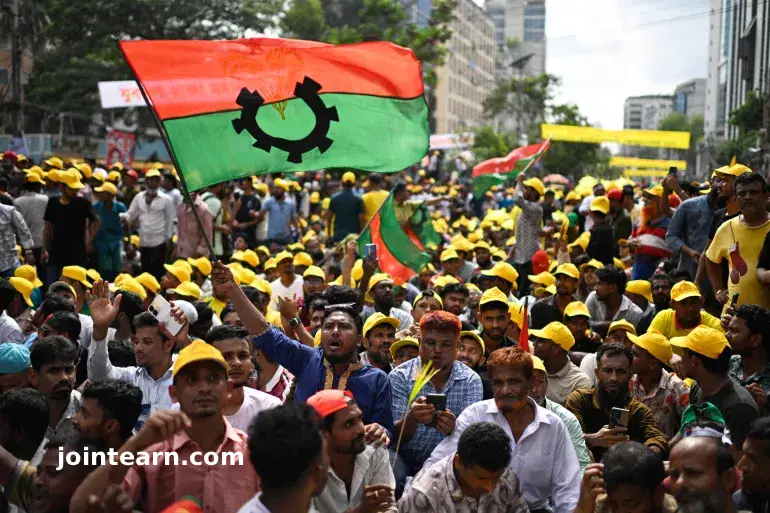
Bangladesh’s political landscape is undergoing a dramatic transformation ahead of the upcoming national elections, as the Bangladesh Nationalist Party (BNP) formally distances itself from its long-standing ally, Jamaat-e-Islami. The BNP, historically the country’s largest opposition party, is now seeking to reinvent itself as a liberal, democratic alternative in the post-Hasina era.
A Major Realignment After the Fall of Sheikh Hasina
The shift comes more than a year after the ousting of former Prime Minister Sheikh Hasina in 2024, following massive nationwide protests against her 15-year rule. Her tenure was marked by widespread allegations of human rights abuses — including enforced disappearances, extrajudicial killings, mass arrests of critics, and violent suppression of dissent. The crackdown surrounding the 2024 protests, in particular, deepened public frustration and helped spark a youth-led uprising.
With Hasina in exile and her Awami League party now banned, a vacuum has opened in the once-dominant secular-liberal political space. The BNP is moving rapidly to fill it — but only after severing ties with Jamaat-e-Islami, a party long criticised for its Islamist ideology and historical opposition to Bangladesh’s independence.
BNP and Jamaat: A Partnership Built on Opposition, Not Ideology
Although the BNP and Jamaat had repeatedly governed as coalition partners — most notably from 2001 to 2006 — the alliance was always uneasy. Their common bond was political rivalry with the Awami League rather than shared ideological ground.
- BNP aligns itself with Bangladeshi nationalism and pluralistic politics.
- Jamaat-e-Islami grounds its agenda in religious identity and Islamist ideology.
These differences sharpened after Hasina’s downfall, particularly as the BNP sought to appeal to a broader, more moderate electorate wary of religious extremism.
Breaking Point: Liberation War Narratives Reemerge
The decisive rupture came when BNP Acting Chairman Tarique Rahman invoked the painful legacy of the 1971 Liberation War, alluding to Jamaat’s opposition to Bangladesh’s independence. Although he did not explicitly name the party, the message was unmistakable. His remarks signaled a strategic repositioning: the BNP was reclaiming the moral and historical language long monopolised by the Awami League.
BNP Secretary-General Mirza Fakhrul Islam Alamgir reinforced this shift, warning against political manipulation “in the name of religion” and calling for unity rooted in democratic values and the spirit of 1971.
Why the BNP Is Rebranding Now
The BNP’s new ideological outlook reflects political opportunities and public expectations in a rapidly changing Bangladesh.
1. A Vacant Secular-Liberal Space
With the Awami League banned and its legacy tarnished by authoritarianism, the traditional secular-nationalist platform is open. The BNP aims to occupy this ideological zone — one historically associated with democracy, civil rights, and pluralism.
2. A Rising Youth Electorate
The 2024 uprising reactivated political engagement among youth and middle-class citizens who demand transparency, rule of law, and limits on executive power. The BNP’s association with Jamaat threatened to alienate these groups.
3. Changing Voter Sentiments
Public frustration with both extremes — the Awami League’s authoritarian excesses and Jamaat’s religious conservatism — has created an appetite for centrist, democratic leadership.
4. Internal Strategic Disputes with Jamaat
Months of disagreements sealed the separation:
- Jamaat pushed for sweeping constitutional restructuring before elections.
- BNP demanded early elections and limited reforms.
These rifts became ideological as Bangladesh moved further from the Hasina era.
Potential Risks for the BNP
While the rebranding may be strategically sound, the BNP faces several challenges:
- Public skepticism: Voters may question whether the change is sincere or merely tactical.
- Internal party resistance: Conservative factions within the BNP may oppose a liberal, pluralistic shift.
- Competition from emerging groups: Youth-backed parties like the National Citizen Party (NCP) and civil society platforms are also targeting centrist voters.
- Fragmentation of the pro-democracy vote: Without alliances, liberal votes may scatter across multiple groups.
A Possible Turning Point in Bangladeshi Politics
If successful, the BNP’s ideological evolution could mark the most significant political realignment since the democratic transitions of the 1990s. The party is no longer presenting itself simply as a centre-right challenger to the Awami League. Instead, it is attempting to become:
- a broad democratic coalition,
- a home for urban liberals,
- a voice for minorities,
- and a platform for youth movements seeking systemic reform.
By breaking from Jamaat, condemning religious politics, and embracing a pluralistic vision, the BNP aims to redefine itself for a new Bangladesh — one freed from decades of binary rivalry between Awami League dominance and BNP-Jamaat alliances.
Whether the public accepts the transformation remains to be seen, but the shift itself is undeniable. The BNP of 2025 is speaking a new political language — one centered on democratic reform, anti-sectarianism, and national unity.
And that change could reshape Bangladesh’s political future.


Leave a Reply