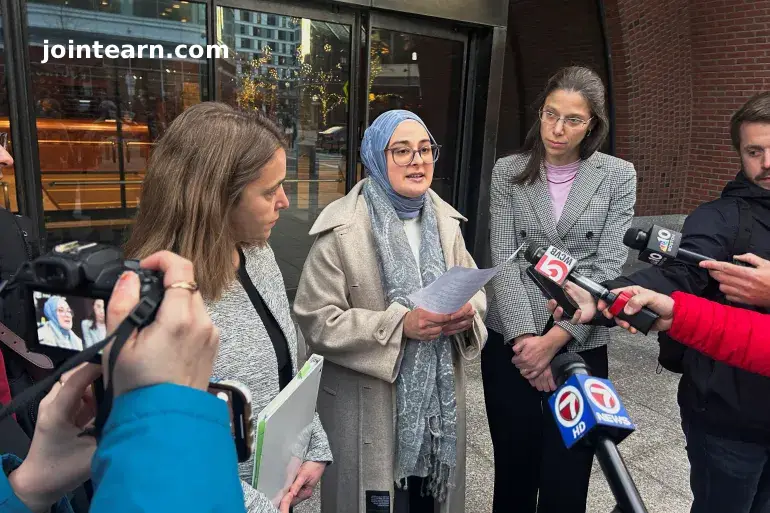
A United States federal court has ordered that the student status of Rumeysa Ozturk, a Turkish doctoral student at Tufts University, be fully restored after it was revoked by the Trump administration amid a crackdown on pro-Palestinian student activism.
The ruling, delivered by US District Judge Denise Casper, directs the administration to reinstate Ozturk’s name and academic standing in the SEVIS database, the federal system used to track international students under the supervision of US Immigration and Customs Enforcement (ICE). The decision marks a major development in a case that has drawn national attention to free speech, student rights, and immigration enforcement.
Months in Detention for Speaking Against the Gaza War
Ozturk, a Fulbright scholar pursuing a PhD focused on childhood development and media, was detained on March 25, 2024, after the government revoked her student visa. The revocation came shortly after she co-authored an opinion piece urging Tufts University to acknowledge the suffering in Gaza, divest from companies connected to Israel, and uphold student-led resolutions on human rights.
Her lawyers argue that her removal from SEVIS and subsequent detention were politically motivated, based solely on her peaceful advocacy and criticism of Israel’s military actions in Gaza.
Ozturk spent 45 days in an ICE-operated for-profit detention center in Louisiana, a period she describes as devastating both personally and academically. She says her arrest, visa cancellation, and incarceration were fundamentally unlawful and designed to intimidate students who spoke out about the war.
Court Ruling: SEVIS Record Must Be Reinstated
Judge Casper’s interim ruling mandates that Ozturk’s student status be returned immediately, allowing her to:
- Resume on-campus and research-related work
- Continue her doctoral studies without immigration-related barriers
- Reenter academic programs and opportunities previously blocked by the visa revocation
Ozturk celebrated the ruling, stating that the decision validates her claim that her student record was “never lawfully cancelled” and that she was targeted for advocating “equal dignity and humanity for all.”
She further emphasized the connection she now feels to students facing educational injustice globally, particularly in Gaza, where academic institutions have been destroyed and scholars have lost their lives.
Crackdown on Pro-Palestinian Students
Ozturk’s case is one of several involving students who faced severe immigration consequences during a broad Trump-era effort to punish campus activism critical of Israel. Universities across the US also intensified crackdowns on student protests—especially the high-profile encampments at Columbia University and other major campuses.
The administration justified Ozturk’s visa revocation by accusing her of supporting Hamas—an allegation her legal team describes as baseless political retaliation.
The ACLU of Massachusetts, which represents Ozturk, welcomed the ruling, calling it a much-needed step toward justice after months of “unlawful and unfair treatment.”
Ongoing Detentions and Legal Battles
While Ozturk is now set to regain her academic status, multiple students remain caught in legal and immigration turmoil.
Some, like former Columbia University student Mahmoud Khalil, continue to navigate long-term immigration issues tied to their political advocacy.
Another activist, Leqaa Kordia, a 32-year-old Palestinian woman involved in the Columbia protests, remains in immigration detention months after her March 13 arrest, according to Amnesty International. Her case has heightened concerns about political retaliation against pro-Palestinian voices in academic spaces.


Leave a Reply