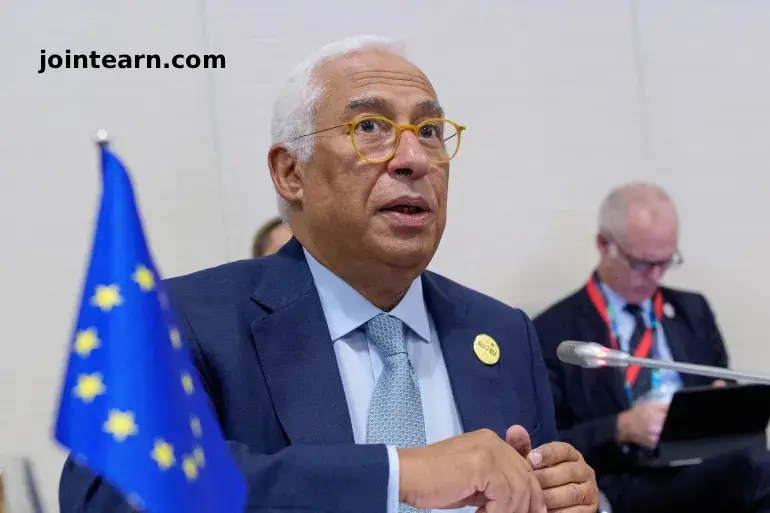
European Union leaders have strongly rebuked the United States’ latest national security strategy, which portrays Europe as a declining power and questions its future reliability as a strategic ally. The criticism underscores growing tensions in transatlantic relations and concerns about how the US may recalibrate its role in European security.
EU Leaders Respond to US Criticism
European Council President Antonio Costa and the German government have publicly criticized the US strategy, which was released on Friday, December 5, 2025. The 33-page document describes Europe as facing the “prospect of civilisational erasure” due to migration, accuses it of censoring free speech, and implies that Washington may reconsider the longstanding security umbrella it provides over Europe.
Speaking at the Jacques Delors Institute in Paris, Costa emphasized that transatlantic relations have shifted significantly since the post-World War II era.
“We need to focus on building a Europe that must understand that the relationships between allies and the post-World War II alliances have changed,” Costa said.
Costa firmly rejected claims that Europe is censoring free speech, asserting that European citizens alone decide their political futures. He warned against US interference:
“The United States cannot replace European citizens in deciding which are the right parties and the wrong parties… There is no freedom of speech without freedom of information.”
Germany Labels Criticism ‘Ideology, Not Strategy’
In Berlin, Sebastian Hille, deputy government spokesperson, dismissed parts of the US strategy as ideological rather than grounded in practical security analysis. He reaffirmed that political freedoms, including freedom of expression, are core EU values.
Hille also criticized the US document for failing to recognize Russia as a threat, despite its February 2022 invasion of Ukraine. Germany reiterated that NATO’s joint assessment identifies Russia as a clear danger to transatlantic security.
Divisions Over Ukraine and Russia
The US strategy emphasizes improving ties with Moscow and suggests that Washington seeks a settlement in Ukraine primarily to “reestablish strategic stability with Russia.” It also criticizes European leaders for having “unrealistic expectations” regarding the resolution of the war.
An initial US proposal would have allowed Russia to retain large parts of eastern Ukraine, sparking European concerns that Washington was pressuring Kyiv to accept unfavorable terms. The plan has since been revised with input from Ukraine and its European allies, though full details remain undisclosed.
Moscow has welcomed the US strategy, prompting Costa to note:
“We can understand why Moscow shares [its] vision… The objective in this strategy is not a fair and durable peace. It’s only about ending hostilities and stabilizing relations with Russia.”
Costa stressed that true stability with Russia cannot exist while it remains a threat to European security, highlighting the EU’s commitment to maintaining both regional peace and sovereignty in decision-making.
Implications for Transatlantic Relations
The US strategy has exposed a shift in the transatlantic alliance, prompting the EU to reconsider its strategic autonomy and defense policies. European leaders are increasingly calling for policies that strengthen internal cohesion, protect citizens’ rights, and maintain a balanced approach to Russia.
This development signals a period of heightened diplomatic negotiations, where Europe seeks to safeguard its interests while navigating a more assertive US foreign policy.


Leave a Reply