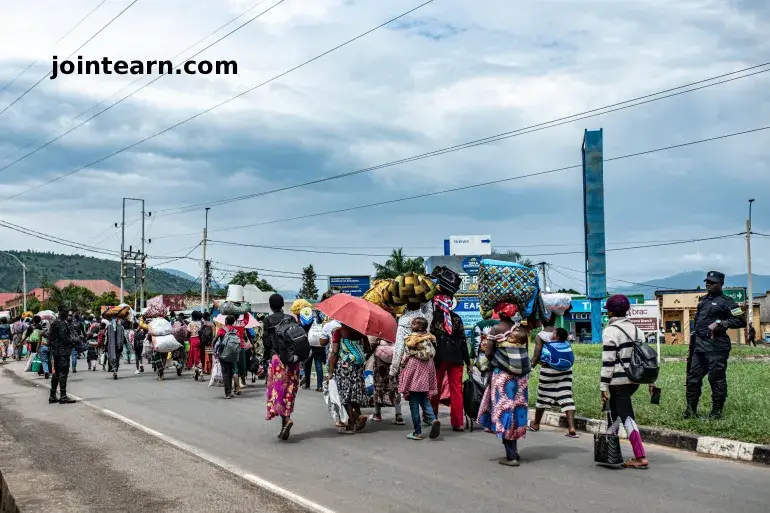
The humanitarian crisis in the eastern Democratic Republic of the Congo (DRC) is worsening rapidly, with the United Nations reporting that nearly 200,000 civilians have fled their homes in just a matter of days. The mass displacement comes amid a renewed and aggressive offensive by the Rwanda-backed M23 rebel group, which has advanced toward the key city of Uvira in South Kivu province, triggering widespread panic and further destabilising an already volatile region.
M23 Pushes Into Uvira Despite Recent Peace Agreement
Local authorities and international agencies confirmed on Wednesday that M23 rebels had advanced into areas in and around Uvira, a vital administrative and strategic stronghold that had served as a base for government forces since their withdrawal from Bukavu in January.
According to UN officials, at least 74 people have been killed in the latest wave of fighting, though the number is expected to rise as clashes continue.
The advance comes just days after a highly publicised United States-mediated peace accord was signed in Washington between the leaders of Rwanda and the DRC. The agreement aimed to halt external support for armed groups and establish a framework for de-escalation, but the new offensive raises serious doubts about the deal’s viability.
Widespread Chaos as Civilians and Soldiers Flee
Sources on the ground—including residents and security officials—told international media that gunfire was heard throughout the city on Wednesday. With the situation deteriorating quickly, Congolese soldiers began retreating, heading south and east toward the border with Burundi, joining thousands of civilians attempting to escape the violence.
Al Jazeera’s reporter in Goma, Alain Uaykani, described the developments as a major blow to government forces.
“There is no DRC army in sight. Most soldiers crossed into Tanganyika province by boat and are still fleeing,” he said, adding that government facilities including the governor’s office were looted during the retreat.
Uvira’s significance stems not only from its size but also from its border with Burundi, whose military has supported Congolese forces for the past two years. Its capture—or even partial loss—marks a significant shift in territorial control in South Kivu.
Local Leaders Sound the Alarm as Panic Spreads
Civil society representatives reported that local populations were overwhelmed by fear as rebels pushed southward.
Marafiki Masimango, a senior civil society figure in Uvira, said residents were “panicked and fleeing in every possible direction”.
Within the military ranks, morale also appeared fractured. A senior Congolese officer acknowledged that troops were abandoning their positions, despite calls from opposition groups urging them to hold ground.
Corneille Nangaa, head of the Alliance Fleuve Congo (AFC)—a broader rebel coalition that includes M23—called on government soldiers to remain in Uvira, promising support from rebel forces.
International Community Expresses ‘Profound Concern’
In Washington, the International Contact Group for the Great Lakes (ICG)—which includes the US, EU, and several regional governments—issued a warning late Tuesday, saying the renewed violence posed a serious risk to regional stability.
The ICG stressed that the offensive “has a destabilising potential for the entire Great Lakes region”, especially given the fragile state of ongoing negotiations.
Despite the escalation, M23 leader Bertrand Bisimwa reiterated support for Qatar-led peace talks in Doha, where a framework agreement was recently signed.
“There are no solutions outside the negotiating table,” he said, emphasising the group’s desire to pressure Kinshasa toward renewed dialogue.
Rwanda Rejects Accusations as Tensions Rise
Rwanda continues to deny any involvement in supporting the rebels, though Washington and the UN say evidence of Rwandan backing is extensive. Prior to this latest offensive, conflict-related violence had already displaced over 1.2 million people in the region.
DRC President Felix Tshisekedi accused Rwanda of violating commitments made during the US-hosted peace talks. Meanwhile, the Trump administration said it was monitoring the situation closely and insisted both countries would be judged on the “immediate implementation” of the agreement.
With fresh battles erupting only hours after the diplomatic ceremony, confidence in the peace process is rapidly eroding.


Leave a Reply