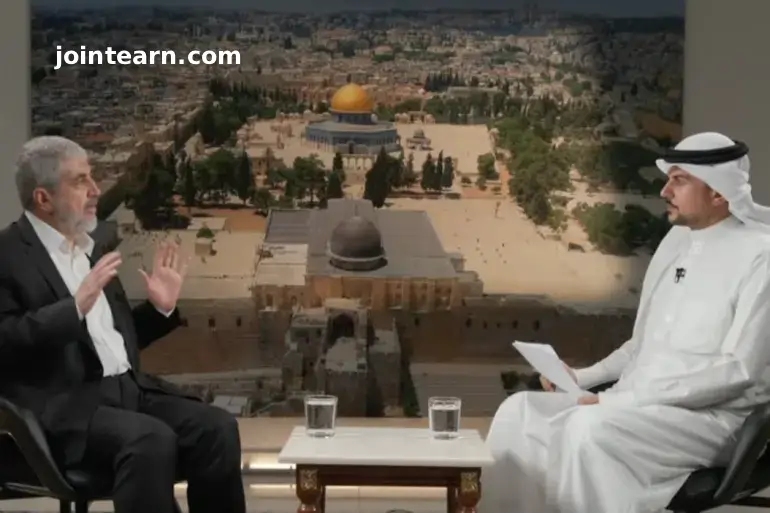
Senior Hamas leader Khaled Meshaal has signaled a willingness to curb any future attacks from Gaza toward Israel, but firmly rejected the possibility of disarming the Palestinian resistance group. Speaking to Al Jazeera Arabic’s Mawazin, Meshaal said that laying down arms would be equivalent to “removing the soul” of Hamas, underscoring how central the movement’s military capabilities are to its identity and political leverage.
His remarks come at a moment of growing concern that the fragile ceasefire between Israel and Hamas, brokered in October by the United States, may lose momentum as the first phase nears its end.
Ceasefire Under Strain as Hamas Accuses Israel of 700+ Violations
Hamas officials warned on Tuesday that the truce cannot progress unless Israel stops its repeated violations. Authorities in Gaza say the ceasefire has been breached at least 738 times since October 10, including airstrikes, raids, and restrictions on humanitarian aid.
Despite the breaches, the ceasefire has largely held, with both sides returning detainees and captives under the terms of the agreement. More than 377 Palestinians have been killed in Israeli attacks since the truce began, despite its intended purpose of halting violence.
At the Doha Forum last week, Qatar, Turkey, and Egypt all urged the United States and mediators to prevent the ceasefire from collapsing. Qatar’s Prime Minister described the situation as a “critical moment”, warning that any slowdown in diplomacy could trigger renewed escalation in Gaza.
Hamas Rejects Foreign Governance in Gaza
In the interview, Meshaal reiterated Hamas’s position that no non-Palestinian authority will be allowed to govern Gaza. This stance comes amid speculation in Washington that US President Donald Trump’s proposed “board of peace” could include international officials tasked with overseeing Gaza during the post-war transition.
Reports this week indicated that former UK Prime Minister Tony Blair had been excluded from the list of potential candidates. Blair’s legacy in the Middle East, particularly his role in the 2003 Iraq invasion and his controversial tenure as Quartet envoy, has made him unacceptable to many Arab governments and to Hamas itself.
Hamas spokesperson Husam Badran had previously dismissed Blair as an “unwelcome figure,” saying he brought “no good to the Palestinian cause” and citing his role in regional instability.
Aid Shortages Threaten Next Phase of the Ceasefire Agreement
A senior Hamas official said Israel has not fulfilled key commitments under the first phase of the deal. These include:
- Opening the Rafah crossing, which remains closed
- Allowing agreed-upon levels of humanitarian aid into Gaza
- Halting military operations during the truce period
Israeli Prime Minister Benjamin Netanyahu claimed the first phase was nearly complete and that he intended to mirror those “results” in the second phase. Netanyahu is expected to meet Trump in Washington later this month to negotiate next steps.
US officials told Al Jazeera that talks for phase two are progressing, but they emphasized the need for increased aid access to Gaza before any new commitments can begin.
Meshaal said Hamas told mediators that Gaza urgently needs large-scale reconstruction support to begin recovering from years of blockade, conflict, and economic collapse.
Disarmament Debate: Central Barrier to Lasting Peace
Disarmament remains the most contentious issue ahead of the second phase of the agreement. Israel insists that Hamas must disarm completely, while Meshaal said relinquishing weapons prematurely would undermine Palestinian sovereignty and resistance.
Hamas leaders have previously indicated they might consider handing over weapons to a fully independent Palestinian state, but not before.
Turkey’s Foreign Minister Hakan Fidan, speaking in Doha, said that Turkey could participate in an International Stabilisation Force (ISF) in Gaza that would eventually oversee disarmament. However, he stressed that such a step would not be part of the initial phase of the peace plan.
Israel, meanwhile, opposes any Turkish military presence in Gaza and maintains that disarming Hamas must be the top priority once phase two begins.
International Stabilisation Force (ISF) Discussions Pick Up Speed
Egyptian Foreign Minister Badr Abdelatty said the ISF must deploy to Gaza “as soon as possible” to ensure that ceasefire violations are documented independently. Abdelatty argued that monitors are necessary because Israel continues to violate the truce while claiming Hamas is at fault.
With nearly all Israeli captives now returned, and hundreds of Palestinian prisoners released—many showing signs of severe mistreatment—international pressure is mounting for both sides to preserve the ceasefire and move toward a long-term political resolution.


Leave a Reply