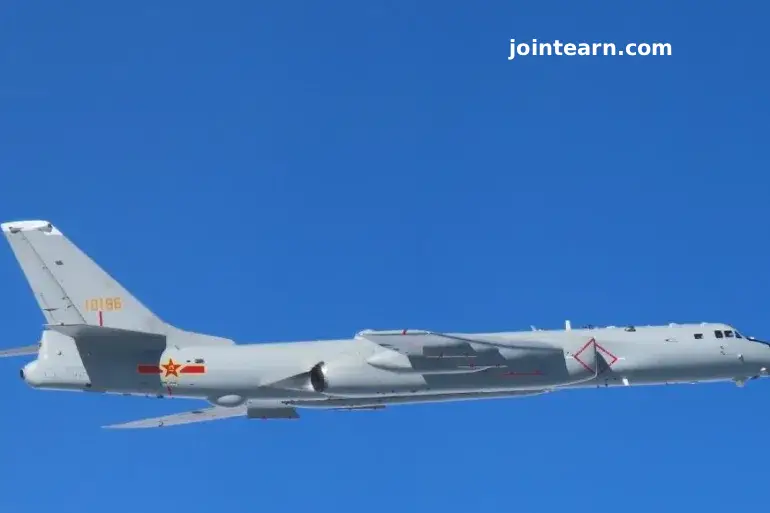
South Korea and Japan launched fighter jets on Tuesday after Russian and Chinese military aircraft conducted a joint air patrol near the Korean Peninsula and Japanese airspace, raising regional security concerns amid rising geopolitical tensions in East Asia.
According to the South Korean Joint Chiefs of Staff, seven Russian and two Chinese aircraft entered South Korea’s Air Defence Identification Zone (KADIZ) at approximately 10 a.m. local time (01:00 GMT). The aircraft included strategic bombers and fighter jets.
While KADIZ is not sovereign airspace, it is a zone where aircraft are expected to identify themselves. In response, South Korea deployed fighter jets “to take tactical measures in preparation for any contingencies.” The planes flew in and out of KADIZ for roughly one hour before departing.
Diplomatic and Military Responses
South Korea lodged a diplomatic protest with Chinese and Russian representatives, emphasizing that its military would continue to monitor and respond to any aircraft entering KADIZ in compliance with international law, said Lee Kwang-suk, director general of the International Policy Bureau at Seoul’s Ministry of Defence.
Meanwhile, Japan also deployed fighter jets to implement “strict air defense measures against potential airspace violations,” according to Japanese Defence Minister Shinjiro Koizumi.
Koizumi detailed that two Russian Tu-95 nuclear-capable bombers flew from the Sea of Japan to the Tsushima Strait, accompanied by two Chinese long-range missile-capable jets, eight other Chinese J-16 fighter jets, and a Russian A-50 surveillance aircraft. The formation conducted a joint flight “around Japan,” traveling between Okinawa’s main island and Miyako Island.
“The repeated joint flights of bombers by both countries signify an expansion and intensification of activities around our country, while clearly intending to demonstrate force against our nation, posing a serious concern for our national security,” Koizumi said.
Previous Incidents and Regional Tensions
The recent patrol follows several similar incidents in the past:
- Sunday: Koizumi accused Chinese fighter jets of directing fire-control radar at Japanese aircraft over international waters near Okinawa.
- Monday: Japan monitored the Chinese aircraft carrier Liaoning and its support vessels near Okinawa, confirming fighter jet operations from the carrier between Okinawa and Minami-Daitojima.
- November 2024: South Korea scrambled jets as Chinese and Russian military planes entered KADIZ.
- 2022: Japan deployed jets after Russia-China warplanes approached its airspace.
Since 2019, China and Russia have regularly flown near South Korean and Japanese airspace without prior notice, citing joint military exercises. These actions coincide with strengthened military ties between the two countries following Russia’s full-scale invasion of Ukraine and both nations’ alliances with North Korea, which is viewed as a regional threat by Seoul and Tokyo.
Official Statements from China and Russia
China’s Ministry of National Defence confirmed the joint exercises, calling them the 10th joint strategic air patrol with Russia, conducted according to “annual cooperation plans.” Moscow also acknowledged the operation, which lasted eight hours, noting that “foreign fighter jets followed the Russian and Chinese aircraft at certain stages of the route.”
The exercises, covering the East China Sea and western Pacific Ocean, are part of a pattern of military signaling and force projection by Moscow and Beijing in the region, causing concern among regional neighbors and international observers.


Leave a Reply