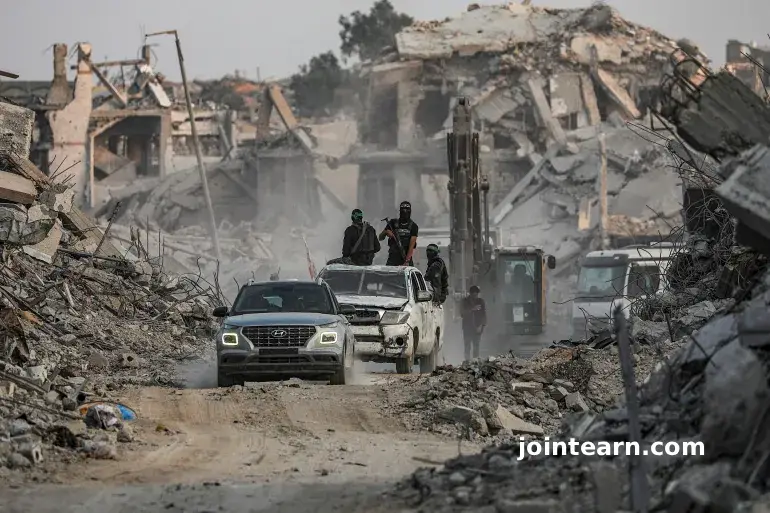
Hamas has confirmed the death of senior commander Raed Saad in an Israeli attack in Gaza, marking the highest-profile assassination of a Palestinian figure since the October ceasefire. The killing has sparked renewed tensions and accusations of ceasefire violations by both sides, raising concerns over the fragile peace in the region.
Key Details of the Attack
- Victim: Raed Saad, senior Hamas commander
- Location: Near Gaza City, Gaza Strip
- Casualties: At least 25 people wounded in the attack
- Confirmation: Hamas Gaza chief Khalil al-Hayya in a video statement
Al-Hayya condemned Israel for violating the truce, calling on mediators, particularly the United States administration, to enforce the ceasefire and ensure compliance with the agreement.
Israel’s Position on Raed Saad
According to the Israeli military, Saad had been involved in rebuilding Hamas’s military capabilities, which were heavily damaged in prior conflicts. Israel described him as:
- One of the planners of the October 7, 2023 attacks on Israel
- Head of Hamas’s weapons manufacturing wing
- Second-in-command of Hamas’s armed faction after Izz al-Din al-Haddad
The Israeli military claims the targeted strike was a calculated operation to prevent the resurgence of Hamas’s offensive capacity.
Ceasefire Violations Since October
Despite the truce, Gaza authorities report that nearly 800 Israeli attacks have occurred since October 10, resulting in at least 386 deaths. The ongoing attacks are seen as breaches of the ceasefire, and Israel’s restrictions on humanitarian aid delivery have exacerbated the humanitarian crisis.
Storm Byron, which recently flooded 27,000 tent shelters, has left hundreds of thousands of Palestinians in urgent need of assistance. The United Nations General Assembly has demanded unrestricted humanitarian access to Gaza and compliance with international law by Israel as the occupying power.
Hamas’s Response and Ceasefire Plans
Khalil al-Hayya emphasized that Hamas remains committed to the ceasefire while urging international actors to:
- Facilitate the entry of aid and medical supplies
- Rehabilitate hospitals, medical centers, and critical infrastructure
- Open the Rafah crossing with Egypt in both directions
- Progress toward phase two of the ceasefire, including Israeli withdrawal
Al-Hayya clarified that the role of any international peacekeeping force should be limited to monitoring the ceasefire and separating the two sides along Gaza’s borders, rejecting any external control over Palestinian territory.
Phase Two of the Ceasefire
Phase two, which is under negotiation, includes:
- Israeli withdrawal from Gaza
- Disarmament of Hamas
- Formal end to hostilities
Hamas leadership, including Khaled Meshaal and Basem Naim, has been engaging with the United States and UN officials to ensure Palestinian input on disarmament procedures. While Hamas is open to freezing or storing weapons temporarily, it opposes any international force exercising authority over its arsenal.
Meshaal stated that the goal is to guarantee long-term peace and prevent renewed conflict, stressing the importance of supervised, limited international involvement rather than foreign control.
Humanitarian Concerns
The ongoing attacks and restrictions have worsened the humanitarian crisis in Gaza. Key issues include:
- Thousands of displaced families following Storm Byron
- Limited access to food, clean water, and medical care
- Urgent need for international support to stabilize the region
The UN continues to push for full compliance with ceasefire terms and access for humanitarian aid, highlighting the critical need for international oversight without undermining Gaza’s sovereignty.


Leave a Reply