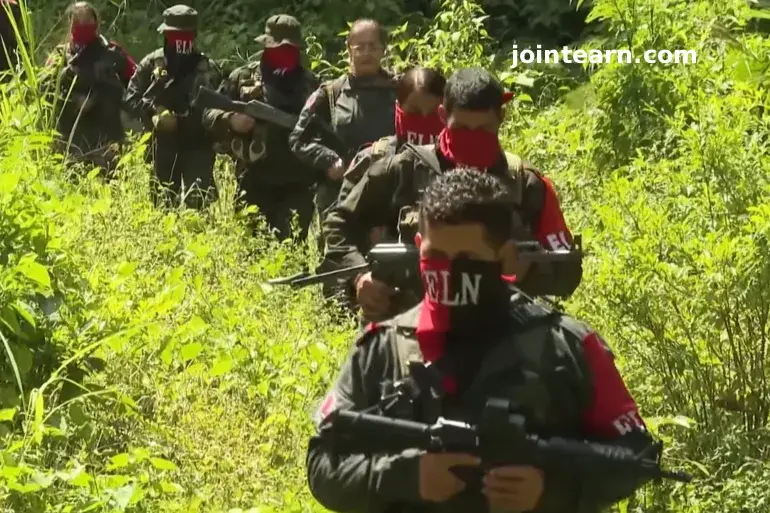
Tensions are soaring in Colombia as the National Liberation Army (ELN), the country’s largest remaining rebel group, has ordered civilians to stay home for three days while it conducts military drills. The precautionary measure comes in response to heightened threats of U.S. military intervention, as President Donald Trump warns nations producing cocaine for the United States could face direct attacks.
ELN Orders Lockdown Amid Rising Tensions
On Friday, the ELN instructed residents in rebel-held areas to avoid major roads and rivers from Sunday morning onwards, describing the exercises as preparation to defend against “imperialist intervention.” The group emphasized that civilians should avoid contact with fighters to prevent accidental casualties.
Colombia’s Defence Minister Pedro Sanchez condemned the rebel directive as “criminal coercion,” assuring that government troops remain present across the country’s mountains, jungles, and rivers.
Escalating U.S.-Colombia Relations
Relations between Washington and Bogota have deteriorated as Trump intensifies rhetoric against Colombian President Gustavo Petro, linking potential military action to cocaine production. Trump recently warned business executives that Petro “better wise up, or he’ll be next,” alluding to U.S. military readiness in the Caribbean region and potential interventions in Latin America.
The Trump administration has also imposed new sanctions on Venezuela, targeting relatives of President Nicolas Maduro’s wife and seizing oil tankers linked to the government, signaling a broader regional crackdown on drug and oil networks.
ELN: Armed and Ideologically Driven
The ELN fields roughly 5,800 fighters and controls key drug-producing regions, particularly Catatumbo along the Venezuelan border. Correspondent Teresa Bo reported that in ELN-controlled areas, fighters exercise unchallenged authority, with banners declaring “Total peace is a failure” and no government presence visible.
Commander Ricardo, a senior ELN official, suggested the rebels might coordinate broader resistance should the U.S. intervene in Venezuela, warning that such moves could trigger wider armed conflicts across Latin America.
Despite ideological claims, the group earns significant revenue from narcotics trafficking, competing with former FARC fighters who refused to disarm under the 2016 peace agreement. Previous peace negotiations with Colombia’s last five governments have repeatedly failed, most recently collapsing after a January ELN assault in Catatumbo that killed over 100 people and displaced thousands.
U.S. Military Posture and Regional Response
Since Trump returned to office, U.S.-Colombia relations have deteriorated sharply. Washington has imposed personal sanctions on Petro, revoked his visa following a pro-Palestinian demonstration in New York, and removed Colombia from the list of trusted counter-narcotics partners.
Trump has also deployed the largest U.S. aircraft carrier and nearly 15,000 troops to the Caribbean. Over the past months, U.S. forces have carried out more than 20 military strikes against alleged drug trafficking vessels in the Caribbean and Pacific, resulting in over 80 deaths. Human rights organizations, U.S. Democrats, and several Latin American countries have condemned these actions as extrajudicial killings and violations of international law.
Conclusion
The current standoff underscores a growing confrontation between the U.S., Colombia, and regional actors amid ongoing cocaine production and armed insurgency. With the ELN staging military drills and civilians caught in the crossfire, the situation highlights the fragile balance of peace and the risks of escalating conflict in northern South America.


Leave a Reply