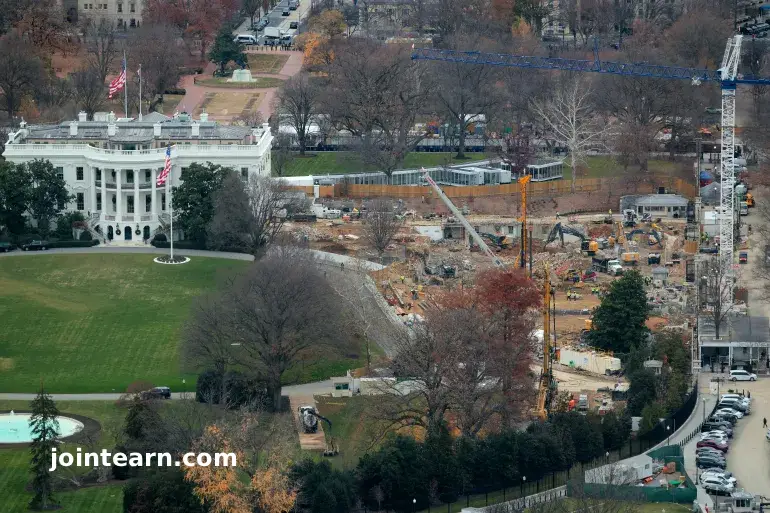
Washington, DC – The National Trust for Historic Preservation has filed a lawsuit seeking to stop the Trump administration’s ambitious construction project at the White House, aimed at adding a massive new ballroom to the historic building. The legal action comes amid growing criticism from preservationists and architectural experts who warn that the project could permanently alter one of the most iconic buildings in the United States.
Trump’s $300 Million Ballroom Project
The lawsuit targets a 90,000-square-foot (27,432-square-meter) addition connected to the East Wing, which President Donald Trump has described as a key initiative to enhance the White House’s capacity for state functions. The planned ballroom will reportedly seat nearly 1,000 people, surpassing the previously announced 650-seat capacity. Trump has said the $300 million cost of the project will be covered entirely by private donations.
Construction began in October, when demolition crews removed a portion of the White House’s East Wing and the Jacqueline Kennedy Garden to make way for the expansion. Critics argue that the project dwarfs the current 55,000-square-foot footprint of the White House and disrupts the historic balance between the East and West Wings.
Carol Quillen, president of the National Trust for Historic Preservation, emphasized the cultural and historical significance of the White House. “The White House is arguably the most evocative building in our country and a globally recognized symbol of our powerful American ideals,” Quillen said. “As the organization charged with protecting places where our history happened, the National Trust was compelled to file this case.”
Legal Challenges Against the Trump Administration
The lawsuit alleges that the Trump administration bypassed multiple legally required approvals, including:
- Failing to file detailed construction plans with the National Capital Planning Commission (NCPC).
- Not preparing an environmental assessment for the new structure.
- Failing to obtain Congressional approval for construction on federal property designated as a national park.
The filing further asserts that these actions violate the Property Clause of the U.S. Constitution, which reserves Congress the authority to manage and dispose of federal property.
Previously, the National Trust had sent formal letters to the NCPC, the National Park Service, and the Commission of Fine Arts, requesting a temporary pause in construction while legal and environmental reviews are conducted.
Trump Administration Response
The Trump administration has defended the project, asserting that all planning and construction comply with legal requirements. In October, Trump aide Steven Cheung dismissed the preservationist concerns on social media, calling the organization “run by a bunch of loser Democrats and liberal donors who are playing political games.”
Despite assurances from the administration, critics argue that the scale of the project represents the most significant physical alteration to the White House since its reconstruction in the early 1800s, and could permanently change the character and aesthetics of the historic property.
National and Historical Significance
While previous presidents have made renovations and internal updates to the White House, its exterior has remained largely unchanged for more than two centuries. Preservationists warn that the new ballroom would overshadow the historic architecture and disrupt the visual harmony of the surrounding grounds, including the East and West Wings.
Experts also emphasize that the White House serves not only as the residence of the U.S. president but as a living symbol of American history, democracy, and cultural heritage. Altering its iconic design without thorough oversight and public consultation raises concerns about precedent and accountability in federal projects.
As the lawsuit moves forward, legal experts predict that it could delay or even halt construction, pending judicial review of whether the Trump administration followed proper procedures. Meanwhile, the debate highlights a broader clash between ambitious modernization efforts and historic preservation in Washington, DC.


Leave a Reply