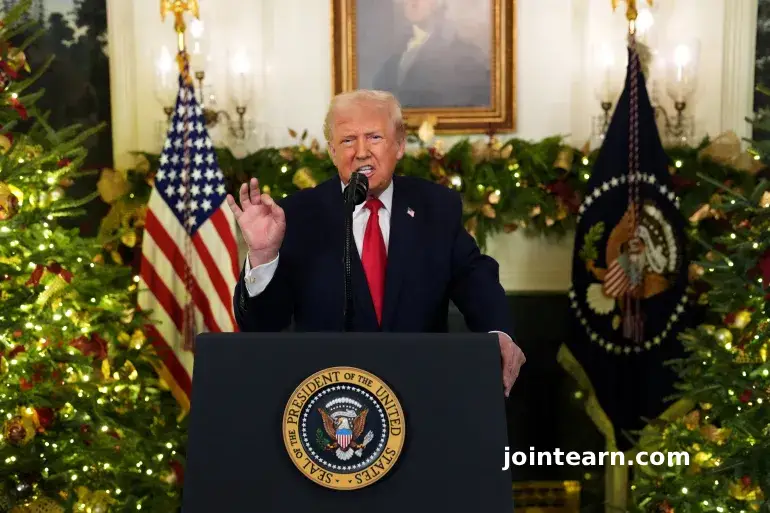
Trump Delivers Unusual Address From the White House
United States President Donald Trump delivered a nationally televised address from the White House on Wednesday, using the rare presidential platform to promote his record, attack immigrants, and criticise his Democratic predecessor, while largely avoiding foreign policy crises dominating headlines.
White House addresses are traditionally reserved for major national announcements or emergencies. However, Trump used the 19-minute speech to reinforce his political narrative that the country is thriving under his leadership, even as polls indicate declining public approval.
“Our nation is strong. America is respected, and our country is back stronger than ever before,” Trump said. “We’re poised for an economic boom the likes of which the world has never seen.”
Immigrants Scapegoated for Economic and Social Problems
A significant portion of Trump’s speech focused on immigration, with the president repeating inflammatory claims that undocumented immigrants are responsible for rising housing costs, strained healthcare systems, and increased public spending.
“At the same time, illegal aliens stole American jobs and flooded emergency rooms getting free healthcare and education paid for by you – the American taxpayer,” Trump said, without presenting evidence.
Trump also claimed immigrants had driven up law enforcement costs to unquantifiable levels, assertions that contradict extensive economic research.
Numerous studies have consistently found that immigrants contribute more to the US economy than they consume, particularly in key industries such as agriculture, construction, and healthcare.
A 2023 American Immigration Council analysis found that immigrants paid more than $651bn in taxes and generated approximately $1.7 trillion in economic activity in that year alone.
The rhetoric drew renewed attention to the fact that Trump’s first wife and his current wife are immigrants from Eastern Europe, a point frequently raised by critics.
False and Inflammatory Claims About Somali Americans
Trump also repeated false claims about Somali Americans, alleging that they had “taken over” Minnesota’s economy and stolen “billions and billions of dollars”.
The comments followed previous remarks in which Trump referred to the Somali community as “garbage”, drawing condemnation from civil rights groups and community leaders.
There is no evidence to support Trump’s assertions, and Somali Americans are widely recognised for their contributions to business, healthcare, and public service in Minnesota.
Border and Affordability Claims Questioned
Trump highlighted his administration’s immigration enforcement, claiming unprecedented success at the southern border.
“We inherited the worst border anywhere in the world, and we quickly turned it into the strongest border in the history of our country,” he said.
The president also argued that the cost of living is falling, citing sharp declines in food and fuel prices. However, several of the figures he referenced were either misleading or contradicted by publicly available data.
Trump claimed egg prices were down 82 percent since March, though economists note that prices had surged earlier in the year due to a temporary bird flu outbreak, inflating comparisons.
He also said gasoline prices were as low as $1.99 per gallon in some states. In reality, the AAA national average stood at $2.90 on Wednesday, roughly in line with prices from the same period last year.
Reporting from Washington, DC, Al Jazeera correspondent Kimberly Halkett said affordability remains a major concern for Americans.
“Groceries, food, and dining costs are still very high for most Americans,” Halkett said, noting that Trump’s tariffs have contributed to price pressures despite generating government revenue.
Foreign Policy Claims and Gaza Remarks
While focusing heavily on domestic issues, Trump briefly addressed foreign policy, repeating exaggerated claims about his role in global conflicts.
He asserted that he had “settled eight wars in 10 months” and claimed to have ended the war in Gaza, saying it brought peace to the Middle East “for the first time in 3,000 years”.
The claim is historically inaccurate. Israel was established in 1948, and the Gaza truce has not halted ongoing Israeli military attacks across Gaza and the wider region.
Venezuela Crisis Absent From Speech
The timing of Trump’s address sparked speculation that he might announce new actions related to Venezuela, as tensions between Washington and Caracas continue to rise.
The US has imposed a naval blockade on Venezuelan oil shipments, increased military deployments near the country, and launched a series of maritime strikes in the Caribbean and Pacific.
Despite this, Trump did not address Venezuela directly during the speech.
Hours earlier, however, he appeared to reinforce claims that US actions were linked to Venezuela’s oil reserves.
“They took our oil rights. We had a lot of oil there … and we want it back,” Trump told reporters.
Venezuela nationalised its oil industry in 2007 under then-President Hugo Chávez, forcing several US companies out of the country.
Trump only briefly referenced US military strikes in the region, saying his administration had “decimated the bloodthirsty foreign drug cartels” without mentioning mounting legal and diplomatic concerns.
Speech Fuels Political and Global Uncertainty
By avoiding Venezuela while escalating rhetoric elsewhere, Trump’s address has deepened uncertainty over US intentions in Latin America, even as his domestic messaging leans heavily on immigration and economic optimism.
Analysts say the speech reflects a strategy aimed at energising his political base while deflecting attention from rising international tensions and unresolved economic anxieties at home.


Leave a Reply