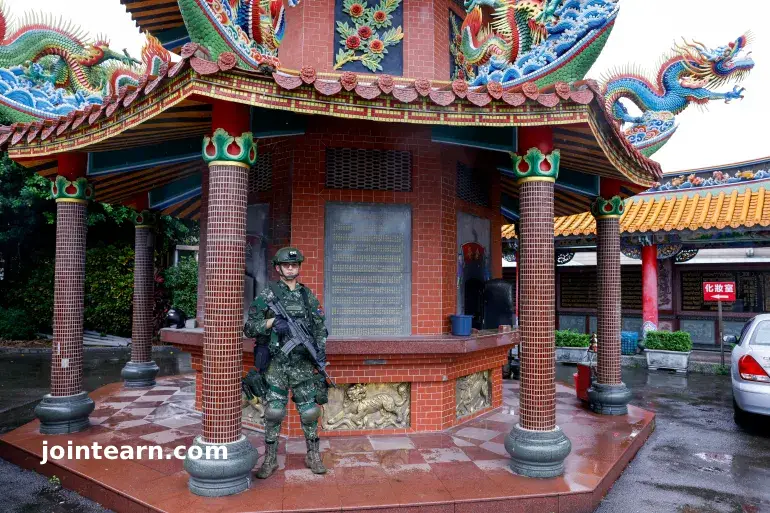
In a landmark decision that could significantly impact the balance of power in the Asia-Pacific region, the United States has officially approved an $11.1 billion arms sale to Taiwan, marking one of the largest weapons packages ever provided to the self-ruled island. The announcement, made by the US State Department during a nationally televised address by President Donald Trump on December 18, 2025, comes amid rising tensions between Beijing and Taipei over sovereignty and regional security.
The arms deal underscores Washington’s commitment to supporting Taiwan’s defense modernization and maintaining a credible deterrent against potential aggression from mainland China. Beijing, which considers Taiwan part of its territory, has repeatedly warned that any foreign military assistance to the island could provoke a strong response.
Details of the $11 Billion US Arms Package
The extensive arms package includes a range of high-tech weaponry and defense systems, some of which are similar to equipment previously supplied by the US to Ukraine:
- 82 High Mobility Artillery Rocket Systems (HIMARS) and 420 Army Tactical Missile Systems (ATACMS), valued at over $4 billion. These systems significantly enhance Taiwan’s long-range strike capabilities.
- 60 self-propelled howitzer artillery systems with related equipment, also valued at more than $4 billion, strengthening Taiwan’s ground forces.
- Drones and unmanned aerial systems valued at over $1 billion, aimed at improving surveillance and rapid-response capabilities.
- Military software and technology worth more than $1 billion.
- Javelin and TOW missiles, helicopter spare parts, and Harpoon missile refurbishment kits, totaling over $887 million.
The Pentagon stated that the sale aligns with US national, economic, and security interests by supporting Taiwan’s ongoing efforts to modernize its armed forces and maintain a credible defense posture.
Reactions from Taiwan and China
Taiwan’s defense ministry and presidential office welcomed the announcement. In a statement, Taiwan’s defense ministry emphasized that the US arms sale would help the island maintain sufficient self-defense capabilities and build strong deterrence against potential threats.
A spokesperson for Taiwan’s presidential office, Karen Kuo, stated that Taiwan would continue to strengthen whole-of-society defense resilience and implement reforms in its defense sector to safeguard national security.
Conversely, Beijing criticized the sale sharply. China’s Taiwan Affairs Office condemned the US decision, urging Washington to adhere to the One-China principle and cease all military contact and arms sales to Taiwan. The office accused Taiwan’s leaders of pursuing independence and warned that the island could become a “war porcupine,” potentially putting its population at risk.
This arms sale follows Taiwan’s announcement last month of a $40 billion supplementary defense budget, which is planned to run from 2026 to 2033. President William Lai Ching-te emphasized that national security was non-negotiable and that Taiwan would continue to strengthen its defensive capabilities.
Regional and Global Implications
Analysts suggest that the $11 billion arms deal could escalate tensions between the US and China and increase military activity in the Taiwan Strait. With advanced weaponry such as HIMARS and drones, Taiwan significantly boosts its ability to deter potential aggression, while also signaling its commitment to self-defense.
This move also reflects the broader geopolitical rivalry between the US and China, particularly in terms of military influence and technological superiority in the Indo-Pacific region. As tensions rise, experts caution that diplomatic efforts and multilateral engagement will be critical to prevent potential conflict.
Conclusion
The approval of this massive arms sale highlights the complex dynamics surrounding Taiwan’s security and US-China relations. As Washington continues to support Taiwan’s defense modernization, Beijing is likely to intensify its warnings and military posturing. The deal not only strengthens Taiwan’s military capabilities but also reinforces the strategic significance of the island in the global geopolitical landscape.


Leave a Reply