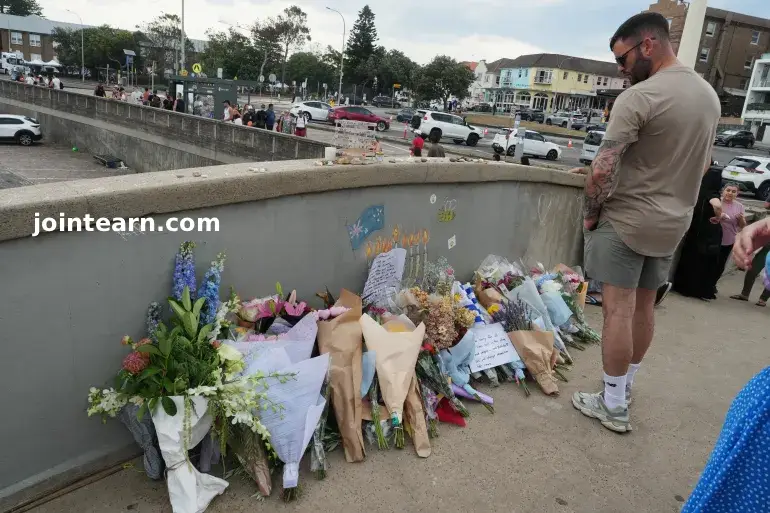
Australia has marked a National Day of Reflection to honour the victims of last week’s deadly Bondi Beach shooting, as Prime Minister Anthony Albanese announced a comprehensive review of the country’s law enforcement and intelligence agencies. The move comes amid growing scrutiny over whether warning signs were missed ahead of the deadliest mass shooting in Australia in nearly three decades.
The attack, which took place on December 14 during celebrations for the Jewish festival of Hanukkah, claimed the lives of 15 people and injured dozens more, sending shockwaves across the nation and prompting renewed debate about counterterrorism preparedness and public safety.
National Day of Reflection Begins at Bondi Beach
Commemorations began early Sunday morning with Indigenous elders leading a traditional smoking ceremony at the Bondi Pavilion, overlooking the waterfront where the attack occurred. The ceremony marked the opening of a day dedicated to remembrance, unity, and reflection.
An impromptu memorial of flowers, candles, and handwritten messages has continued to grow near the site, with mourners gathering quietly throughout the day to pay their respects.
Government buildings across Australia flew flags at half-mast, and authorities called for a national minute of silence at 6:47pm local time (07:47 GMT)—the exact moment the attack began.
Australians were also invited to light candles on Sunday evening, coinciding with the eighth and final night of Hanukkah, as a symbolic gesture of solidarity with the victims and their families.
Heavy Security for Public Memorials
An evening memorial event at Bondi Beach was scheduled under tight police security, with officers, including armed units, deployed in the area. Police said the measures were necessary to ensure public safety while allowing mourners to gather peacefully.
Officials have classified the attack as an act of terrorism, saying it deliberately targeted members of the Jewish community.
Details of the Attack and Ongoing Investigation
Authorities believe the attack was carried out by a father-and-son pair inspired by ISIL (ISIS). Flags associated with the armed group were reportedly found inside the attackers’ vehicle.
The older suspect, Sajid Akram, 50, was shot dead by police at the scene. His son, Naveed Akram, 24, survived after being hospitalised in critical condition and emerging from a coma earlier this week.
Naveed Akram has since been charged with 59 offences, including murder and terrorism-related charges, and remains under police guard in hospital. As of Sunday, 13 victims were still receiving treatment in Sydney hospitals.
The Bondi Beach attack is Australia’s deadliest mass shooting since the 1996 Port Arthur massacre, a tragedy that led to sweeping gun law reforms.
Albanese Orders Review of Intelligence and Law Enforcement
Prime Minister Albanese acknowledged serious concerns about the handling of intelligence prior to the attack, revealing that one of the suspects had come to the attention of authorities several years earlier.
“We need to examine exactly how the systems worked,” Albanese told Australia’s national broadcaster, ABC. “We need to look back at what happened in 2019, when this individual was assessed, and determine whether the right conclusions were reached.”
In a formal statement, Albanese confirmed that a wide-ranging review of Australia’s intelligence and federal policing agencies would be conducted, led by a former head of the national spy agency.
The review will assess whether agencies have:
- Adequate legal powers
- Effective operational structures
- Proper information-sharing arrangements
- Sufficient safeguards to prevent future attacks
The findings are expected to be delivered by the end of April.
Gun Laws and Political Fallout
In response to the attack, Albanese has already announced plans for a nationwide gun buyback scheme, despite Australia having some of the world’s strictest firearms laws. Gun safety experts have long argued that existing regulations contain loopholes that allow illegal weapons to circulate.
The prime minister also strongly condemned anti-immigration rallies that took place in Sydney and Melbourne on Sunday, accusing organisers of exploiting the tragedy to promote division.
“These rallies seek to sow hatred and division in the aftermath of an antisemitic terrorist attack,” Albanese said. “They have no place in Australia.”
According to reports, attendance at the Sydney rally remained small, with roughly 50 people present by mid-afternoon.
A Nation in Mourning
As Australia reflects on the Bondi Beach tragedy, calls for accountability, reform, and unity continue to grow. Community leaders, religious groups, and political figures have urged Australians to reject hate and stand together against extremism.
The National Day of Reflection served not only as a moment to honour those lost, but also as a reminder of the ongoing challenges facing public safety and social cohesion in an increasingly volatile global environment.


Leave a Reply