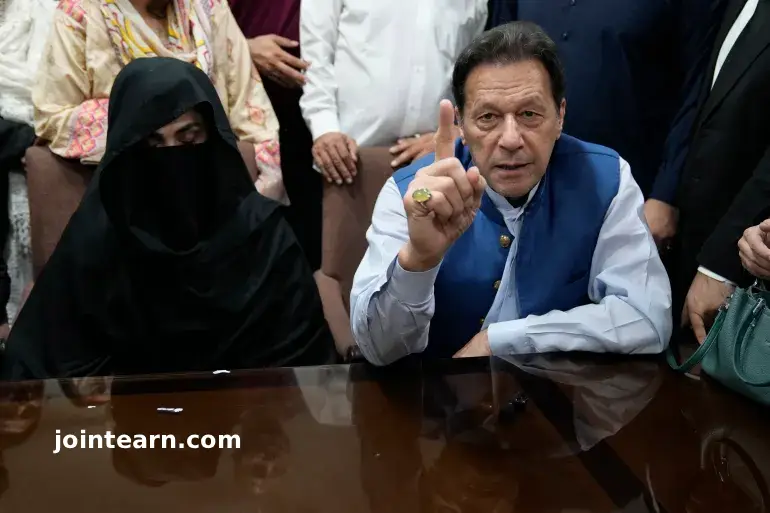
Imran Khan and Wife Convicted
Pakistan’s former prime minister, Imran Khan, and his wife, Bushra Bibi, have been sentenced to 17 years in prison after being found guilty of illegally retaining and selling state gifts, including jewellery from foreign dignitaries. The verdict, announced on Saturday, concludes a years-long legal saga that has captured global attention.
The couple denies all charges, maintaining that they did not profit illegally from the gifts.
Allegations of Misrepresentation
Under Pakistani law, officials wishing to keep gifts from foreign leaders must purchase them at market value and declare any profits from subsequent sales. Prosecutors claimed that the Khans acquired gifts at an artificially low price of $10,000, despite a market value of $285,521, before selling them for personal gain.
Zulfikar Bukhari, Imran Khan’s spokesperson, criticized the verdict, saying:
“Criminal liability was imposed without proof of intent, gain, or loss, relying instead on a retrospective reinterpretation of rules.”
The Pakistan Tehreek-e-Insaf (PTI) party also condemned the ruling on social media, labeling the trial a “sham” and describing it as “a black chapter in history.”
Court Proceedings and Controversy
The verdict was announced while Khan was present in Adiala prison, Rawalpindi, though family members were reportedly denied access. PTI described the trial as a closed-door military proceeding, questioning its fairness.
However, Minister of Information and Broadcasting Attaullah Tarar defended the ruling, asserting that the court examined solid evidence and delivered a fair verdict based on Khan and his wife’s alleged corruption.
Political Background
Imran Khan, 73, served as Pakistan’s prime minister from 2018 until April 2022, when he was removed in a no-confidence vote. Since his ouster, Khan has faced multiple charges, including corruption and leaking state secrets, all of which he denies, claiming political motivation.
He has previously been acquitted of certain charges but remains imprisoned, with protests erupting across Pakistan in support of him over the past two years. Khan has also alleged that his removal was part of a foreign-backed conspiracy, a claim denied by the United States, Pakistan’s military, and political opponents.
Supporters Condemn the Verdict
Khan’s sister, Aleema Khanum, called the case fabricated, alleging it was part of a broader effort to prevent Khan from returning to power. She described her brother’s conditions in prison, claiming he and his wife are isolated and subjected to harsh treatment, including solitary confinement.
“You think Imran is going to spend 10 years in jail for a necklace being underpriced? Seriously? That’s 17 years of conviction?” Khanum said, calling the judicial process a “collapsed system.”
Legal Perspective
Tania Bazai, a high court advocate, defended the prosecution, stating that the case was built on documented evidence. Key witnesses included Khan’s principal secretary and military secretary, whose testimonies reportedly strengthened the case.
Bazai emphasized:
“One of the main witnesses came with solid evidence. This entire case is based on documented evidence.”
International and Domestic Reactions
The sentencing of a former prime minister has sparked political unrest in Pakistan, with widespread debates over judicial independence, political targeting, and the role of military influence in high-profile cases. Khan’s supporters have staged demonstrations demanding his release, citing politically motivated persecution, while government officials assert that justice has been served through proper legal channels.
Conclusion: A Landmark Verdict
The 17-year prison sentence for Imran Khan and Bushra Bibi marks a pivotal moment in Pakistan’s political landscape. With both domestic and international attention focused on the case, the ruling is expected to have far-reaching implications for Pakistan’s governance, legal system, and upcoming elections.


Leave a Reply