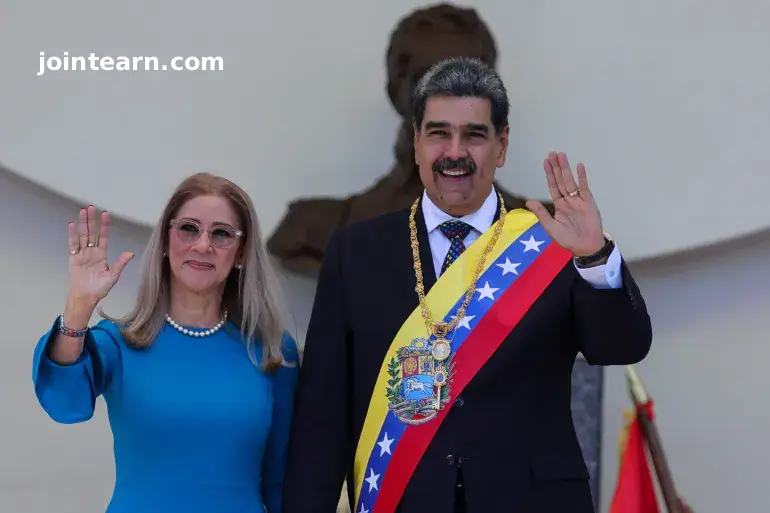
The United States Department of the Treasury has announced a new round of sanctions targeting several family members and associates of Venezuelan President Nicolas Maduro, escalating pressure on Caracas amid heightened military activity along Venezuela’s borders. The sanctions come as part of the Trump administration’s broader strategy to confront Maduro’s government and secure U.S. interests in the region.
Details of the Sanctions
On Friday, U.S. Treasury Secretary Scott Bessent stated that the measures aim to dismantle networks that support Maduro’s regime, which the administration describes as “illegitimate” and a threat to regional stability.
The newly sanctioned individuals include seven people connected to Malpica Flores, Maduro’s nephew, and Panamanian businessman Ramon Carretero. These individuals had been linked in previous U.S. sanctions announced on December 11, which also targeted six Venezuelan-flagged oil tankers and shipping companies.
Malpica Flores, one of three of Maduro’s nephews by marriage and dubbed a “narco-nephew” by the U.S. Treasury, has been repeatedly linked to corruption within Petroleos de Venezuela, S.A. (PDVSA), the state-run oil company. The Treasury statement claimed that these connections were critical in “propping up Nicolas Maduro’s rogue narco-state.”
“Maduro and his criminal accomplices threaten our hemisphere’s peace and stability,” Bessent said. “The Trump Administration will continue targeting the networks that prop up his illegitimate dictatorship.”
Military Escalation and Regional Impact
The sanctions announcement comes amid ongoing U.S. military operations near Venezuelan waters, which have included strikes on vessels off the country’s coasts. These attacks have reportedly killed more than 100 people. The U.S. has also seized a Venezuelan oil tanker and implemented a naval blockade affecting vessels arriving and departing from Venezuelan ports under sanctions.
While the Trump administration maintains that the operations are primarily aimed at curbing drug trafficking, critics argue that the focus increasingly appears to be on Venezuela’s vast oil reserves, which remain largely untapped due to previous U.S. sanctions.
Homeland Security adviser Stephen Miller recently asserted that Venezuela’s oil resources rightfully belong to the United States, claiming on social media that the “tyrannical expropriation” of Venezuela’s oil was a significant theft of American wealth and property.
Economic and Political Consequences
U.S. sanctions targeting Venezuela’s oil industry have exacerbated the country’s economic crisis, contributing to inflation, shortages, and growing discontent with Maduro, who has led Venezuela since 2013.
In response, Maduro accused the United States of fabricating “a new eternal war” aimed at regime change and seizing Venezuela’s oil reserves, framing U.S. actions as an attack on national sovereignty.
The European Union has also maintained targeted sanctions on Venezuela, renewed last week through 2027. These measures, first imposed in 2017, include an arms embargo, travel bans, and asset freezes on individuals linked to state repression and human rights violations.
Broader Geopolitical Context
The sanctions highlight ongoing tensions between the United States and Venezuela and underscore international concerns about corruption, state repression, and illegal trafficking. Observers note that continued U.S. pressure, combined with international sanctions, may further destabilize Maduro’s government while intensifying the humanitarian and economic crisis in the country.


Leave a Reply