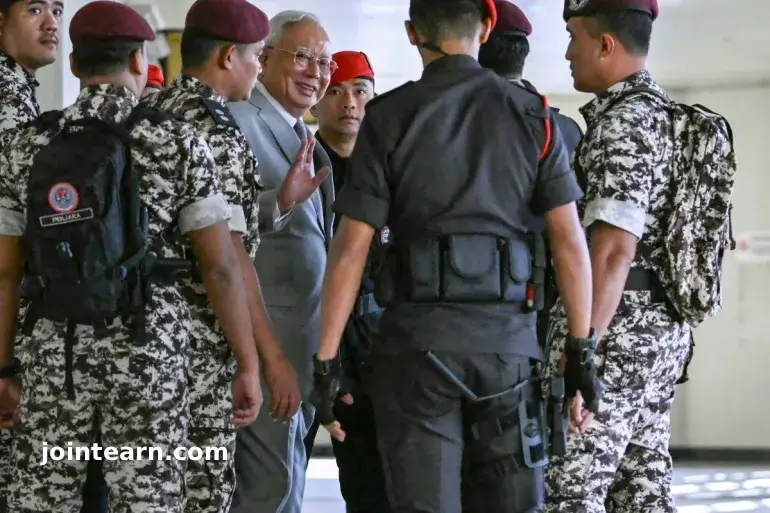
The Kuala Lumpur High Court has dismissed former Malaysian Prime Minister Najib Razak’s request to serve the remainder of his 1MDB corruption sentence under house arrest, ruling that a royal decree authorizing the move was legally invalid.
Najib, 72, has been in prison since August 2022 following his conviction in the multibillion-dollar 1MDB scandal. The court said the “addendum order” Najib relied upon lacked legal enforceability because it was not issued in consultation with Malaysia’s pardons board, as required under the federal constitution.
Court Ruling: Limits of Royal Pardons
While the Malaysian monarch has the constitutional power to grant pardons, Judge Alice Loke emphasized that the king’s authority is not absolute. The ruling clarified that:
“The court ruled that the king could not grant house arrest independently of the pardons board. A house arrest order is not capable of execution, no legal provision for such a mechanism in Malaysia.”
Najib had argued that the royal order entitled him to complete the remainder of his six-year sentence at home. The High Court’s decision prevents that and reaffirms the legal requirement for the pardons board’s involvement in such decisions.
Reaction and Next Steps
Najib remained composed in court, smiling as his lawyer Muhammad Shafee Abdullah described the ruling as “shocking.” The defense intends to appeal the verdict, prolonging Najib’s legal battles.
Najib’s Corruption Convictions
Najib was originally sentenced to 12 years in 2020 in the SRC International Sdn Bhd case, involving 42 million ringgit (approx. $9.9m). The sentence was later halved by the pardons board.
He is also facing a verdict this week in the main 1MDB trial, with charges including:
- Four counts of abuse of power totaling 2.28 billion ringgit ($554m)
- 21 counts of money laundering
Prosecutors allege Najib used his positions as Prime Minister, Finance Minister, and 1MDB advisory board chairman to divert billions from the state fund to personal accounts. Evidence includes bank records, documents, and testimony from over 50 witnesses.
If convicted, Najib could face up to 20 years per abuse of power count and up to five years per money laundering charge.
1MDB Scandal Background
The 1MDB fund, launched by Najib in 2009, has been at the center of an international corruption scandal. Investigators claim at least $4.5 billion was siphoned off by Najib’s associates, financing Hollywood films, luxury yachts, hotels, jewelry, and artwork.
The scandal triggered a national backlash and contributed to the historic 2018 election defeat of Najib’s party, the United Malays National Organisation (UMNO), which had ruled Malaysia since independence.
Political Context
The court rulings are closely observed as a measure of current Prime Minister Anwar Ibrahim’s anti-corruption campaign. While Anwar asserts judicial independence, some observers question the autonomy of Malaysia’s attorneys general, who are appointed by the prime minister.
Despite his imprisonment, Najib retains influence in UMNO, now part of Anwar’s unity government, reflecting his continued political relevance in Malaysia.


Leave a Reply