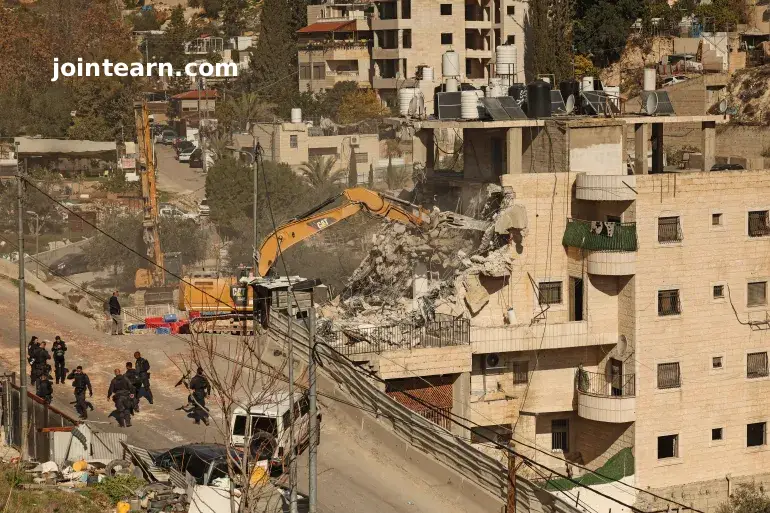
Israeli forces have demolished several Palestinian commercial premises near the Qalandiya refugee camp, north of occupied East Jerusalem, as part of an intensified series of military raids targeting multiple Palestinian neighbourhoods, according to eyewitnesses, medical officials, and local authorities.
The raids began in the early hours of Tuesday and quickly expanded into the nearby town of Kafr Aqab, where large contingents of Israeli troops were deployed. Residents reported widespread house searches, forced evacuations, arrests, and the use of heavy machinery, including military vehicles and bulldozers.
Commercial Premises Targeted Near Qalandiya
Witnesses said Israeli forces moved into the commercial area surrounding the Qalandiya refugee camp and began demolishing Palestinian-owned shops, confiscating goods and damaging storefronts. Authorities cited alleged violations such as unpaid municipal taxes and construction without permits — accusations Palestinians say are routinely used to justify demolitions.
According to residents, Israeli forces destroyed shop signage, advertising billboards, and business infrastructure, actions that local observers described as an attempt to further cripple the Palestinian economy in Jerusalem-adjacent areas.
Injuries and Use of Live Fire
The Palestine Red Crescent Society confirmed that its medical teams treated at least three Palestinians injured during the raids in Qalandiya and Kafr Aqab. Injuries included a bullet wound to the thigh, wounds caused by shrapnel from live ammunition, and injuries resulting from physical assault by Israeli forces.
The Jerusalem governorate reported additional casualties, stating that at least three Palestinians were injured by Israeli gunfire, while dozens suffered from tear gas inhalation after Israeli forces fired stun grenades and gas canisters into residential areas.
Forced Evictions and Military Takeovers of Homes
Residents in Kafr Aqab said Israeli troops ordered several families to evacuate their homes, with at least three houses converted into temporary military outposts. Homeowners were reportedly told they would not be allowed to return until at least Wednesday morning, heightening fears of prolonged displacement.
Israeli forces also stormed the youth club inside the Qalandiya refugee camp, transforming the community facility into a military base, according to Al Jazeera Arabic.
Arrests and Detentions
Several Palestinians were detained during the large-scale incursion. Among those arrested were Anan Mohammed Taha and his father, Mohammed Taha, residents of the Qalandiya refugee camp, according to the Palestinian Wafa news agency.
The arrests are part of what Palestinian officials describe as a broader campaign of mass detentions accompanying Israel’s daily raids across the occupied West Bank.
Journalists Targeted During Raids
Journalists covering the events were also targeted. Israeli forces fired stun grenades and tear gas canisters toward reporters, including Al Jazeera Arabic journalists, while they were documenting the raid in Kafr Aqab.
According to the Jerusalem governorate, Israeli forces also fired stun grenades directly toward students returning home from school, and confiscated private surveillance cameras from the area.
‘Intimidation’ and Daily Anxiety for Residents
Al Jazeera correspondent Nida Ibrahim, reporting from Kafr Aqab, said the raids reflect a pattern of systematic intimidation.
“They have raided Palestinian stores and destroyed plaques and advertisement billboards,” she said, adding that the actions appear designed to undermine Palestinian livelihoods and increase psychological pressure on residents.
“This is part of the anxiety that Palestinians live through day in and day out as these Israeli raids continue on a daily basis,” Ibrahim said, noting that Israeli incursions across the West Bank average around 60 raids per day.
Municipal Taxes and Discriminatory Policies
In addition to demolitions, Israeli forces confiscated goods from Palestinian-owned shops in Qalandiya, Kafr Aqab, and northern Jerusalem, citing alleged unpaid municipal taxes.
Most Palestinians living in these areas hold Jerusalem residency identification cards, which subject them to high municipal taxes while offering limited access to basic services such as infrastructure, waste collection, and building permits.
Wider West Bank Escalation
Separately, confrontations were reported in the town of Beit Furik, east of Nablus in the occupied West Bank, after Israeli forces stormed the area, underscoring the continued escalation of Israeli military operations across Palestinian territories.
Human rights groups have repeatedly warned that demolitions, forced evictions, and military raids in occupied East Jerusalem and the West Bank violate international humanitarian law and deepen an already volatile situation.


Leave a Reply