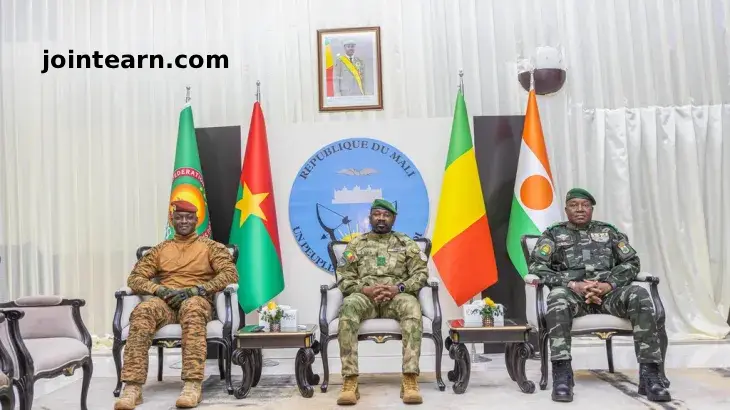
Ouagadougou, Burkina Faso – Burkina Faso’s interim leader, Captain Ibrahim Traore, has pledged large-scale joint operations against armed groups in the Sahel region, as the three-member Alliance of Sahel States (AES) strengthens its military and economic cooperation.
Traore’s announcement comes during the AES summit, held on Tuesday, following the launch of a 5,000-strong joint military battalion, the AES Unified Force (FU-AES), designed to combat groups linked to al-Qaeda and ISIS (ISIL).
AES Summit and Regional Security
The AES, composed of Burkina Faso, Mali, and Niger, was formed in 2024 after the three nations withdrew from the Economic Community of West African States (ECOWAS) following recent coups. At the summit, the military leaders emphasized their commitment to regional sovereignty, marking a decisive pivot from traditional Western security partners such as France and the United States, toward cooperation with Russia.
“No country or interest group will decide for our countries any more,” declared General Omar Tchiani, leader of Niger’s military government, highlighting the alliance’s focus on self-determination.
Traore warned of escalating external threats, terming the period a “Black Winter”, characterized by violence, destabilization, and economic pressures targeting the Sahel.
Military and Strategic Developments
The FU-AES battalion represents a major milestone for AES, signaling a coordinated approach to counterterrorism across national borders. During the summit, General Assimi Goita of Mali reported operational successes, stating that AES forces had destroyed several terrorist bases, while committing to continued action against extremist groups threatening the region.
Additionally, AES leaders launched AES Television, a joint broadcaster aimed at countering disinformation and hostile narratives targeting their countries. Goita described the new media platform as a strategic tool to ensure accurate reporting and strengthen regional cohesion.
Economic and Social Messaging
Beyond security, AES leaders sought to reshape narratives about the Sahel’s economic potential. Goita emphasized the region’s immense mining and agricultural resources, challenging claims that Sahelian states are inherently poor or economically fragile.
Ulf Laessing, head of the Sahel program at the Konrad Adenauer Foundation, noted that the second annual AES summit demonstrates increasing collaboration among the three nations, despite tensions stemming from coups and international sanctions.
“The alliance enjoys popularity among citizens of the three countries,” Laessing told the Associated Press.
“It is working to maintain momentum by deepening cooperation beyond cross-border military operations, including economic and media initiatives.”
Regional and Global Implications
The AES alliance reflects a significant shift in West African geopolitics, with the bloc asserting autonomy from former colonial and Western powers. Analysts note that the coordinated military presence, coupled with economic and media strategies, is designed to reinforce the sovereignty of AES member states and reduce dependency on external actors.
By bolstering regional security and countering extremist threats, AES aims to stabilize a historically volatile region, while simultaneously positioning itself as a growing force in Sahelian and West African affairs.
Conclusion
The AES summit and the formation of the FU-AES battalion mark a decisive step in joint military operations, counterterrorism, and regional sovereignty for Burkina Faso, Mali, and Niger. As the alliance continues to consolidate its security and economic initiatives, its actions will have a lasting impact on stability and power dynamics across the Sahel region.


Leave a Reply