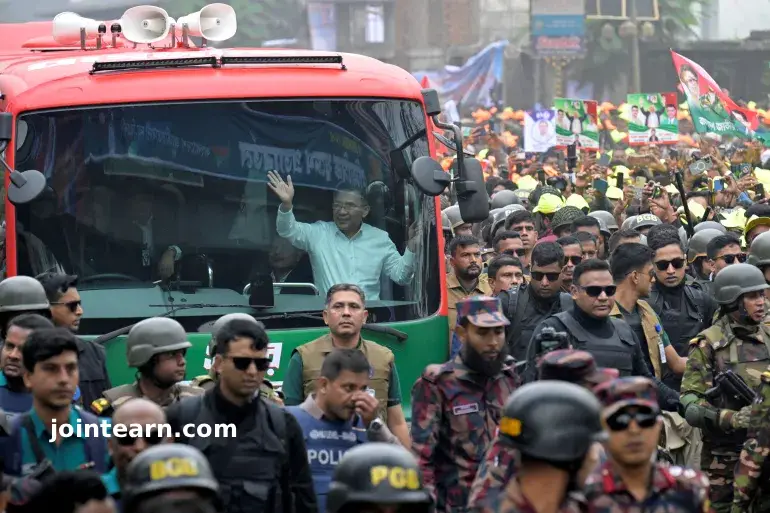
Dhaka, Bangladesh – After 17 years in exile, Tarique Rahman, acting chairman of the Bangladesh Nationalist Party (BNP), returned to Dhaka on December 25, 2025, in a historic and widely publicized homecoming. Thousands of supporters welcomed him as the BNP’s potential frontrunner for the upcoming national elections.
Rahman arrived at Hazrat Shahjalal International Airport alongside his wife Zubaida and daughter Zaima, stepping barefoot onto Bangladeshi soil under tight security—a symbolic gesture marking a pivotal moment for the BNP and national politics.
Who Is Tarique Rahman?
Tarique Rahman, 60, is the eldest son of former Bangladesh President Ziaur Rahman and Prime Minister Khaleda Zia, Bangladesh’s first female head of government.
- He has lived in London since 2008 and acted as BNP chairman since 2018, following his mother’s imprisonment.
- Rahman’s early political prominence came during Khaleda Zia’s second term (2001–2006).
- He has faced allegations of corruption, cronyism, and political violence, including convictions linked to a 2004 grenade attack on an Awami League rally.
- His supporters and the BNP claim these charges were politically motivated.
Rahman’s return follows the August 2024 student-led uprising, which led to the ousting of Prime Minister Sheikh Hasina and the appointment of an interim government under Nobel laureate Muhammad Yunus.
Exile and Political Background
The BNP has been locked in decades-long rivalry with the Awami League, led by Sheikh Hasina. Political tensions escalated after the military-backed emergency rule of 2007–2008, during which Rahman was arrested and later moved to the UK for medical treatment.
- Both families, Zia and Hasina, have alternated power since the 1990s.
- During Hasina’s 15-year uninterrupted rule, BNP leaders faced political suppression, arrests, and trials.
- Rahman’s exile coincided with these turbulent years, limiting his direct influence on domestic politics.
The Significance of Rahman’s Return
Rahman’s return comes at a critical juncture:
- The Awami League is barred from the February 12, 2026 elections after its leadership, including Hasina, faced legal actions for human rights abuses during the 2024 crackdown.
- His mother, Khaleda Zia, is hospitalized, leaving Rahman as the de facto leader of the BNP.
- Rahman’s leadership offers the BNP an opportunity to consolidate support, project secular and centrist policies, and distance itself from its former alliance with Jamaat-e-Islami.
In a rally in Dhaka, Rahman called for an inclusive Bangladesh:
“We want to build a safe Bangladesh. In Bangladesh, no matter who a woman, man, or child is, they should be able to leave their homes safely and return safely.”
BNP’s Electoral Prospects
The BNP is widely viewed as the frontrunner for the upcoming elections.
- A December 2025 poll by the International Republican Institute (IRI) showed BNP leading with 30% support, followed by Jamaat-e-Islami at 26%, and the National Citizen Party at 6%.
- Bangladesh’s first-past-the-post system allows a party to win seats without a majority, favoring the BNP in a multiparty contest.
Former US diplomat Jon Danilowicz noted:
“The upcoming election is BNP’s to lose. The party has demonstrated resilience over the past 17 years, despite repression and exile.”
Challenges remain: Rahman must integrate his core lieutenants from exile with the broader BNP apparatus assembled by his mother to unify the party ahead of elections.
Why Tarique Rahman Matters
Rahman’s return marks a potential turning point in Bangladesh’s politics:
- It signals the BNP’s resurgence after nearly two decades out of power.
- It positions Rahman as a potential prime ministerial candidate.
- It could redefine political alliances and governance priorities in the post-Hasina era.
With elections set for February 12, 2026, all eyes in Bangladesh and South Asia are now on Tarique Rahman’s next moves.


Leave a Reply