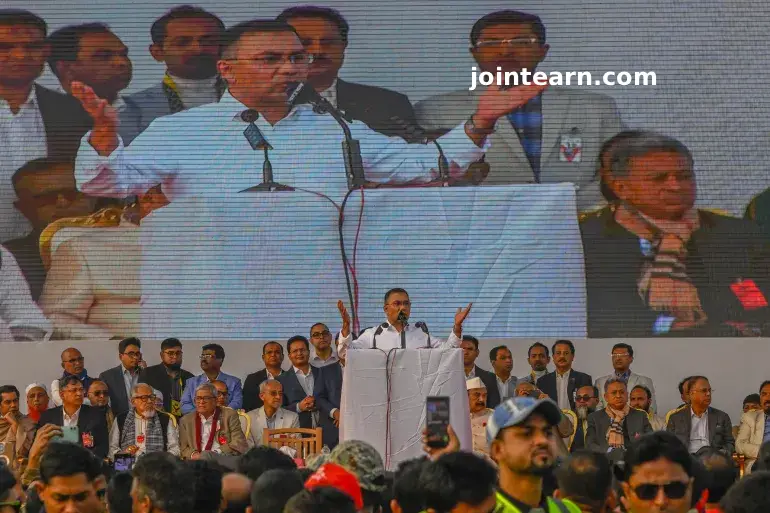
Dhaka, Bangladesh — After more than 17 years in self-imposed exile in London, Tarique Rahman, acting chairman of the Bangladesh Nationalist Party (BNP), returned to Bangladesh on Thursday, igniting massive rallies and renewed political energy ahead of the February 2026 national elections.
The son of former Prime Minister and critically ill BNP chairperson Khaleda Zia, and grandson of former President Ziaur Rahman, Tarique Rahman’s arrival marks a pivotal moment for the BNP and the broader political landscape in Bangladesh. Tens of thousands of supporters greeted him at Dhaka’s Hazrat Shahjalal International Airport, reflecting his enduring influence and the high stakes of the upcoming election.
A Return Amid Political Turmoil
Rahman returned at a time of heightened political uncertainty, following the assassination of youth leader Sharif Osman Hadi, violent clashes across the country, attacks on media outlets, and rising public unrest. With the February 2026 election approaching, analysts suggest his presence could provide stability and restore confidence in Bangladesh’s democratic process.
“We want peace,” Rahman told supporters. “We have people from the hills and the plains in this country – Muslims, Hindus, Buddhists, and Christians. We want to build a safe Bangladesh, where every woman, man, and child can leave home safely and return safely.”
Experts such as Asif Mohammad Shahan, professor of development studies at the University of Dhaka, view Rahman’s return as an opportunity to reduce electoral uncertainty and stabilize the political environment.
Strengthening the BNP Ahead of Elections
Tarique Rahman’s arrival is widely seen as bolstering the BNP, which has historically been viewed as a frontrunner in polls against the interim government that took over after Sheikh Hasina fled to India in August 2024. The BNP has faced significant political challenges during the past 16 months, including criticisms of governance under the interim administration led by Muhammad Yunus.
Analysts note that Rahman’s return demonstrates the BNP’s organisational strength and its ability to mobilize mass support. His presence also appeals beyond the traditional party base, attracting voters eager for political stability and reform.
Challenges and Expectations
While Rahman’s return opens a window for political stabilization, questions remain about his ability to lead effectively and connect with the broader electorate. Shahan emphasizes that Rahman must take a firm stance against extremism, address citizens’ concerns, and demonstrate readiness to govern while maintaining control over the party. Failure to do so could exacerbate political volatility.
Overcoming a Controversial Past
Rahman’s political journey has been marked by controversy, including multiple convictions in absentia during Bangladesh’s military-backed caretaker government (2006–2009). Allegations ranged from corruption to murder. However, all charges were dropped or stayed over the last year and a half, clearing the path for his return.
Political commentators, such as US-based columnist Shafquat Rabbee, highlight Rahman’s policy-focused approach, noting that his speech emphasized plans for governance, stability, and development.
Implications for Bangladesh’s Regional Relations
Rahman’s return is also significant for South Asian geopolitics, particularly relations with India. Historically, India maintained closer ties with Sheikh Hasina’s Awami League, while the BNP’s alliance with Jamaat-e-Islami complicated bilateral relations. In recent months, however, the BNP has broken with Jamaat and pursued a centrist approach, positioning itself as a stabilizing force.
Observers suggest that India may now perceive Tarique Rahman as a “serious political actor” capable of constructive engagement, restoring predictability to bilateral interactions.
Toward a Potential ‘Wave’ Election
Recent surveys suggest a tight race between the BNP and the remnants of Awami League-affiliated parties, with many voters undecided. Rahman’s high-profile return could energize the party base and sway undecided voters, potentially leading to a landslide victory if he demonstrates effective leadership and a clear policy agenda.
As Shahan notes, “His presence will definitely energize the party base and encourage undecided voters to break for the BNP. If he performs, we may very well see a ‘wave’ election where the BNP can win in a landslide.”
Ultimately, Tarique Rahman’s return to Bangladesh is more than symbolic; it represents a potential turning point for the BNP and a critical test for Bangladesh’s democratic institutions amid ongoing political turbulence.


Leave a Reply