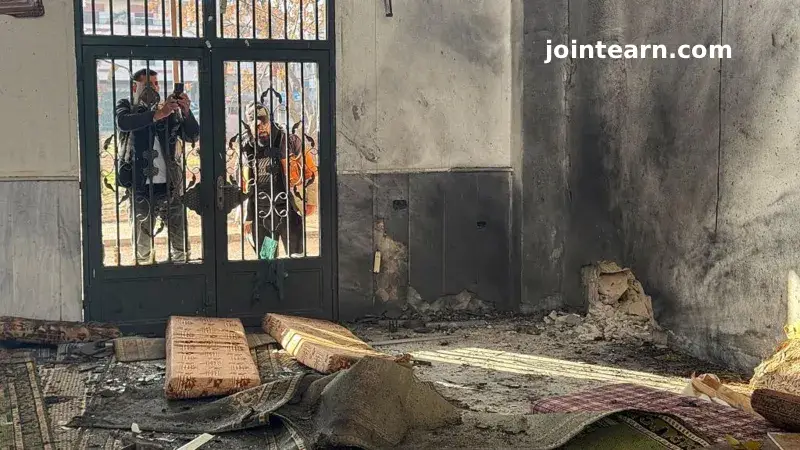
A devastating explosion at the Imam Ali ibn Abi Talib Mosque in the Syrian city of Homs has left at least eight people dead and 18 injured during Friday prayers, Syrian health authorities reported. The blast has caused widespread shock across the country and raised concerns about ongoing sectarian violence in Syria.
Details of the Attack
According to Syria’s state-run news agency Sana, the explosion caused extensive damage inside the mosque. Photographs show scorched walls, broken windows, and blood-stained carpets. Security sources told Sana that the blast was caused by an explosive device planted inside the mosque.
The mosque is located in the Wadi al-Dhahab neighborhood, which is predominantly home to the Alawite community, a Shia sect and one of Syria’s largest religious minorities.
The jihadist group Saraya Ansar al-Sunnah has claimed responsibility for the attack, stating that it was carried out in collaboration with another unidentified group using explosives planted at the site. The group has previously claimed responsibility for attacks on religious minorities and targets linked to the former Syrian government.
Context and Sectarian Tensions
The blast occurs a year after Syrian rebel forces overthrew President Bashar al-Assad, an Alawite, who has since fled to Russia with his family. The Alawite community has faced waves of sectarian violence, fearing reprisals and attacks amid ongoing instability.
Observers have speculated that Saraya Ansar al-Sunnah could be linked to the Islamic State (IS) due to similarities in their messaging, types of targets, and tactics. The group first rose to prominence in June after claiming responsibility for a deadly church bombing in Damascus.
In March, security forces were accused of killing dozens of Alawites in Latakia province, according to the Syrian Observatory for Human Rights (SOHR). These ongoing attacks underscore the fragile security situation in Syria and the persistent threats to minority communities.
Reactions and Condemnations
Syria’s Foreign Ministry condemned the attack as a “terrorist crime”, calling it a “cowardly act” designed to undermine national security and stability. The ministry emphasized that the attack represents an assault on human and moral values.
The incident has further heightened concerns about sectarian reprisals and instability in areas still recovering from years of conflict, as communities struggle to maintain security amid ongoing political and religious tensions.
Implications
The Homs mosque bombing highlights the continuing risk of sectarian attacks and terrorism in Syria, particularly against Alawite and other minority communities. The attack underscores the challenges facing the country as it deals with post-conflict recovery, rebel insurgencies, and extremist groups claiming responsibility for targeted violence.


Leave a Reply