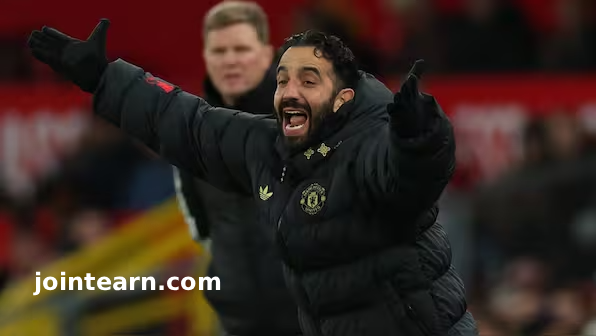
Manchester United head coach Ruben Amorim has insisted that his recent decision to change formation was driven by tactical timing rather than pressure from fans or the media. The Portuguese coach moved away from his trademark back-three system with wing-backs for the first time this season during United’s win over Newcastle United, opting instead for a more traditional back four supported by two holding midfielders.
Amorim acknowledged that the system effectively became a back six late in the match as United protected their lead, but the change helped deliver only the club’s second clean sheet of the campaign—a rare defensive success in a difficult season.
“Changing Because of Pressure Would Be the End”
Speaking candidly after the match, Amorim said altering his tactical approach in response to outside criticism would have undermined his authority.
“If I had changed because of pressure from the media, it would have been the end for me,” Amorim said. “The players would understand immediately that I was reacting to noise, not making decisions for the right reasons.”
Despite previously declaring that “not even the Pope” could force him to abandon his preferred system, Amorim stressed that flexibility has always been part of his long-term plan at Old Trafford. However, he believes such changes can only be effective when the team is stable enough to understand them.
“When I arrived last season, I knew we didn’t have the right players to fully play that system, but it was the start of a process,” he explained. “We were building an identity. Now it’s a different moment.”
Injuries Force Tactical Adaptation
United’s squad depth has been severely tested, with seven senior players already ruled out of the upcoming Premier League clash against Wolverhampton Wanderers. That number could rise if Mason Mount fails to recover after being forced off at half-time against Newcastle.
Amorim admitted that the lack of available players has accelerated the need for tactical adaptation.
“We don’t have a lot of players at the moment, so we have to adapt,” he said. “But it’s important the players understand why we are changing. It’s not because of pressure from fans or media.”
The coach added that once injured players return, United will not be locked into a single formation.
“We are going to become a better team. When all the players are available again, we won’t play with three defenders all the time.”
Bruno Fernandes Ruled Out but Still Leading
Manchester United captain Bruno Fernandes will miss the Wolves game despite pushing to return sooner from a hamstring injury sustained against Aston Villa on 21 December.
“Bruno is already saying he needs to train,” Amorim revealed. “But there is no chance he plays against Wolves. No chance.”
While Fernandes remains sidelined, Amorim praised his leadership and influence behind the scenes. The midfielder was seen observing warm-ups closely from the tunnel area before the Newcastle match—something the manager says typifies his commitment.
“He’s a leader,” Amorim said. “He’s always talking, always helping. That’s why he’s the captain. There are many things people don’t see.”
Amorim also joked about Fernandes’ intensity, acknowledging his animated gestures on the pitch while highlighting his positive influence off it.
“I don’t know if he wants my job or not,” Amorim laughed, “but he’s a leader. The guy is a leader.”
United Waiting on Key Returns
Alongside Fernandes, Kobbie Mainoo, Matthijs de Ligt, and Harry Maguire are also currently unavailable, with no confirmed return dates. Relief is expected by the end of January, when Noussair Mazraoui, Amad Diallo, and Bryan Mbeumo return from the Africa Cup of Nations.
Although United had won just two of their previous eight matches before the Newcastle victory, Amorim believes the performance marked progress, even if results have not consistently reflected improvement.
As pressure continues to build at Old Trafford, Amorim remains adamant that decisions will be made on footballing logic—not external demands—as he attempts to steer Manchester United toward greater tactical balance and long-term stability.


Leave a Reply