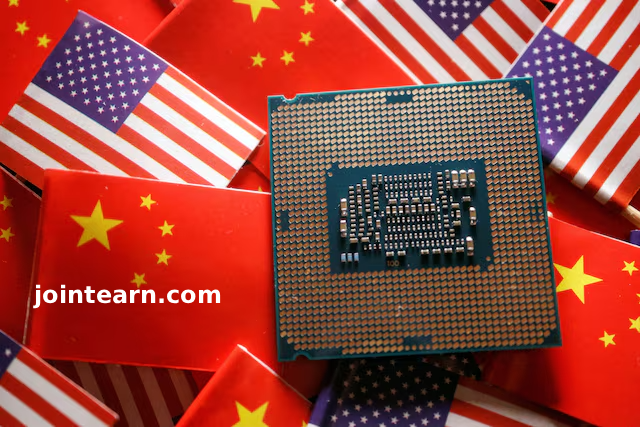
President Donald Trump has blocked U.S. photonics firm HieFo Corp’s $3 million acquisition of Emcore, a New Jersey-based aerospace and defense company, citing national security risks and China-related concerns, according to a White House order released on January 2, 2026.
Details of the Blocked Deal
Trump’s order states that HieFo, which he claimed was “controlled by a citizen of the People’s Republic of China,” may “take action that threatens to impair the national security of the United States.” As a result, he directed HieFo to divest all interests and rights in Emcore’s assets within 180 days.
The order did not name the individual involved or provide further specifics about the national security threat.
“The Transaction is hereby prohibited,” Trump said in the executive order.
The deal had involved HieFo acquiring Emcore’s chip business and indium-phosphide wafer-fabrication operations for $2.92 million. Emcore was publicly traded at the time of the transaction but was later taken private.
Background on HieFo and Emcore
HieFo was co-founded by Genzao Zhang, a former vice president of engineering at Emcore, and Harry Moore, who previously served as a senior sales director at Emcore. The company had planned to expand its photonics operations through the acquisition.
The U.S. Treasury Department, citing the Committee on Foreign Investment in the United States (CFIUS), noted that the review identified potential national security risks, though specific threats were not detailed.
As of the release of the order, neither HieFo nor Emcore had publicly commented on Trump’s decision.
Implications for U.S. Tech and Defense
This decision underscores ongoing U.S. concerns regarding foreign influence in critical technology sectors, particularly semiconductors, aerospace, and defense. With China-related security issues at the forefront, U.S. authorities continue to scrutinize cross-border acquisitions that may affect sensitive supply chains and national security.
Experts note that limiting foreign control over semiconductor and defense assets has become a priority amid global competition in advanced chip manufacturing and AI technologies.


Leave a Reply