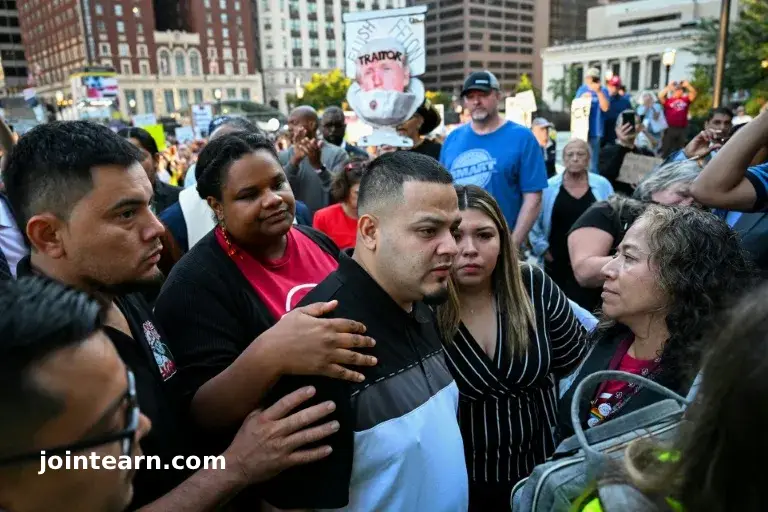
Deportation Dispute Intensifies as US Targets Salvadoran Man for Removal to Liberia
Washington, D.C., October 25, 2025 — The United States government has announced plans to deport Kilmar Abrego Garcia, a Salvadoran migrant residing in Maryland, to Liberia — a country with which he has no ties — by the end of October.
The case has become a flashpoint in the ongoing immigration debate under President Donald Trump’s administration, highlighting deep divisions over the treatment of migrants, due process, and deportation ethics.
Abrego Garcia’s deportation order follows months of legal battles after he was wrongly deported to El Salvador in March 2025, only to be returned to the US in June when officials admitted to an “administrative error.”
A Controversial Deportation Destination
According to a federal court filing in Maryland released Friday, government attorneys claim that Liberia has been identified as a viable “removal site” because it is not on the list of countries previously rejected by Abrego Garcia’s defense team.
“Liberia is a thriving democracy and one of the United States’ closest partners on the African continent,” the filing states, arguing that the West African nation is “committed to the humane treatment of refugees.”
The government further noted that Liberia is an English-speaking country, suggesting the deportation could be completed “as soon as October 31.”
However, critics have blasted the move as arbitrary and punitive, pointing out that Abrego Garcia has no cultural, familial, or legal connection to the African nation.
Defense Team Calls Deportation “Cruel and Unconstitutional”
Simon Sandoval-Moshenberg, Abrego Garcia’s attorney, sharply condemned the deportation plan, accusing Immigration and Customs Enforcement (ICE) of attempting to “inflict maximum hardship” on his client.
“The government is trying to deport Kilmar to Liberia — a country thousands of miles from his family and home in Maryland — where he has no ties whatsoever,” said Sandoval-Moshenberg.
“Costa Rica has offered to accept him as a refugee, yet the administration has chosen a cruel and unconstitutional path.”
Abrego Garcia, who has been married to a U.S. citizen, was previously granted protected legal status in 2019 after a judge ruled that returning him to El Salvador could endanger his life.
Despite this, he became one of more than 200 people deported to El Salvador’s CECOT mega-prison in March during a Trump-led operation targeting undocumented migrants and alleged MS-13 gang members.
Administrative Errors and Legal Challenges
The Department of Justice later admitted that Abrego Garcia’s initial deportation was “wrongful”, citing an administrative mistake that violated his court-ordered protection status.
Upon his return to the United States, Abrego Garcia was detained again in Tennessee on separate human smuggling charges, though his lawyers maintain the case is politically motivated and unrelated to his immigration status.
Federal Judge Catherine Blake in Maryland had earlier blocked an attempt to deport him to Uganda in August, ruling that the government must justify its choice of destination countries under international and domestic law.
The latest move to send him to Liberia reignites concerns about the lack of due process in the administration’s broader mass deportation campaign.
Trump Administration’s Deportation Crackdown Draws Global Criticism
President Donald Trump’s immigration crackdown, a centerpiece of his second-term agenda, has been lauded by right-wing supporters as a strong defense of national sovereignty. However, human rights advocates and legal experts say the deportation process has grown increasingly chaotic, secretive, and unlawful.
They warn that the government’s “random selection” of deportation destinations violates both international human rights conventions and U.S. immigration law, which require deportees to be sent to countries where they have legal or familial ties.
“What we’re seeing is a weaponization of deportation — a system designed to punish rather than process,” said Dr. Elena Ruiz, a senior researcher at Human Rights Watch.
Broader Political and Humanitarian Implications
The Abrego Garcia case has sparked international attention, with Costa Rica formally offering to receive him as a refugee under humanitarian protections.
Advocates say the U.S. government’s refusal to consider Costa Rica’s offer — and preference for Liberia, a distant and unrelated nation — demonstrates a politicized approach to immigration enforcement.
Meanwhile, immigration rights groups have intensified calls for judicial oversight of deportation practices and greater transparency from ICE and the Department of Homeland Security.
Legal observers warn that the outcome of this case could set a precedent for “third-country deportations”, allowing the U.S. to send migrants to unrelated countries with little accountability.
What’s Next for Kilmar Abrego Garcia?
With the federal filing submitted, the government could act on the Liberia deportation plan by October 31, pending court approval.
Abrego Garcia’s defense team has filed an emergency injunction to block the deportation, arguing that it would violate his constitutional rights and endanger his safety.
For now, he remains in ICE custody in Maryland, separated from his wife and community as legal proceedings continue.
Human rights advocates have vowed to keep the spotlight on his case, warning that the decision could shape the future of U.S. immigration policy under Trump’s renewed enforcement agenda.


Leave a Reply