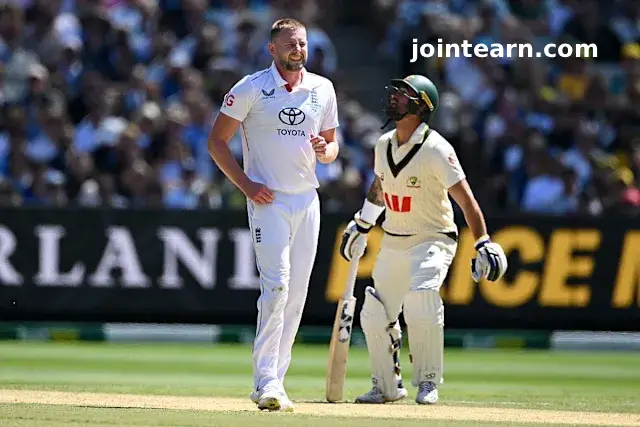
England’s struggles in the Ashes reached a new low on day two of the fifth Test in Sydney, as a disastrous bowling performance allowed Australia to seize complete control despite a heroic century from Joe Root earlier in the match.
Sydney may statistically lose more playing time to rain than any other Test venue in the world, but for England, the misery came in torrents rather than drizzle. What should have been a competitive position after posting 384 runs quickly unraveled as Australia surged to 166-2 in just 34.1 overs, barely breaking a sweat.
Former England spinner Phil Tufnell summed it up bluntly, rating England’s bowling effort a “two out of 10” — a damning verdict on a performance that highlighted long-standing issues with discipline, selection, and leadership.
Root’s 160 Undone by England’s Wayward Bowling
Joe Root’s magnificent 160 was one of the few bright moments for England in an otherwise grim Ashes campaign. His innings gave England a rare sense of competitiveness in a series where they have routinely been overwhelmed.
However, that advantage evaporated almost immediately once England took the field. Even the early removal of Jake Weatherald and a momentary squeeze applied by Ben Stokes and Josh Tongue failed to slow Australia’s momentum.
By stumps, Travis Head and Marnus Labuschagne had added 105 runs in just 113 balls, capitalizing on England’s inability to maintain a consistent line and length.
England’s Length Problem Exposed Again
England’s lack of control with the new ball has been a recurring theme throughout the Ashes, and Sydney was no exception. Brydon Carse and Matthew Potts set the tone with a chaotic opening spell that gifted Australia seven boundaries inside the first six overs.
According to analysis, 47% of England’s deliveries in the opening overs were shorter than eight meters, compared to just 19% from Australia on day one. The result was predictable: cuts, pulls, and effortless scoring.
Potts, making his first appearance of the series, finished with figures of 0-58 from seven overs, while Carse once again conceded runs at more than four per over — a trend that has plagued him throughout the tour.
Australia have now scored at a staggering rate in the series, hitting a boundary every 13.4 balls, well ahead of the global Test average. In this innings alone, they found the rope once every 7.2 deliveries, underlining England’s lack of pressure.
“Why Can’t They Hit the Top of Off Stump?”
Tufnell’s criticism went beyond tactics and questioned England’s basic execution.
“I don’t think it’s planning anymore,” he said. “It’s coming down to ability. Why can’t professional bowlers hit the top of off stump six balls out of six? They’re the best we’ve got.”
England’s inability to build sustained pressure has been stark. Missed lengths, wide lines, and poor consistency allowed Australia to dominate from the outset — a pattern repeated throughout the series.
Selection and Leadership Under Fire
England’s bowling strategy also came under scrutiny, particularly the decision to give Brydon Carse the new ball once again. Remarkably, this was the first time in his 63-match first-class career that Carse had ever opened a bowling attack, yet England have persisted with him in that role since the third Test.
Meanwhile, Josh Tongue, England’s most effective fast bowler of the series, has repeatedly been denied the new ball. Statistically, the decision is puzzling: Tongue averages 27 with the new ball in first-class cricket, while Carse has taken just five wickets at an average of 82.
Former England captain Michael Vaughan openly questioned the leadership group’s approach, suggesting past data and evidence are being ignored.
Should Ben Stokes Be Opening the Bowling?
Another major talking point is Ben Stokes’ reluctance to open the bowling. Despite being captain and one of England’s most effective bowlers against left-handers, Stokes has only opened the bowling twice in his Test career.
This is particularly baffling given Australia’s left-handed opening combination and the absence of senior bowlers such as James Anderson, Stuart Broad, and Chris Woakes, all of whom have now retired.
However, Stokes’ fitness remains a concern. Just weeks ago, he did not bowl at all during a full day in Adelaide, raising questions about whether England can realistically expect him to shoulder an even greater workload.
A Worrying Glimpse of England’s Future
Beyond this Test, the broader implications for England are troubling. Australia have scored nearly 30% of their runs through cuts and pulls in the series, exposing England’s inability to adapt their lengths to Australian conditions.
With Mark Wood sidelined and uncertain to return long-term, and Gus Atkinson failing to build on a promising start to his Test career, England’s fast-bowling cupboard looks worryingly bare.
Jofra Archer remains a potential savior — if fitness allows — but outside of him, there are few domestic options pushing strongly for selection.
In conditions that were expected to suit England’s pace attack, the performances in Sydney have instead raised serious alarms about the future of England’s Test bowling unit.
As rain threatens to disrupt play once again, England’s problems are unlikely to be washed away anytime soon.


Leave a Reply