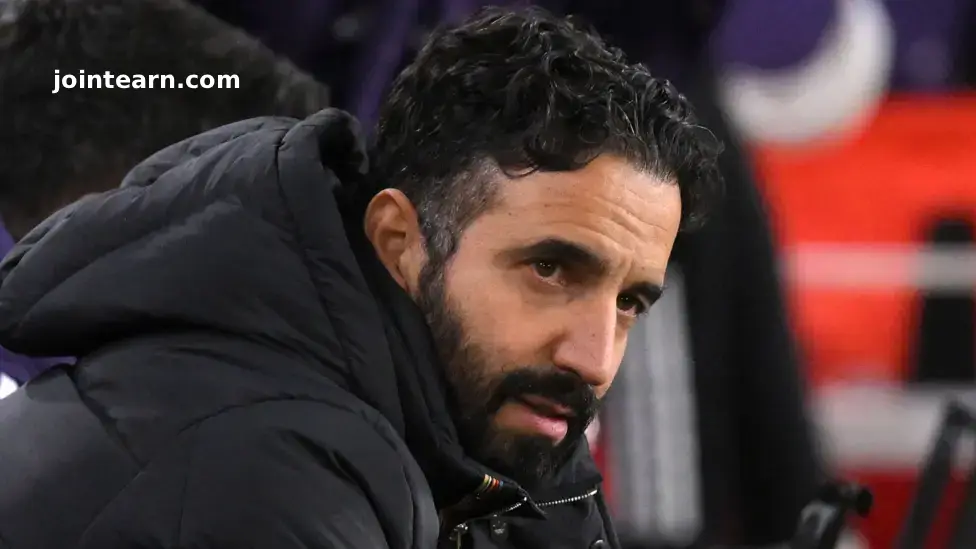
Manchester United have sacked head coach Ruben Amorim after just 14 months in charge, bringing an abrupt end to a reign marked by tactical uncertainty, strained internal relationships and underwhelming results.
The Premier League club confirmed the decision less than 24 hours after a 1-1 draw with Leeds United, with former midfielder Darren Fletcher set to take interim charge for Wednesday’s league fixture against Burnley.
In a statement, United said the decision was made “reluctantly” but insisted it was necessary to give the team the “best opportunity of the highest possible Premier League finish”, with the club currently sitting sixth in the table.
Amorim’s Exit Comes After Public Tensions With Club Hierarchy
Amorim’s departure follows a weekend in which he publicly hinted at deepening fractures behind the scenes at Old Trafford. On Friday, the Portuguese coach suggested his relationship with club officials was strained, particularly around transfer policy and decision-making authority.
After Sunday’s draw at Elland Road, Amorim went further, stating he wanted to work as a “manager, not just a coach”, and admitting he was prepared to see out the final 18 months of his contract rather than resign.
Those comments left United’s leadership facing a stark choice: publicly back Amorim or remove him. Within hours, the club opted for the latter.
Club Statement Confirms Amorim’s Departure
“Manchester United have parted company with Ruben Amorim after 14 months as head coach,” the club said.
“With Manchester United currently sixth in the Premier League, the club’s leadership believes now is the right time to make a change to maximise results for the remainder of the season.
“The club thanks Ruben for his contribution and wishes him well for the future.”
Amorim’s entire coaching staff have also left the club.
Darren Fletcher to Lead United on Interim Basis
Former United midfielder Darren Fletcher, currently head coach of the club’s under-18s, will oversee first-team duties in the short term. Fletcher previously served as United’s technical director between 2021 and 2024 but has never held a senior managerial role.
The 41-year-old, who won five Premier League titles and the 2007–08 Champions League during his playing career at Old Trafford, is expected to face the media on Tuesday ahead of the Burnley match at Turf Moor.
Why United Lost Faith in Amorim
Sources close to the club told BBC Sport that there was insufficient evidence of tactical evolution or on-pitch progress under Amorim this season.
When United appointed the former Sporting boss in November 2024 — triggering an €11m (£9.25m) release clause — they viewed him as a progressive appointment suited to a modern football structure.
However, frustration grew internally over his persistent use of a 3-4-3 system, despite repeated assurances that his tactics would evolve to suit United’s squad.
That frustration peaked in late December when Amorim reverted to a back three against Wolves, just days after a rare switch to a back four in a win over Newcastle. The decision baffled supporters and executives alike, particularly after Patrick Dorgu was moved from an effective attacking role into left wing-back.
Transfer Strategy and Tactical Mismatch
United’s recruitment strategy increasingly clashed with Amorim’s preferred system. The club had already spent more than £200m on attacking players, including Bryan Mbeumo, Benjamin Sesko and Matheus Cunha, with the expectation of a more conventional attacking setup.
Efforts to sign Bournemouth winger Antoine Semenyo — with assurances he would play as a left winger — further highlighted the disconnect between boardroom vision and touchline execution.
The failure to beat bottom-placed Wolves in a 1-1 draw, after the tactical reversal, was viewed internally as a major setback.
A Rocky 14 Months in Charge
Amorim won 25 of his 63 matches as United head coach, making his reign the shortest permanent managerial spell at the club since David Moyes was dismissed in 2014.
His tenure included:
- United’s worst-ever Premier League finish, ending last season in 15th place
- Defeat in the Europa League final against Tottenham
- A humiliating Carabao Cup exit to League Two Grimsby
- The club’s worst statistical defensive record under a modern-era manager
Despite reaching a European final and staging a dramatic comeback against Lyon, United failed to show consistent league improvement.
Amorim’s Damaging Public Comments
Internally, Amorim’s blunt criticism of players and club processes did him few favors. Club executives were reportedly unimpressed by his dismissive attitude toward academy players and his willingness to air grievances publicly.
His final media appearance, in which he said he “would not quit” but wanted autonomy from football director Jason Wilcox, was viewed as a breaking point.
United believed Wilcox’s input represented standard oversight; Amorim saw it as interference. The relationship never recovered.
What Happens Next for Manchester United?
United now face another period of transition, with the FA Cup third-round tie against Brighton looming and uncertainty over long-term leadership.
Despite sitting sixth — roughly in line with pre-season expectations — there is a widespread belief inside Old Trafford that the squad is capable of significantly better performances with clearer tactical direction.


Leave a Reply