In a bold move that has sent shockwaves through international politics, former US President Donald Trump’s raid to seize Venezuelan leader Nicolás Maduro has upended decades of carefully cultivated Chinese influence in Latin America. The operation, which took place overnight in Caracas, has left global analysts scrambling to assess the impact on China-Venezuela relations, the Global South, and broader US-China geopolitical competition.
A Sudden Shift in China-Venezuela Relations
Just hours before his capture, Nicolás Maduro publicly praised Chinese President Xi Jinping as “an older brother” and lauded his leadership during a meeting with senior Chinese diplomats. The two countries, long-standing partners, had cultivated extensive economic and political ties. China has invested heavily in Venezuela, securing energy resources and infrastructure contracts, while Venezuela relied on Chinese loans and development projects.
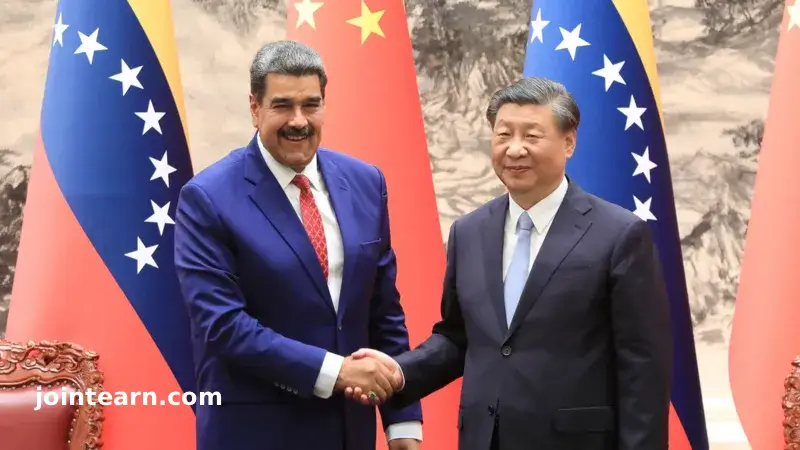
State media in Beijing emphasized this cooperation, showcasing footage of Maduro and Xi reviewing agreements between the two nations. But those images starkly contrasted with photographs taken hours later, showing Maduro handcuffed and blindfolded on a US warship, wearing grey sweats—a visual symbol of the sudden disruption in China’s strategic plans.
Beijing Condemns US Actions
China swiftly condemned the US operation, accusing Washington of overstepping its authority as a “world judge” and violating international law. A statement from Beijing highlighted that “the sovereignty and security of all countries should be fully protected under international law.”
While China’s rhetoric was strong, Beijing faces the delicate task of balancing condemnation with pragmatic calculations. It must preserve its economic and strategic foothold in South America, maintain stability in relations with Washington, and navigate the great power competition with the United States in the Western Hemisphere.
Risks and Uncertainties for China
Trump’s intervention in Venezuela has intensified China’s concerns about US intentions, particularly regarding efforts to curb Chinese influence in the region. As US Secretary of State Marco Rubio stated on NBC, “This is the western hemisphere… we’re not going to allow it to be a base of operations for adversaries, competitors and rivals of the United States.” The implicit warning was aimed squarely at Beijing: stay out of the Americas.
Although Beijing is unlikely to withdraw from Latin America, the raid introduces risk, uncertainty, and frustration. For China, which typically favors long-term, calculated strategies, Trump’s unpredictable actions in Caracas represent a destabilizing factor. Analysts note that this could complicate China’s plans to cultivate influence across the Global South.
Implications for Taiwan and Regional Strategy
Some observers have speculated that China might draw parallels between Venezuela and Taiwan, questioning whether the US precedent emboldens Beijing to take assertive action in East Asia. However, experts such as David Sacks from the Council on Foreign Relations note that US operations in Venezuela do not fundamentally alter China’s strategy toward Taiwan. China continues to rely on coercive measures to pressure Taiwan toward negotiation rather than direct invasion, and the Caracas raid does not change this approach.
Nevertheless, Trump’s raid is a cautionary tale for Beijing: it underscores the risks of operating in a region where the US may act unilaterally, potentially disrupting Chinese investments or influence.
The Economic Stakes in Venezuela
China has invested over $100 billion in Venezuela between 2000 and 2023, funding infrastructure projects including railways, power plants, and oil development. In exchange, Venezuela provided China with critical energy resources, with around 80% of Venezuelan oil exports sent to China last year.
Chinese companies like CNPC and Sinopec remain major stakeholders in Venezuelan oil, but the raid raises concerns about the security of these assets. Outstanding loans totaling approximately $10 billion to Chinese creditors also present potential financial exposure, though experts caution that immediate risks are unclear.
Beijing may now face increased caution from Chinese enterprises considering investment in Latin America, due to the threat of US intervention. Analysts suggest that the raid could deter foreign investment, potentially disrupting China’s broader strategy in the region.
Strategic Balance: Latin America and the Global South
China has methodically built influence in Latin America over the past two decades, encouraging countries to recognize the “One China” principle and align diplomatically with Beijing over Taiwan. Nations such as Costa Rica, Panama, El Salvador, Nicaragua, and Honduras have shifted recognition from Taipei to Beijing, reflecting China’s patient, strategic diplomacy.
Trump’s raid, however, highlights the volatility of relying on US-dominated international order and underscores the challenges of projecting Chinese influence in the Americas. Beijing now faces a complex balancing act: protecting its interests in Venezuela and the broader region while avoiding direct confrontation with the United States.
Long-Term Implications
The raid could also reshape global perceptions of US reliability and predictability. Countries across South America may reconsider major Chinese investments, wary of drawing unwanted US attention. The US has already applied pressure on nations like Panama to reconsider Chinese holdings in the Panama Canal, signaling its intent to limit Beijing’s strategic influence.
China’s strategy will likely focus on preserving long-term gains, strengthening ties with the Global South, and projecting Xi Jinping as a stable leader amid global uncertainty. Analysts warn that Venezuela could descend into chaos, but past lessons from Iraq suggest China can secure energy supplies even amid US-led disruptions.
“The situation in Venezuela could easily descend into chaos… but China has demonstrated the ability to navigate complex geopolitical crises while safeguarding its interests,” says Eric Olander, editor-in-chief of The China-Global South Project.
For Beijing, Trump’s Venezuela raid is a strategic gamble that China did not anticipate. It reinforces the unpredictability of US foreign policy, while testing China’s ability to maintain influence in Latin America without direct confrontation.


Leave a Reply