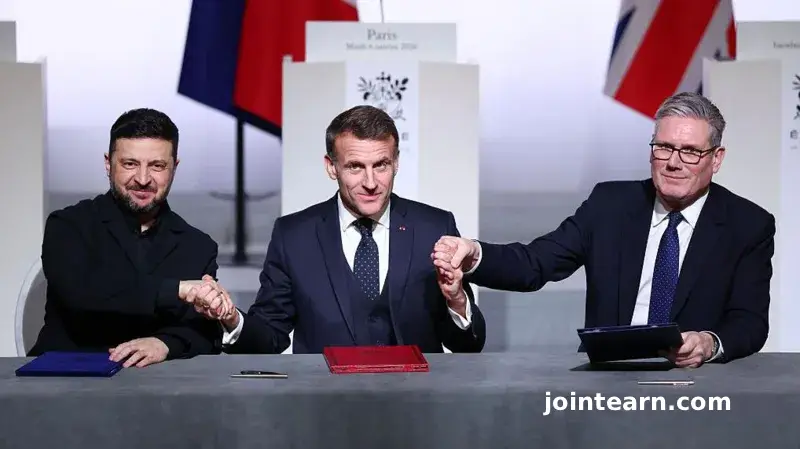
The United Kingdom and France have announced plans to deploy troops to Ukraine in the event that a peace agreement is reached with Russia, as high-level talks in Paris brought Kyiv’s allies together to negotiate security guarantees.
The announcement, made by UK Prime Minister Sir Keir Starmer and confirmed by French President Emmanuel Macron, outlines the creation of military hubs across Ukraine to deter future invasions and provide long-term support for the country’s armed forces. Macron noted that thousands of troops could eventually be stationed if a truce is formalized.
Key Outcomes of the Paris Talks
The Paris negotiations, attended by leaders from the so-called “Coalition of the Willing”, focused on robust security guarantees for Ukraine and proposals for the US to lead monitoring of a potential ceasefire.
- Starmer described the declaration as a “vital part of our commitment to stand with Ukraine for the long term”, providing a legal framework for allied forces to operate on Ukrainian soil.
- The UK confirmed it would participate in any US-led verification operations to monitor compliance with a ceasefire.
- US negotiator Steve Witkoff emphasized that durable security guarantees and strong economic support are essential for lasting peace.
Zelensky Highlights “Huge Step Forward”
Ukrainian President Volodymyr Zelensky called the talks a “huge step forward” but cautioned that real progress depends on ending the war. He also stressed that security guarantees must be credible to convince Ukrainians that the conflict would not resume.
While significant agreement has been reached on allied troop deployment and monitoring, critical issues remain unresolved:
- Territorial disputes: Russia continues to control about 20% of Ukrainian territory, including large portions of the Donetsk and Luhansk regions in the Donbas.
- Ceasefire lines: The precise demarcation of territory for a future peace deal is still under negotiation, and Kyiv has resisted ceding territory unilaterally.
- Russia’s position: Moscow has repeatedly warned that foreign troops would be a “legitimate target” and has not commented publicly on the latest Paris announcement.
Security Guarantees and International Backing
The Paris talks reflect an international effort to ensure Ukraine receives robust military and economic support:
- Multinational forces from the UK, France, and other allies could be deployed to protect Ukrainian skies, borders, and critical infrastructure.
- Additional weapons support and military training for Ukraine’s armed forces are expected to accompany the deployment.
- US officials stressed the importance of backstopping any truce with enforceable measures to prevent future Russian aggression.
Zelensky warned that without these guarantees, Ukrainians may remain skeptical about the efficacy of a ceasefire, particularly as Russia continues strikes on cities and infrastructure across the country.
Challenges Ahead
Despite progress, several hurdles remain:
- Russia’s President Vladimir Putin has historically opposed European-led forces operating on Ukrainian territory.
- Negotiators are still finalizing security protocols, troop deployment areas, and reconstruction support, while balancing Kyiv’s insistence on retaining sovereignty over key regions.
- The remaining disputes over territory and enforcement of security guarantees will determine whether a peace deal can finally be implemented.
Zelensky previously stated that the peace deal was “90% ready”, with the final 10%—mainly around territory and security arrangements—set to determine the fate of Ukraine and Europe’s stability.


Leave a Reply