The Foreign Press Association (FPA) has strongly condemned the Israeli government’s continued refusal to lift its ban on unrestricted media access to Gaza, despite the ongoing ceasefire in the region. The decision has sparked widespread criticism from international press organizations and human rights advocates, raising serious concerns over press freedom in conflict zones.
On Tuesday, January 7, 2026, the FPA released a statement expressing its “profound disappointment” with the Israeli government. Just two days prior, Israel had informed the Supreme Court that it would maintain the media ban, citing security concerns as justification for restricting foreign journalists from independently entering Gaza.
Palestinian Journalists Protest Media Restrictions
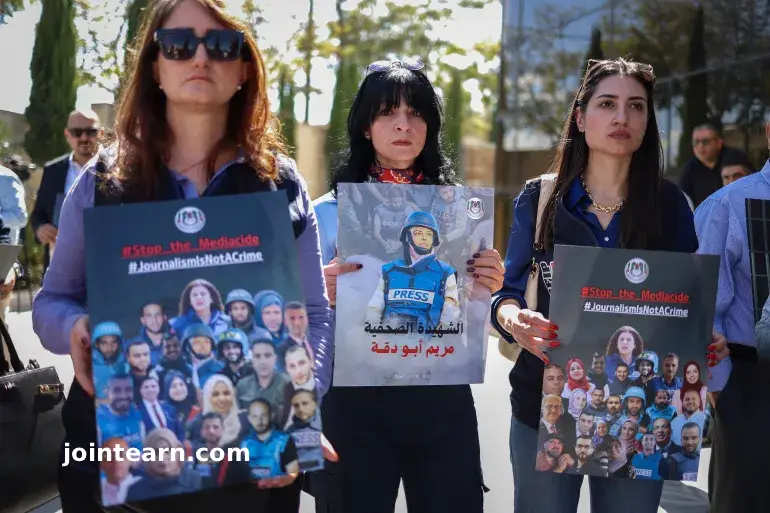
The ongoing restrictions on media access have prompted protests from Palestinian journalists and local officials. In Ramallah, the Palestinian Journalists Syndicate organized demonstrations, holding up images of media workers who were killed during the conflict. These protests serve as a stark reminder of the risks journalists face while reporting in Gaza, where attacks on media personnel have tragically resulted in hundreds of deaths since the conflict began.
The protests underscore growing concerns about Israel’s approach to media coverage, which critics argue is aimed at silencing independent reporting and controlling narratives about the war in Gaza.
Israel’s Restrictions on Foreign Journalists
Since the war broke out in October 2023, Israel has barred foreign journalists from freely entering Gaza. The government has only allowed a limited number of journalists to work under strict military supervision, often embedded with troops on a case-by-case basis.
The FPA had initially petitioned the Supreme Court in September 2024, demanding unfettered access for foreign media to Gaza to ensure accurate reporting from the conflict zone. The court granted several extensions to allow Israel time to present a plan for media access, setting a final deadline of January 4, 2026.
Despite the ceasefire, the Israeli government has yet to provide a concrete framework for independent reporting, leaving journalists frustrated and international media watchdogs increasingly vocal in their criticism.
Threats to Journalists’ Safety
The lack of access to Gaza has compounded the dangers faced by journalists reporting in the region. According to the International Federation of Journalists (IFJ), Palestine was the deadliest place for journalists in 2025, with 56 Palestinian media professionals killed over the year. Since the outbreak of the war, nearly 300 journalists and media workers have lost their lives in Gaza, as reported by Shireen.ps, a monitoring platform named after the late Al Jazeera correspondent Shireen Abu Akleh, who was killed in 2022 in the occupied West Bank.
The FPA has pledged to submit a robust response to the Supreme Court, emphasizing the importance of press freedom, independent reporting, and the need for international journalists to work safely alongside their Palestinian colleagues.
Global Concerns Over Press Freedom
The continued media ban has drawn attention from human rights organizations and international journalists, who argue that restricting independent coverage undermines transparency and limits the global understanding of humanitarian conditions in Gaza. Critics warn that such measures not only jeopardize journalists’ safety but also obstruct accountability in conflict zones.
The FPA’s ongoing legal challenge highlights the tension between national security claims and the fundamental right of journalists to report freely. As the international community watches closely, the outcome of this case could set a significant precedent for media access in conflict areas around the world.


Leave a Reply