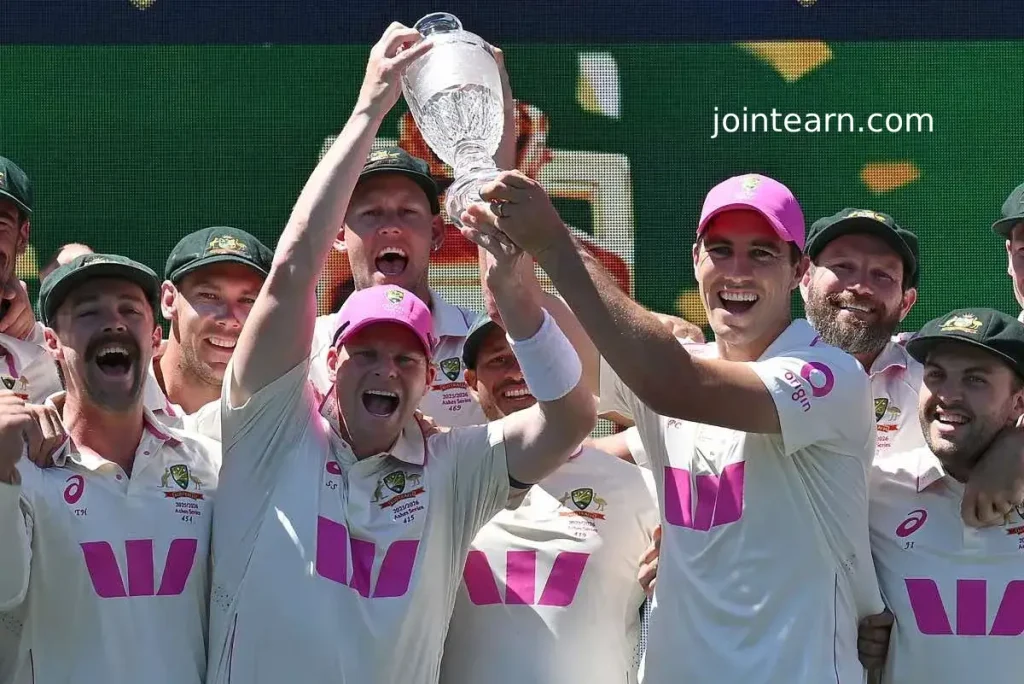
Australia completed another commanding Ashes series triumph, defeating England by five wickets in the fifth Test at the Sydney Cricket Ground to secure a 4–1 series win and retain the urn in emphatic fashion.
Chasing a modest target of 160 runs on the final afternoon, Australia wrapped up victory under clear skies in Sydney, underlining their continued dominance over England on home soil. The result marked Australia’s fourth consecutive Ashes series win at home and extended their hold on the urn, which has now lasted since 2018.
For England, the defeat brought an end to one of their most disappointing Ashes tours in recent memory, a campaign that promised much but delivered very little.
Australia Finish the Job in Sydney Sunshine
Resuming the final day with England already resigned to their fate, Australia calmly chased down the target after lunch, losing only five wickets. Despite dealing with significant injury setbacks — including captain Pat Cummins missing most of the series — the hosts once again demonstrated their depth, resilience, and ruthless efficiency.
The series victory was all the more impressive given Australia’s depleted bowling resources. Cummins featured in only one Test, Josh Hazlewood did not play at all, and Nathan Lyon was restricted by injury and unhelpful conditions. Yet Australia still dominated England with what was effectively a second-choice bowling attack.
England’s Ashes Collapse Began in Perth
England’s problems began immediately. What had been billed as a golden opportunity to compete in Australia unravelled spectacularly in the first Test in Perth, where England suffered a shocking two-day defeat. From that moment on, they never recovered.
Poor preparation, injuries, loss of form, and mounting off-field scrutiny all contributed to a tour that spiralled quickly out of control. England lost the first three Tests in succession, surrendering the series at the earliest possible stage.
While Ben Stokes’ side briefly rallied with a victory in the fourth Test in Melbourne, it proved to be a false dawn. That match, played on a green pitch and finished inside two days, stood out as an anomaly in a series where England were largely outclassed.
Bazball Breaks Down Under Pressure
This tour was meant to be the defining moment of the Bazball era. Head coach Brendon McCullum had described the Ashes as a series that could “define” his team. Instead, England were defined as yet another side overwhelmed by Australian conditions.
It was the fourth consecutive Ashes tour in which England lost at least four Tests in Australia. Since 2000, England have suffered 27 defeats in 35 Tests on Australian soil, with the famous 2010–11 Ashes win remaining their only series victory here in the past 40 years.
Several players trusted by England’s management struggled badly. Ollie Pope was dropped after three Tests, the opening partnership of Zak Crawley and Ben Duckett collapsed, and wicketkeeper Jamie Smith endured a torrid tour well below his usual standards. Spinner Shoaib Bashir, earmarked long in advance, did not play a single Test.
Injuries and Ill Discipline Compound England’s Problems
As is often the case on Ashes tours, England were ravaged by injuries. Mark Wood returned home with a knee problem that may end his international career. Jofra Archer’s promising series was cut short by a side strain, while Gus Atkinson missed the final Test with a hamstring injury.
Off the field, England were also caught off guard by intense Australian media scrutiny. Incidents involving leisure activities, scooter fines, and confrontations with photographers added to the sense of a tour drifting away from its core purpose.
Images from England’s controversial Noosa break, where player behaviour was investigated internally, became symbolic of a lack of focus that followed the team throughout the series.
Final Test: Missed Chances and Familiar Frustrations
England’s slim hopes on the final day rested on Jacob Bethell, who had already scored a superb maiden Test century. Resuming unbeaten on 142, Bethell briefly threatened to add pressure before falling for 154, his innings the standout individual effort of England’s tour.
Australia’s chase was not without drama. England were incensed when Jake Weatherald survived a caught-behind appeal despite movement on Snicko, reigniting a familiar Ashes controversy. Weatherald was eventually dismissed, but not before England’s frustration boiled over.
Dropped catches continued to haunt the tourists — 18 in the series — including a costly miss of Marnus Labuschagne, who was later run out in a mix-up. Even then, England failed to capitalise as Australia calmly closed out the match.
As Alex Carey struck the winning runs, the Barmy Army sang through their repertoire, acknowledging the end of a long and painful tour.
Individual Performances: Few Bright Spots for England
There were limited positives for England. Josh Tongue emerged with credit, leading England’s attack with pace and hostility, while Jacob Bethell’s breakthrough performance suggested a bright future — though questions remain as to why he was not trusted earlier.
Joe Root finally scored a Test century in Australia, providing England’s most uplifting moment of the series. However, this was another Ashes campaign where Root and Stokes — two of England’s modern greats — ended up on the wrong side of a heavy defeat.
Stokes, who played the final Test despite a groin injury, has indicated his desire to continue as captain, with fitness likely the only obstacle.
Australia Look Ahead, England Search for Answers
While Australia celebrate another home Ashes triumph, they too have questions to answer ahead of the 2027 Ashes series in England. Positions at opener, number three, all-rounder, and frontline spinner remain open for debate as they seek their first away Ashes win since 2001.
For England, however, the reckoning is immediate. Pressure is mounting on Brendon McCullum and Rob Key, both of whom have acknowledged failings but remain keen to continue. The England and Wales Cricket Board will now assess whether genuine improvements have been made.
England’s rebuild begins almost immediately, with a T20 World Cup and a white-ball tour of Sri Lanka starting in just two weeks. Whether lessons from this disastrous Ashes tour have truly been learned remains to be seen.


Leave a Reply